Alec's Construction handles hurricane and storm damage in Huntington Station, Suffolk County — fallen trees, flooding and water damage, roofs and siding torn open, the cleanup and the rebuild — as one job from the first tarp to the finished repair, working out of the yard in East Patchogue. If the roof is open, a tree is on the house or there is water inside, call or text (631) 312-7441 rather than fill in the form, and tell us what you are looking at.
What a Hurricane Does in Huntington Station
Huntington Station is inland and wooded — the hamlet climbs south from the village toward the Expressway on the moraine, with no tidal water — and the Town of Huntington was the hardest hit on Long Island in this weekend's nor'easter, with the outages to match. The streets off New York Avenue and Pulaski Road are 1920s to 60s houses on small lots under big old street trees, and the newer streets south toward Melville are 1960s and 70s colonials and splits under oaks saved when the lots were cut. Norway maples and oaks over one and two-storey roofs come over whole when the ground is saturated, and the commercial strip along New York Avenue takes the wind on flat roofs and signage.
Mature Oaks Over Two-Storey Roofs
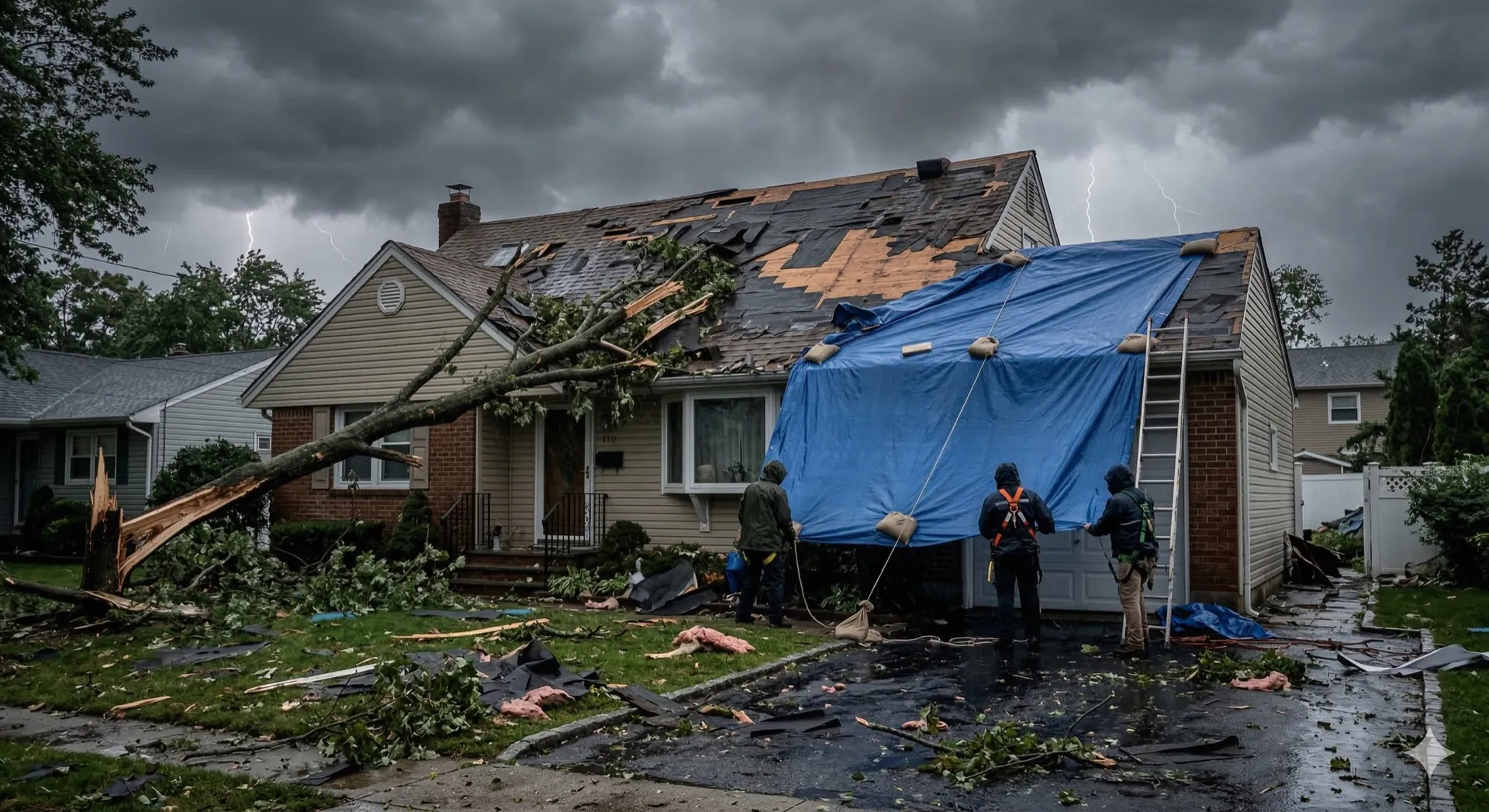
The damage here is the trees. The colonials, splits and ranches went in during the 1960s and 70s under oaks and tulip trees that were saplings or saved trees at the time and are now standing directly over two-storey roofs. When the ground is saturated and the wind turns after the eye passes they come down whole — a crown across the ridge, a trunk through the garage, a limb the size of a tree through the second-floor ceiling — and across the overhead service drops that run through them, which is why these hamlets stay dark for days. A whole tree on a roof is a structural event, and the order in which it comes off decides whether the roof survives the removal.
What We Handle After a Storm
- Fallen or damaged trees — the tree on the roof, the limb through the porch, the leaner against the wall. Structural check first, then removal in the right order, then the repair.
- Flooding and water damage — surge, rain that came in through the roof, the basement that filled. Wet material out, real drying equipment in, moisture measured before anything is closed.
- Interior and exterior storm damage — roofing, siding, windows, soffits, gutters, ceilings, walls, floors and insulation.
- Storm cleanup and debris removal — cut, haul and clear, so the repair crew can get to the house.
- Repairs to damaged areas — from a tarp on the first day to the finished rebuild, one crew, one scope, one point of contact.
The Order of Work
- Make it safe. Nobody goes under a tree on a roof or into a room with a sagging ceiling until it has been looked at. Downed lines are the utility's, and they get called first.
- Photograph everything as found. Before a limb is cut or a wet carpet is pulled. This is what both claims rest on.
- Stop the water. Tarp the roof, board the openings, pump and pull the wet material that will grow mould if it stays.
- Dry and document. Drying equipment in, moisture readings taken and kept.
- Write the scope line by line with the photographs attached, storm damage kept separate from wear, wind damage kept separate from flood damage.
- Rebuild to the agreed scope, and correct what let the storm in so it does not repeat.
Homeowners Policy, Flood Policy and the Hurricane Deductible
Wind damage, and the rain that came in through it, is a homeowners claim. A tree on the house is a homeowners claim, and most policies pay something toward removing that tree, up to a limit that varies by policy. Water that rose — from the bay, a canal, a creek or a river — is a flood claim under a separate flood policy, whether National Flood Insurance Program or private, and the homeowners policy generally excludes it. Many coastal New York policies also carry a hurricane deductible that is a percentage of the dwelling coverage rather than a flat figure, and it applies when a named hurricane triggers it. We do not adjust claims; we document and scope the damage so the adjuster sees what the storm did, and we tell you which of the three buckets each item belongs in before you file.
Building Department in Huntington Station
Huntington Station files with the Town of Huntington at Town Hall on Main Street in Huntington. Emergency repairs to make the house safe and dry do not wait for a permit. The permanent repair that follows — structural work, re-roofing, electrical — is permitted work like any other, and we file it once the scope is agreed.
Free walkthrough in Huntington Station. Call or text (631) 312-7441.
By the job in Huntington Station: Tree Removal · Flood Cleanup · Storm Debris · Storm Roof & Siding
Frequently Asked Questions
Huntington was hit hardest this weekend. How long is the wait?
We run the list in the order the calls came in, roof-open houses first, and Huntington Station is about forty minutes from the yard in East Patchogue. Tell us on the phone whether the roof is open, whether a tree is on the house and whether there is water inside, and we bring the right equipment the first trip. Photograph everything as it is while you wait — that is what the claim rests on.
Is a fallen tree covered by insurance?
A tree that falls on the house, the garage or another covered structure is the classic covered peril under a standard homeowners policy, and most policies also pay something toward removing that tree, up to a limit that varies by policy. A tree that fell in the yard and hit nothing usually is not covered. We photograph the tree where it lies before anyone cuts it.
Do I need a permit for storm repairs?
Not for the emergency work. Tarping, boarding, shoring, pumping and drying make the house safe and do not wait for a permit. The permanent repair — structural work, re-roofing, electrical, anything that changes the building — is permitted work like any other job, and we file it once the scope is agreed with the carrier.
Do you remove the tree and repair the house, or do I need two companies?
One call. Where a tree is on a structure the removal and the repair are the same job — the tree has to come off in an order that does not drop the roof, and the roof has to be supported and covered as the weight comes off. We coordinate the removal, do the structural repair, the roofing, the interior and the cleanup, and write it as one scope.
Related Guides
- Hurricane & Storm Damage Repair in Dix Hills, NY
- Hurricane & Storm Damage Repair in Melville, NY
- Hurricane & Storm Damage Repair — our service page
- Hurricane Damage Repair on Long Island
- What to Do in the First 48 Hours After Hurricane Damage
Also Serving Huntington Station
- Attic Insulation in Huntington Station — air sealing, baffles and R-49 depth
- Basement Finishing in Huntington Station — egress, ceiling height and moisture
- Bathroom Remodeling in Huntington Station — full gut renovations
- Fallen Tree Removal & Roof Repair in Huntington Station — tree off the house, roof supported and repaired
- Flood & Water Damage Cleanup in Huntington Station — wet material out, drying metered
- Gutter Installation in Huntington Station — seamless gutters, fascia and drainage
- Interior Painting in Huntington Station — the right work for the cold months
- Kitchen Remodeling in Huntington Station — cabinets, counters and layout
- Roofing in Huntington Station — tear-offs, repairs and storm damage
- Storm Debris Removal & Cleanup in Huntington Station — trees, building debris and hauling
- Storm Roof & Siding Repair in Huntington Station — wind damage, tarped and rebuilt
Work With Alec's Construction
This guide is written by the crew that does the work. See Alec's Hurricane & Storm Damage Repair service — fallen trees, flooding, roof and siding damage, cleanup and the rebuild. Licensed and insured on Long Island, one crew start to finish, free walkthrough and a written estimate inside 48 hours.
Booking the cold months now: we also handle Roofing and Storm Damage & Insurance Restoration.
Get a Free Estimate from Alec's Construction
Licensed and insured, working across Nassau and Suffolk County since 2018. We come out, look at the actual job, and put a written number in your hand — no pressure, no obligation.
Or call (631) 312-7441