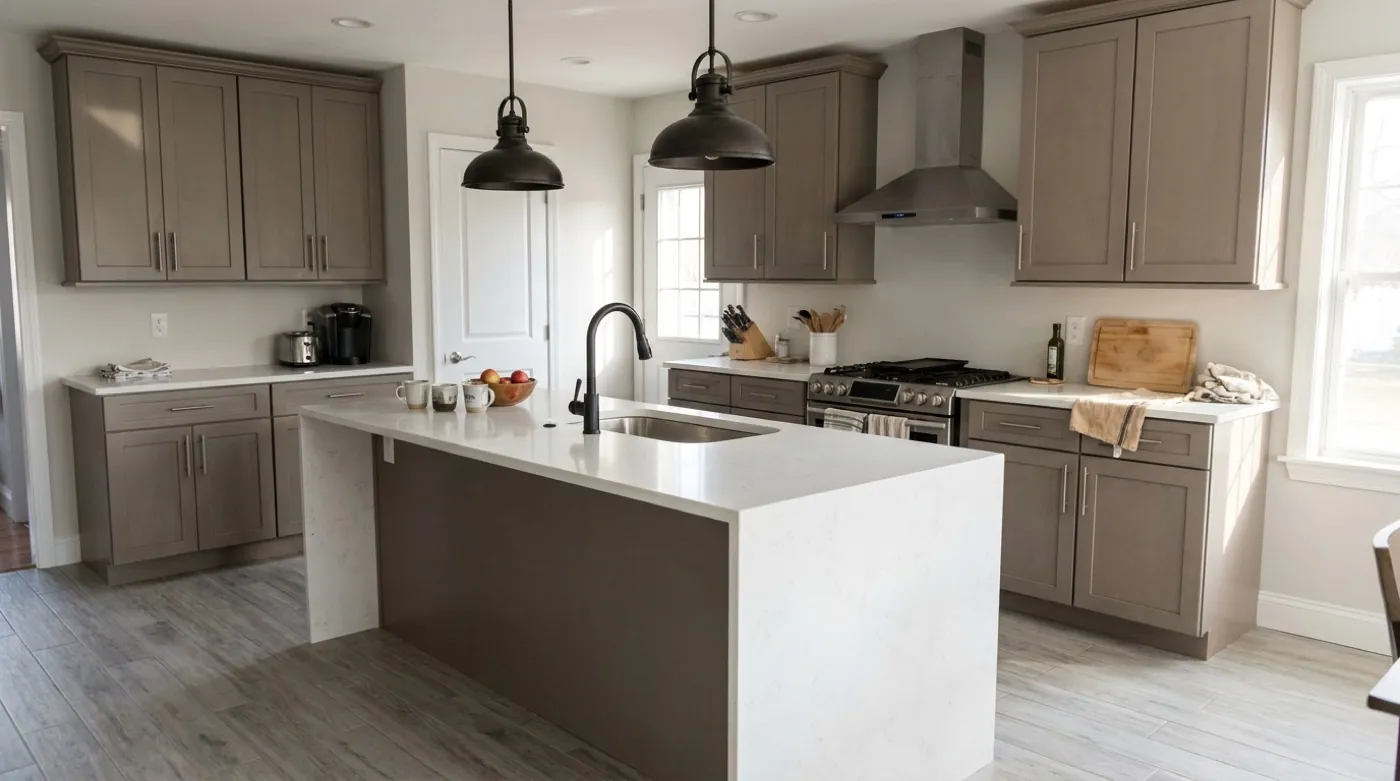
Almost every kitchen question we get on Long Island eventually turns into a permit question, and the answer changes depending on which side of a town line the house sits on. Two identical kitchens, one in Bay Shore and one in Huntington, can have genuinely different filing requirements. Nobody tells homeowners this until they are already three weeks in.
This page covers what triggers a permit for a kitchen remodel in Suffolk County, what does not, and where the towns actually differ. It is written from each town's own published requirements, checked in August 2026.
The rule that covers most kitchens
Here is the whole thing in one sentence: swapping cabinets and countertops in the same footprint is finish work and generally needs no building permit. The moment you move the sink, run gas to a new range location, add circuits, or take down a wall, you are in permit territory.
That distinction is not ours — it is roughly how the towns themselves draw the line. The Town of Islip's own “When is a Permit Required?” handout states plainly that no permit is required for finish work such as paint, wallpaper, tile, carpet and cabinets, while permits are required for piping and gas connections. Most Suffolk towns land in the same place, using different words.
So the honest triage on your own kitchen is this:
- New doors, new boxes, new counters, sink stays where it is, no new circuits. Usually finish work. Usually no building permit.
- Sink or dishwasher moves. Plumbing permit. The waste line and vent have to be right, and this is the single most common thing homeowners get caught on.
- Gas range moves, or you convert electric to gas. Permit, and generally a licensed plumber to run and pressure-test the line.
- New circuits, a new panel, or an induction cooktop that needs 240V. Electrical inspection, billed by the inspection agency, plus a town fee in most jurisdictions.
- A wall comes down, even a partial one. Now it is structural and the drawings need a professional. This is the one where an unpermitted job can genuinely block a future sale.
Where the Suffolk towns actually differ
Four departments, checked directly this month. The differences are not cosmetic.
Huntington — the $10,000 line
Huntington is the outlier and it matters most to anyone doing a real kitchen. Under the Town's published requirements, any alteration costing more than ten thousand dollars must have plans drawn and sealed by a New York State licensed architect or professional engineer, as must anything affecting structural safety.
Read that against a normal Long Island kitchen budget and the implication is obvious: essentially every full kitchen remodel in Huntington needs stamped drawings. Not optional, not a formality — a line item you have to plan and pay for. The full Huntington filing list is here, including the notarized applications and the three surveys most homeowners do not know they need.
Islip — the clearest published exemption
Islip publishes the cleanest statement of what does not need a permit, and cabinets are named on it. That is genuinely useful if your kitchen is a straight replacement. It is also the reason people in Islip get surprised: the exemption covers the cabinets, not the plumbing behind them. Islip specifics
Brookhaven — the biggest town, and a one-year clock
Alterations require a building permit, and the permit is valid for one year from the date of issue. On a kitchen that is normally irrelevant. On a kitchen that stalls because a cabinet order slips or money gets tight, it is not. Brookhaven specifics
Smithtown — file it online
Smithtown runs an online residential building permit portal, which is a meaningful convenience over towns that still want paper across a counter. Smithtown publishes a residential fee schedule, but its own FAQ notes the posted figures are dated and asks you to call for an accurate number — so we are not going to quote you a fee we cannot stand behind. Smithtown specifics
What an unpermitted kitchen actually costs you
Homeowners hear “you need a permit” as a fee and a delay. The real cost shows up years later, at the closing table.
- The appraisal and the CO stop matching. Work that changed the plumbing or the electric without a permit can leave the certificate of occupancy out of step with the house as it stands.
- Buyers' attorneys ask. On Long Island, open or missing permits are a standard title objection, and they get resolved on the seller's dime under time pressure — the worst possible negotiating position.
- Insurance gets an argument. If a fire traces back to unpermitted electrical work, you have handed the carrier a reason to fight the claim.
- Legalizing after the fact costs more than filing up front. Every time. Sometimes the walls have to open back up.
We deal with this constantly on the legalization side — legalizing work that was done without permits is a real part of what we do, and it is always more expensive than doing it in order.
Who files it — and why that is four different people
This is the part that catches homeowners, and it is the same trap we walk people through on accessory apartments. A permitted kitchen is not one hire. It is an architect or engineer if drawings need a seal, somebody to file the application and chase the department, a licensed plumber and electrician for their portions, and the contractor doing the work. Left to the homeowner, that is four relationships and you are the referee between them.
We do all of it under one contract. That is not a sales line, it is the actual reason people call us for this — the coordination is the hard part, not the cabinets.
The cost side, so the permit conversation is in context
Long Island kitchen remodels published by contractors across the Island in 2026 land roughly between $30,000 and $80,000, with Nassau running higher than Suffolk and reconfigured layouts running higher still. Permit and professional fees are real but they are a small fraction of that number — they are almost never the reason a kitchen does not happen.
Our own installed kitchens run $20,000 to $30,000, which sits below the budget end of that range. The reason is specific and finite: the cabinet sets came from projects that were cancelled after the cabinets were already ordered, so they are paid for and sitting in our warehouse rather than ten weeks out from a factory. What is included at that price.
Verified August 2026. Town requirements and fees change without notice and each department publishes independently. Confirm anything here with your town building department at (631) 312-7441 before you order materials or sign a contract. We are contractors, not your building department, and we would rather you make the call than take our word for it.
Not sure whether your kitchen needs a permit?
Tell us what you want to change and we will tell you straight, before you spend anything.
Suffolk County towns and the villages inside them
Which department you file with depends on the town, and on Long Island a village inside a town often runs its own building department with its own rules. If you are in an incorporated village, the village governs, not the town.
- Brookhaven — Patchogue, Medford, Holbrook, Farmingville, Coram, Selden, Bellport, Shirley, Mastic, Centereach
- Islip — Islip, Bay Shore, West Islip, East Islip, Sayville, Bohemia, Oakdale, Brentwood, Holbrook
- Huntington — Huntington, Northport, Dix Hills, Melville, Greenlawn, Centerport, Huntington Station
- Smithtown — Smithtown, Nesconset, Commack, Kings Park, St James, Hauppauge
- Babylon — Babylon, West Babylon, North Babylon, Lindenhurst, Copiague, Deer Park, Wyandanch
- Riverhead — Riverhead, Wading River, Calverton, Aquebogue, Jamesport
- Brookhaven villages — Port Jefferson, Bellport, Patchogue village and Lake Grove each have their own building department separate from the Town
If your town is not on the list, call anyway — the list is where we work most, not a boundary. Anything from Nassau through the Twin Forks is fair game; we tell you honestly if travel makes a small job uneconomical.
Frequently Asked Questions
Do I need a permit to remodel my kitchen on Long Island?
It depends what you are changing. Replacing cabinets and countertops in the same layout is generally treated as finish work and does not require a building permit. Moving the sink, relocating a gas range, adding electrical circuits, or removing a wall does require permits. Requirements are set by your town, not the county, and they differ.
Does replacing kitchen cabinets require a permit in Suffolk County?
Generally no, if nothing behind the cabinets moves. The Town of Islip specifically lists cabinets as finish work that does not require a permit. If the cabinet layout forces the sink or an appliance to a new location, the plumbing or electrical work does require a permit even though the cabinets themselves do not.
Which Long Island town has the strictest kitchen remodel requirements?
Huntington sets the lowest threshold for professional drawings. Any alteration costing more than ten thousand dollars must have plans sealed by a licensed architect or professional engineer, which captures nearly every full kitchen remodel.
What happens if I remodel a kitchen without a permit?
The immediate risk is a stop-work order. The larger risk arrives at resale, when open or missing permits become a title objection that the seller has to resolve under time pressure. Unpermitted electrical or plumbing work can also give an insurer grounds to contest a claim.
Who pulls the permit, me or the contractor?
Either can, but a licensed contractor filing on your behalf is normal and usually faster. Be cautious of any contractor who asks you to pull the permit yourself as the homeowner. That shifts liability for the work onto you.
Related Reading
- Huntington kitchen permits — the $10,000 architect threshold and the full filing list
- Islip kitchen permits — what the town names as exempt finish work
- Brookhaven kitchen permits — the largest town, and the one-year permit clock
- Smithtown kitchen permits — the online filing portal
- Cabinet replacement and permits — the single most common question we get
- Bathroom remodel permits — same rules, more plumbing
- Kitchen remodel cost — what the work runs here in 2026
Work With Alec's Construction
This guide is written by the crew that does the work. See Alec's Kitchen Remodeling service — cabinets, counters and layout, installed by one crew. Licensed and insured on Long Island, one crew start to finish, free walkthrough and a written estimate inside 48 hours.
Booking the cold months now: we also handle Bathroom Remodeling and Painting.
Not sure whether the town or village files your permit? That question trips up more Long Island projects than any other — the directory sorts it out.
Ready to Get Started?
Tell us what you want to change and we will tell you whether it needs a permit. Call Alec's Construction at (631) 312-7441. No charge for the answer, and no obligation. We would rather you know before you order cabinets.