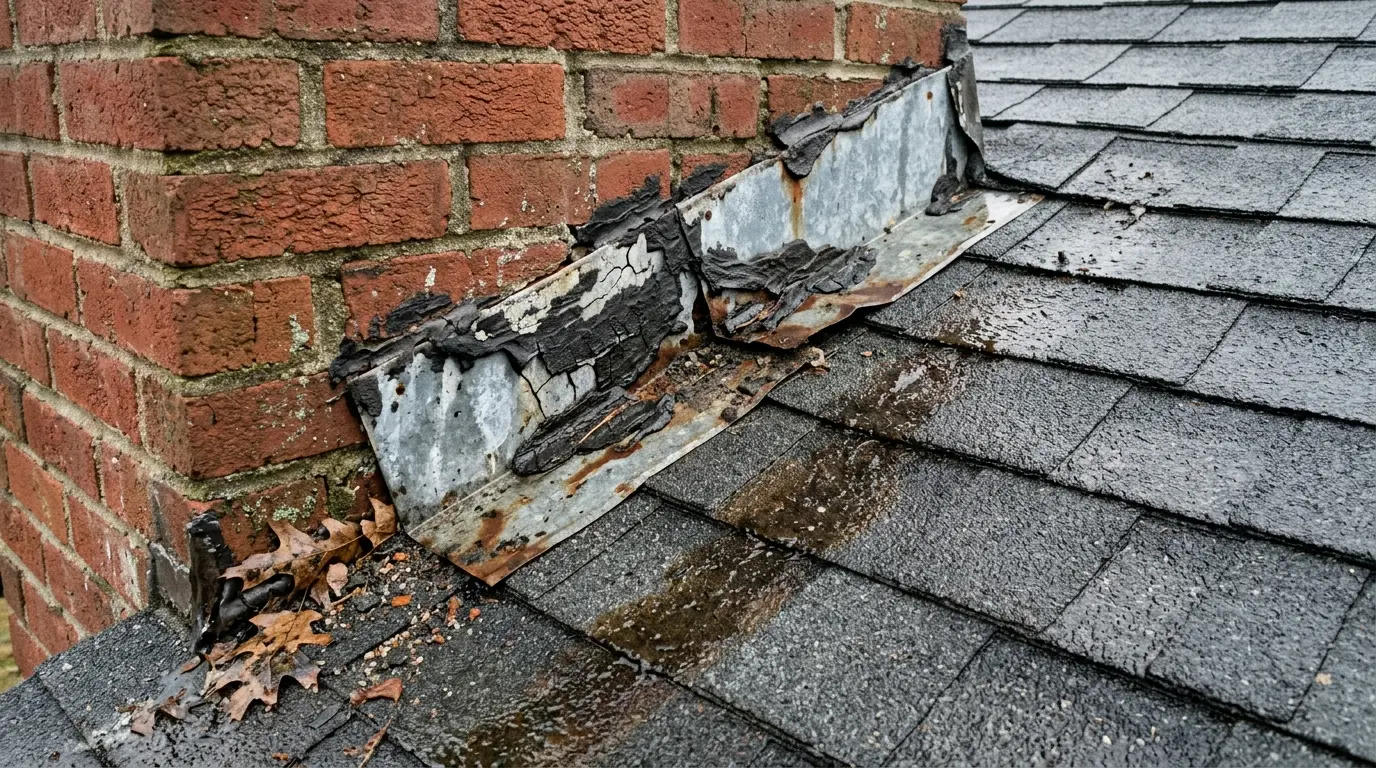
You don't lose a roof to bad shingles. In eighteen years of doing this on Long Island, I can count on one hand the leaks that started because a shingle wore out in the field. Almost every callback I get in November and December traces back to flashing, the metal that seals the seams where a roof plane meets a chimney, a wall, a pipe, or a skylight curb. Shingles shed water on a flat run. Flashing has to do the hard part, and it's usually the cheapest, fastest thing on the roof to fix if you catch it before it fails.
That's the whole case for doing this work in fall instead of waiting. A loose piece of step flashing or a cracked pipe boot is a half-day repair with a caulk gun, a few fasteners, and maybe a strip of ice and water shield. Let it go through one nor'easter and a freeze-thaw winter, and you're not talking about flashing anymore, you're talking about soaked insulation, a stained ceiling, and possibly a claim.
Long Island runs 40 to 50 freeze-thaw cycles in a normal season, and every one of those cycles works on whatever gap already exists at a flashing seam. Water gets under a lifted edge during a 45-degree afternoon, sits there overnight, freezes, expands the gap a little more. By February that quarter-inch lift is an inch, and the nails holding it are backing out of the deck. Add salt air coming off the Sound to the north and the Atlantic to the south, and any exposed galvanized flashing or bare fastener head is corroding faster than it would forty miles inland. This is a coastal-roof problem as much as a cold-weather problem, and Long Island gets hit with both at once.
Where Flashing Fails First on a Long Island Roof
When I walk a roof in Brookhaven, Islip, or Smithtown this time of year, I go straight to four spots before I look at anything else: valleys, sidewalls, pipe boots, and skylight curbs. Those are the transitions, and transitions are where every roof on the Island eventually gives up first. A twenty-year-old roof with perfectly good shingles can still be actively leaking at one of these four points, and the homeowner has no idea until there's a brown ring on the bedroom ceiling.
Valleys and Leaf Load
A valley is where two roof planes meet and funnel water down in a concentrated channel, which makes it the highest-volume, highest-pressure spot on the whole roof. On a property with mature oaks or pines, and half of Suffolk County qualifies, that valley also becomes a debris trap. Wet leaf mat sits against the metal all fall, holds moisture against it around the clock, and accelerates rust on an open galvanized valley faster than almost anything else I see. A rusted-through spot the size of a quarter is enough to funnel water straight under the shingle courses on either side. If your gutters are already loading up with the same leaf drop, that's not a coincidence, it's the same problem in two places, and it's worth having both looked at together. See our gutter cleaning guide for what that debris does downstream.
Sidewall and Step Flashing Near Chimneys and Dormers
Step flashing is the layered metal that runs up a wall where a roof plane butts into siding, a dormer, or a chimney. It only works if each piece overlaps correctly and the counterflashing above it is still tied into the wall or the mortar joint. I see this fail two ways constantly out here: a re-siding job where the old step flashing got covered instead of replaced, and a chimney where the counterflashing reglet has opened up from decades of mortar movement. Capes and colonials with dormers, which is most of the housing stock from Babylon to Huntington, have a lot of linear feet of sidewall flashing, and it's usually original to the house even after a reroof. If the chimney itself is the source, that's a related but separate repair, covered in our chimney repair guide.
Pipe Boots Don't Last as Long as the Roof Does
Every plumbing vent stack coming through your roof gets sealed with a rubber boot, and that rubber has a shorter service life than everything else up there. UV exposure and ozone crack the collar around the pipe somewhere between eight and twelve years, well before the shingles around it are due. A cracked boot is a small, quiet leak, a trickle that runs down the pipe into the attic rather than showing up as a dramatic drip. I replace more pipe boots in October than any other single flashing component, because it's the one thing on an otherwise sound roof that's guaranteed to wear out on its own clock.
Skylight Curbs
Older curb-mounted skylights depend on a metal or rubber cap flashing wrapping the wood curb, and on houses with additions or dormered-in bedrooms, I see a lot of these curbs from the 1990s and early 2000s reaching the end of that flashing's life. The tricky part with skylights is that homeowners often assume interior moisture is condensation, since skylights do fog up in cold weather. Real flashing leaks show up as staining that follows a corner of the frame, not the whole glass, and they get worse after wind-driven rain specifically, which is the giveaway.
Why Fall Beats Spring for This Repair
Sealants and flashing cement need real cure temperature to bond correctly, which is harder to get once nighttime lows drop into the 30s. Doing this work now, before the first nor'easter and before the ground freezes, means the seal has weeks to set before it's tested by real weather. It also matters for drainage on the South Shore, where the water table sits high enough that a flashing leak combined with saturated ground gives you nowhere for that water to go but into the house. This is exactly the kind of item that belongs on a pre-winter walkthrough. We cover the rest of it in our fall home maintenance checklist.
What Happens If You Wait
A flashing leak you ignore doesn't stay a flashing leak. Water tracks along the deck, soaks the insulation, and by the time it shows on your ceiling it's already been running for weeks, sometimes months. Once drywall, insulation, and framing are wet, you're not calling a roofer for an afternoon repair anymore, you're filing a claim and dealing with an adjuster, a drying-out period, and a rebuild. I've walked into more than one Long Island attic in January where a fifteen-minute pipe boot fix in October would have prevented the whole thing. If you're already past that point, that's a different conversation, one we handle through our insurance restoration work.
What We Do
We inspect all four flashing points, valleys, sidewalls, pipe boots, and skylight curbs, as a standalone visit, not just as a line item buried inside a full reroof estimate, and we fix what's actually failing rather than pushing a replacement you don't need yet.
Call (631) 312-7441 or book a free walkthrough before the next nor'easter finds the gap for you.
Frequently Asked Questions
How do I know if my roof leak is coming from flashing and not the shingles themselves?
Flashing leaks almost always show up at a specific edge or corner, near a chimney, a skylight frame, or a wall line, rather than in the open middle of a ceiling. If the stain follows a straight line along a wall or wraps one side of a skylight, that points to a seam, not worn-out shingles in the field.
Can flashing be repaired without replacing the whole roof?
In most cases, yes. Valleys, step flashing, pipe boots, and skylight curbs can all be repaired or replaced as standalone work as long as the surrounding shingles and decking are still sound. A full reroof only becomes necessary if the underlying deck has rotted from a leak that ran unaddressed for a long time.
How often should pipe boots be replaced on a Long Island roof?
Plan on inspecting rubber pipe boots every few years starting around year eight, since UV and ozone crack the rubber collar well before the shingles around it wear out. It's one of the most common single points of failure we find on roofs that are otherwise in good shape.
Is fall really better than spring for this kind of repair?
Yes. Flashing cement and sealants need decent temperatures to cure properly, and doing the work before winter gives the seal weeks to set before it faces a nor'easter or a hard freeze-thaw cycle. Spring repairs are fixing damage that already happened over the winter.
Will homeowners insurance cover flashing repair before there's a leak?
Generally no, routine maintenance and preventive flashing repair are the homeowner's responsibility. Insurance typically comes into play after storm damage or an active leak has caused interior damage, which is exactly why catching flashing issues early is worth doing on your own schedule.
Do older homes on Long Island have different flashing problems than newer construction?
Yes. Capes and colonials with dormers, common from Babylon through Huntington, often still have original step flashing even after a reroof, since it's easy to cover over during a re-siding job instead of replacing. Newer builds tend to have more skylights and complex rooflines, which means more transition points to check.
Related Guides
- Chimney Repair Long Island
- Gutter Cleaning Long Island
- Fall Home Maintenance Checklist Long Island
- Emergency Roof Repair Long Island
Get a Free Estimate from Alec's Construction
Licensed and insured, working across Nassau and Suffolk County since 2018. We come out, look at the actual job, and put a written number in your hand — no pressure, no obligation.
Book a Free WalkthroughOr call (631) 312-7441