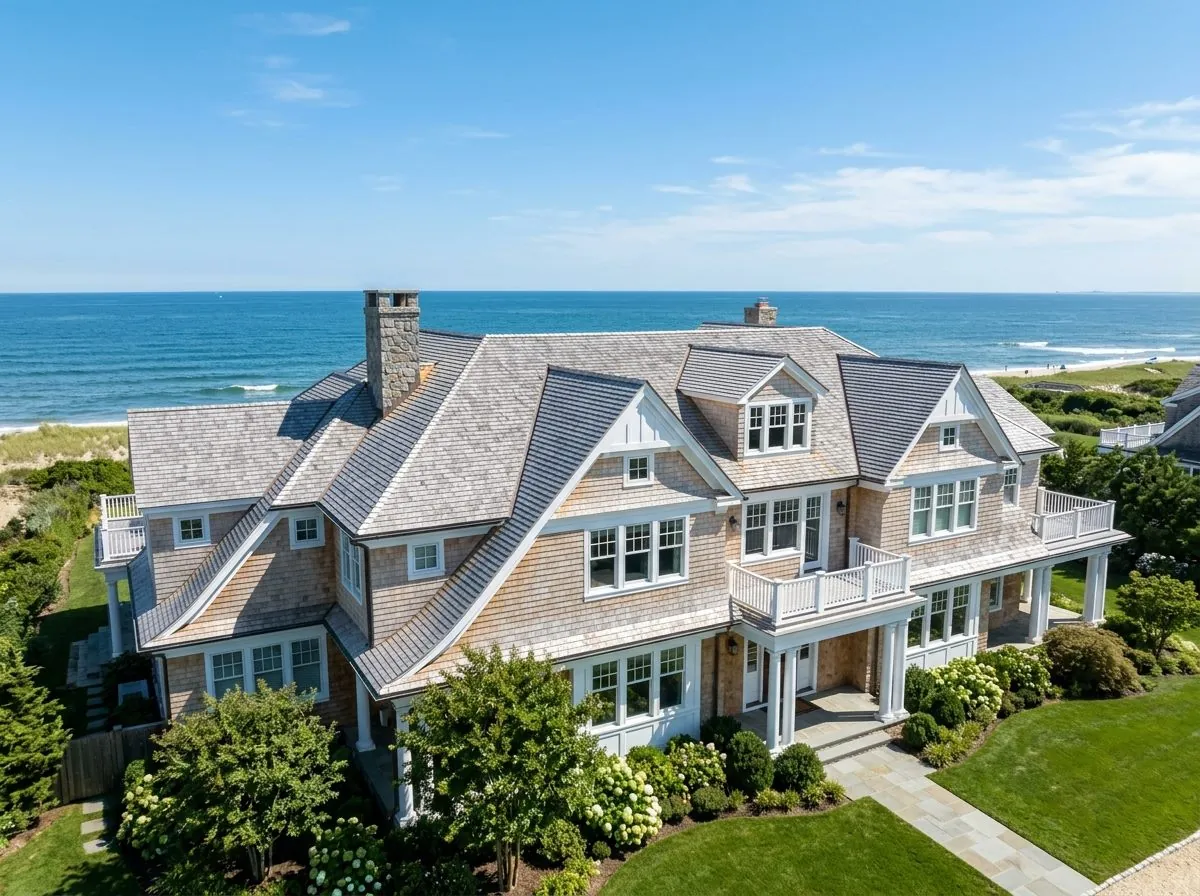
West Islip's ranch stock came with a signature the capes next door never got: wide overhangs. Deep eaves on shallow-pitch hip roofs were the style, they still look right, and they are also the most wind-vulnerable detail on the house — a two-foot overhang is a wing, and gusts off the bay load it from below.
Uplift starts at the eave
- Wind pressure under a deep overhang levers the eave edge up; the first course and the starter strip take the fight, and a stapled or under-nailed starter loses it
- Hip roofs actually help — no gable ends to catch the wind broadside, which is why the hips here outlast the capes in storms — but the perimeter zone is still where the spec earns its money
- Ice-and-water at the eave, a glued and correctly overhung starter, drip edge under (not over) the underlayment at the eave, and high-wind perimeter nailing: none exotic, all frequently skipped
- Aluminum fascia and soffit wrap from the 1980s hides what the overhang has been doing since — we open a section before quoting rather than guessing
The soffit is the ventilation system
Those wide soffits are also the intake for the whole attic — or they would be, if the retrofits had not choked them. Blown-in insulation shoved into the eave bays, solid aluminum wrap over original vented panels, paint-clogged screening: most West Islip ranch attics are running on a fraction of their design intake, and the shingles above cook for it. On every re-roof here we verify the intake path — baffles at the eave bays, perforated soffit where solid wrap blocked it — because a ridge vent with no intake is decoration.
The expanded capes carry a different roof
The other half of the housing stock is capes that grew — dormers and second-floor pop-ups — and their roofs are transition collections: addition planes meeting original planes at new valleys and wall lines. Those junctions, not the fields, are where they leak, and we price each one individually rather than quoting by the square and hoping.
Bay-side blocks, coastal spec
South toward the causeway the salt-and-wind package applies: upgraded hardware, perimeter fastening, and hands-on inspection for seal-broken shingles after every named storm. Inland, a standard suburban re-roof at a standard suburban price.
Frequently Asked Questions
Why do roof problems on my ranch always start at the edges?
The overhangs. A deep eave is a wing — gusts load it from below and lever the edge up, so the starter strip and first course take the fight. The answers are unglamorous and frequently skipped: ice-and-water at the eave, a glued high-wind starter, drip edge sequenced correctly, and perimeter nailing to the high-wind schedule.
My attic is hot but I have a ridge vent. What is missing?
Intake. On these ranches the wide soffits are the intake system, and decades of retrofits choked them — insulation stuffed into the eave bays, solid aluminum wrap over vented panels. A ridge vent with no intake path moves almost no air. We verify and restore the soffit path on every re-roof, with baffles holding the eave bays open.
How long does a roof replacement take?
One to two days for a typical Long Island house. Tear-off and dry-in happen the same day — we never leave a roof open overnight.
Related Reading
- Roof Ventilation — the thing that quietly kills roofs early
- Comparing Roofing Quotes — the checklist every bid must answer
- How Long a Roof Lasts Here — salt, wind and freeze-thaw
- What a Real Inspection Covers — versus what a sales call covers
- Hiring a Roofing Contractor — the questions that separate bids
Also Serving West Islip
- ADUs in West Islip — accessory apartments and grants
- Attic Insulation in West Islip — air sealing, baffles and R-49 depth
- Basement Finishing in West Islip — egress, ceiling height and moisture
- Bathroom Remodeling in West Islip — full gut renovations
- Chimney Repair in West Islip — repointing, crowns, caps and flashing
- Driveway Paving in West Islip — blacktop, resurfacing and repairs
- Emergency Roof Repair in West Islip — tarping, leaks and storm response
- Fallen Tree Removal & Roof Repair in West Islip — tree off the house, roof supported and repaired
- Flood & Water Damage Cleanup in West Islip — wet material out, drying metered
- Garage Conversion in West Islip — turning the garage into living space
- Gutter Installation in West Islip — seamless gutters, fascia and drainage
- House Painters in West Islip — exteriors while the fall window holds
- Hurricane & Storm Damage Repair in West Islip — trees, flooding, cleanup and repairs
- Storm Damage & Insurance Restoration in West Islip — emergency tarping and the claim
- Interior Painting in West Islip — the right work for the cold months
- Kitchen Remodeling in West Islip — cabinets, counters and layout
- Siding in West Islip — James Hardie, vinyl and cedar
- Storm Debris Removal & Cleanup in West Islip — trees, building debris and hauling
- Storm Roof & Siding Repair in West Islip — wind damage, tarped and rebuilt
- Windows & Doors in West Islip — insert and full-frame replacement
Work With Alec's Construction
This guide is written by the crew that does the work. See Alec's Roofing service — tear-offs, repairs, flashing and storm damage across Suffolk and Nassau. Licensed and insured on Long Island, one crew start to finish, free walkthrough and a written estimate inside 48 hours.
Booking the cold months now: we also handle Seamless Gutters and Storm Damage & Insurance Restoration.
Not sure whether the town or village files your permit? That question trips up more Long Island projects than any other — the directory sorts it out.
Ready to Get Started?
Free roof inspection with photos of what we find and a written scope listing underlayment, ice-and-water coverage and ventilation. Nassau and Suffolk County.