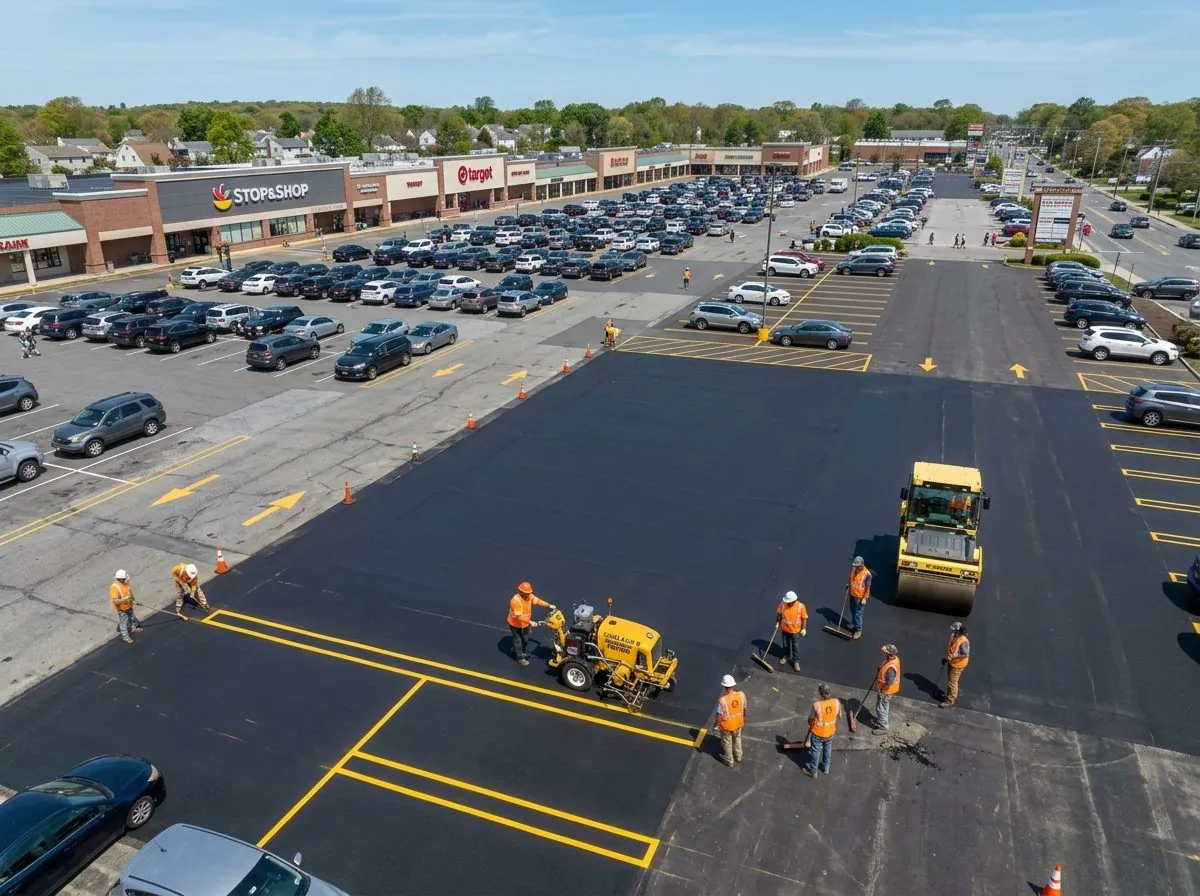
West Islip is a Town of Islip hamlet, built out largely from the late 1940s through the 1960s as postwar subdivisions running south toward the Great South Bay. Apron and curb-cut work goes through Islip.
Flat means the pitch is manufactured
There is essentially no natural grade to work with here. On a sloped lot gravity does half the drainage job for you. On a flat West Islip lot, every bit of fall on that driveway is something the installer deliberately created — and if they did not create it, water sits.
Standing water on asphalt is not merely cosmetic. It works into the surface, and in winter it freezes in place and expands, so the same low spot gets worse every year until it is a pothole. The overwhelming majority of mid-driveway failures we are called to look at here started as a low spot nobody pitched out.
- Minimum consistent fall to the street or to a drywell across the whole surface
- No dead-flat sections, especially near the garage
- A reverse-pitch section at the garage apron so the last feet fall away from the slab
- Drywell sized for the actual driveway area, not a token one
- We shoot grades rather than eyeballing it, and the pitch goes on the estimate
Whole streets reach end of life together
Like the other postwar subdivision hamlets, West Islip streets were built in one push by one builder, with the same original spec. Sixty years later, they fail together. If several neighbors have replaced driveways recently, yours is on the same clock and it is not a coincidence.
It also means doing two or three adjacent driveways in one mobilization is genuinely cheaper for everyone — one truck, one roller, one crew, one delivery. Ask for the multi-property number.
Original builder spec was thin
Postwar subdivision driveways were built to a developer minimum: thin base, thin mat, priced to finish the tract. When we core one here we typically find either a sound base that only needs a new surface, or stacked overlays from the 1980s and 1990s sitting on almost nothing.
The first is a resurface. The second is a rip-out, and no amount of fresh blacktop over it will hold. We core before quoting so you get told which one you have.
Frequently Asked Questions
Water sits in the middle of my driveway. Can that be fixed?
Yes, and repaving is the right moment because the surface is coming off regardless. On flat West Islip lots there is no natural grade, so the pitch is entirely created by the installer. We shoot grades, build consistent fall to the street or a drywell, and put the pitch on the estimate.
My neighbors are all replacing driveways. Should I?
Probably. West Islip streets were built in one push by one builder to the same original spec, so they reach end of life together. Doing two or three adjacent driveways in one mobilization also cuts the cost for everyone — ask for the multi-property number.
How long does a driveway take?
One day for a resurface on a typical residential driveway, one to two days for a full rip-out and repave. You can walk on it the same evening and park on it in 48 to 72 hours. Full cure takes about 30 days, which is why we ask you not to turn your wheels while stationary during the first month.
What time of year can you pave?
Roughly April through mid-November on Long Island. Hot-mix asphalt must be laid and compacted while hot, and once ground and air temperatures drop the mat cools before the roller can seat it. A driveway paved in December looks fine in December and ravels the following spring.
Related Reading
- Driveway Drainage Done Right — where the water goes before it goes into your garage
- Repair or Replace Your Driveway — how to tell which you actually need
- Blacktop Driveway Cost on Long Island — real per-square-foot numbers
- Driveway Sealing — when it helps and when it hides the problem
- Driveway Paving on Long Island — the full homeowner guide
Also Serving West Islip
- ADUs in West Islip — accessory apartments and grants
- Attic Insulation in West Islip — air sealing, baffles and R-49 depth
- Basement Finishing in West Islip — egress, ceiling height and moisture
- Bathroom Remodeling in West Islip — full gut renovations
- Chimney Repair in West Islip — repointing, crowns, caps and flashing
- Emergency Roof Repair in West Islip — tarping, leaks and storm response
- Fallen Tree Removal & Roof Repair in West Islip — tree off the house, roof supported and repaired
- Flood & Water Damage Cleanup in West Islip — wet material out, drying metered
- Garage Conversion in West Islip — turning the garage into living space
- Gutter Installation in West Islip — seamless gutters, fascia and drainage
- House Painters in West Islip — exteriors while the fall window holds
- Hurricane & Storm Damage Repair in West Islip — trees, flooding, cleanup and repairs
- Storm Damage & Insurance Restoration in West Islip — emergency tarping and the claim
- Interior Painting in West Islip — the right work for the cold months
- Kitchen Remodeling in West Islip — cabinets, counters and layout
- Roofing in West Islip — tear-offs, repairs and storm damage
- Siding in West Islip — James Hardie, vinyl and cedar
- Storm Debris Removal & Cleanup in West Islip — trees, building debris and hauling
- Storm Roof & Siding Repair in West Islip — wind damage, tarped and rebuilt
- Windows & Doors in West Islip — insert and full-frame replacement
Work With Alec's Construction
This guide is written by the crew that does the work. See Alec's Driveways & Blacktop service — asphalt paving, resurfacing and sealcoating. Licensed and insured on Long Island, one crew start to finish, free walkthrough and a written estimate inside 48 hours.
Booking the cold months now: we also handle Masonry & Pavers and Roofing.
We pull the permits on our own jobs — if you need the building department for your town, we keep a current directory of all 23 Long Island permit offices.
Ready to Get Started?
Free on-site measure and a written price that lists base depth, asphalt thickness and compaction lifts. Most residential driveways are a one-day install.