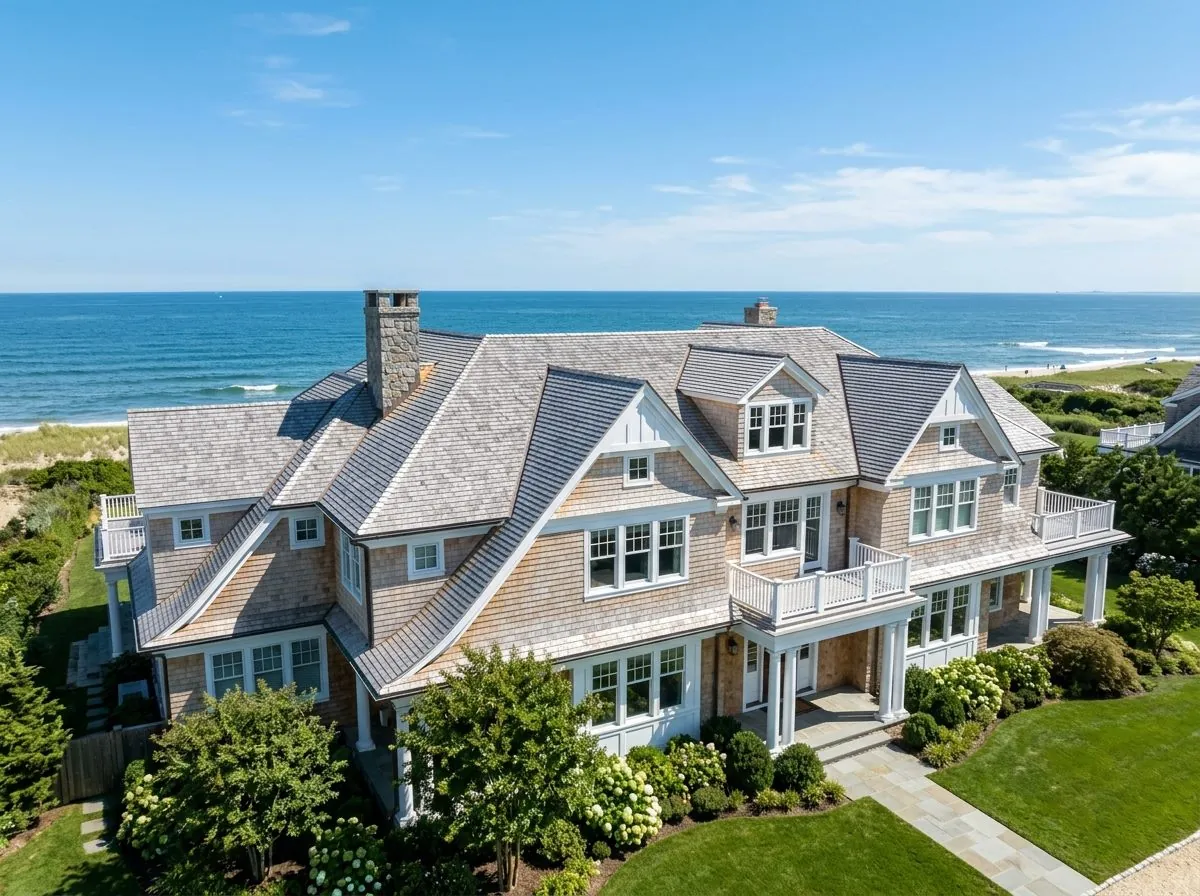
Port Jefferson splits into the incorporated Village down at the harbor and Port Jefferson Station inland, which is unincorporated Brookhaven. On chimney work those are two different jobs at two different prices.
Village core: old brick, real review
The village is a nineteenth-century shipbuilding town, and the chimneys reflect it — soft brick, lime mortar, corbelled caps and profiles that are part of what the street looks like. A rebuild above the roofline on a contributing structure is visible from everywhere and is subject to review.
Repointing with modern Portland-based mortar on brick this soft is the standard expensive mistake. The joints end up harder than the brick, freeze-thaw pushes the stress into the faces, and the brick spalls permanently. We match mortar composition, hardness and joint profile to what is there.
Access is the other cost driver
The village streets fall steeply toward the harbor, they are narrow, they are parked solid, and ferry traffic constrains delivery and equipment windows on East Broadway.
- Where a lift cannot reach, work runs off staging or roof jacks — slower
- Staging on a steep site takes longer to set and to make safe
- Debris carried by hand where a truck cannot get close
- Material deliveries scheduled around the ferry
A contractor quoting a village chimney at Station prices will discover this on the first morning, and it becomes a change order. We price it up front.
Harbor salt
Salt-laden air carries into porous brick and mortar and crystallizes inside it, exerting pressure whenever the masonry dries — a second destructive cycle on top of freeze-thaw. Galvanized flashing corrodes quickly here. Copper is the traditional and correct answer on these houses and it weathers into the building.
Port Jefferson Station
Up the hill it is ordinary suburban chimney work: postwar and later stock, modern brick, no village review, straightforward access. Those jobs run faster and cost meaningfully less, and we quote them that way rather than applying village pricing to a Station address.
Frequently Asked Questions
Why is chimney work in the village more expensive than in the Station?
Two reasons. The village core has architectural review on anything that changes the stack above the roofline, and the brick is soft nineteenth-century masonry that needs matched lime mortar rather than a standard mix. Then access — steep, narrow, parked streets where a lift often cannot reach and everything runs off staging.
Should copper or galvanized flashing go on a harbor-adjacent chimney?
Copper. Galvanized corrodes quickly in salt air, and when it goes it streaks rust down the brick and the roof below before it stops keeping water out. Copper is also the traditional material on these houses and weathers into the building rather than standing out.
Do you sweep or clean chimneys?
No. We handle the structure — repointing, crowns, caps, flashing, rebuilds and leak repair. Sweeping and flue cleaning are a separate trade with its own certification. If that is what you need we will say so rather than take the job.
When can chimney work be done?
Roughly April through November for mortar work, because masonry mortar has to cure above about 40 degrees and cannot freeze while curing or it never reaches strength. Flashing and cap work can be done colder. Emergency leak repairs we handle year-round with temporary measures until it can be done properly.
Related Reading
- Chimney Repair Services — repointing, crowns, flashing and rebuilds
- Repointing: When and Why — and why the mortar mix matters more than the mason
- Freeze-Thaw and Masonry — what actually breaks brick on Long Island
- Chimney Repair on Long Island — the full homeowner guide
- Hiring a Masonry Contractor — the questions that separate the bids
Also Serving Port Jefferson
- ADUs in Port Jefferson — accessory apartments and grants
- Attic Insulation in Port Jefferson — air sealing, baffles and R-49 depth
- Basement Finishing in Port Jefferson — egress, ceiling height and moisture
- Bathroom Remodeling in Port Jefferson — full gut renovations
- Emergency Roof Repair in Port Jefferson — tarping, leaks and storm response
- Fallen Tree Removal & Roof Repair in Port Jefferson — tree off the house, roof supported and repaired
- Flood & Water Damage Cleanup in Port Jefferson — wet material out, drying metered
- Front Steps & Stoops in Port Jefferson — rebuilds, treads and railings
- Garage Conversion in Port Jefferson — turning the garage into living space
- Gutter Installation in Port Jefferson — seamless gutters, fascia and drainage
- House Painters in Port Jefferson — exteriors while the fall window holds
- Hurricane & Storm Damage Repair in Port Jefferson — trees, flooding, cleanup and repairs
- Storm Damage & Insurance Restoration in Port Jefferson — emergency tarping and the claim
- Interior Painting in Port Jefferson — the right work for the cold months
- Kitchen Remodeling in Port Jefferson — cabinets, counters and layout
- Masonry & Pavers in Port Jefferson — patios, walkways and retaining walls
- Roofing in Port Jefferson — tear-offs, repairs and storm damage
- Siding in Port Jefferson — James Hardie, vinyl and cedar
- Storm Debris Removal & Cleanup in Port Jefferson — trees, building debris and hauling
- Storm Roof & Siding Repair in Port Jefferson — wind damage, tarped and rebuilt
- Windows & Doors in Port Jefferson — insert and full-frame replacement
Work With Alec's Construction
This guide is written by the crew that does the work. See Alec's Chimney Repair service — repointing, crowns, caps and roofline flashing. Licensed and insured on Long Island, one crew start to finish, free walkthrough and a written estimate inside 48 hours.
Booking the cold months now: we also handle Roofing and Seamless Gutters.
We pull the permits on our own jobs — if you need the building department for your town, we keep a current directory of all 23 Long Island permit offices.
Ready to Get Started?
Free chimney inspection with photos of the crown, flashing, joints and cap — and a written scope naming which one is actually leaking. Most jobs are one to three days.