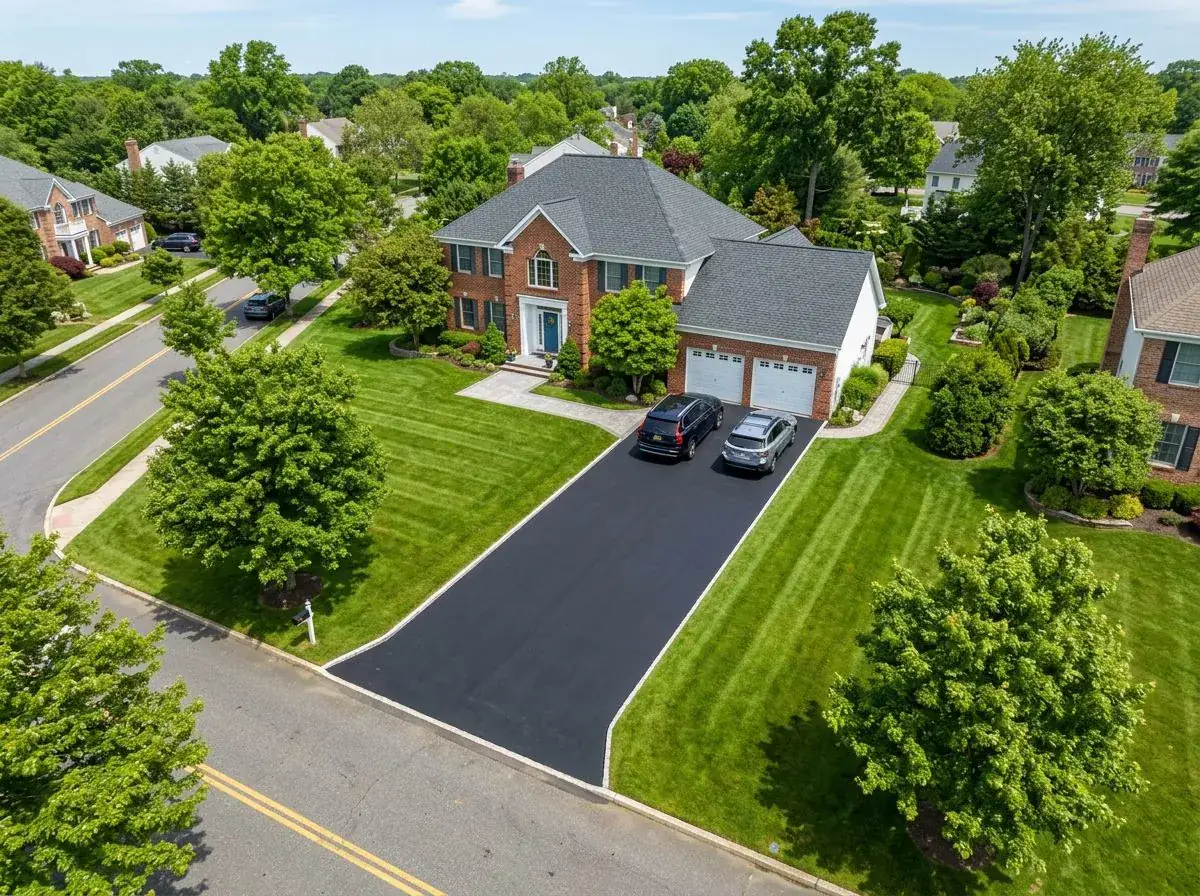
Blue Point tilts toward the Great South Bay, and on the streets that ride that slope a specific driveway geometry repeats: the road sits higher than the house, and the driveway descends from the curb. A below-grade driveway inverts the usual drainage problem — the water you are managing is not yours. It is the street's, and every storm delivers it to your garage door unless the design refuses it.
Refusing the road's water
- The hump: the first car-length off the apron crowns slightly above curb flow-line, so street water follows the gutter past your drive instead of turning in — a few inches of deliberate grade that does more than any drain
- The interceptor: a trench drain across the drive below the hump, catching what gets past, sized and piped to a drywell that holds a real storm
- The door line backstop: a second drain at the garage apron with a reverse-pitch last few feet — the same belt-and-suspenders the Syosset under-house pages describe, tuned for street inflow
- Winter honesty: a descending drive ices from the bottom up as the drains freeze; texture on the slope and a maintained drywell are what keep February walkable
The apron is where the fight is won
On a below-grade drive the apron geometry is the whole game, and it is also Brookhaven Highway territory — the crown, the curb cut and the gutter line have to work together, and we detail that transition on the drawing rather than improvising it under the paver. Done right, the street never knows your driveway exists; done flat, your driveway is the street's drain.
Bay-colony compact lots
The hamlet's cottage-era blocks share the small-parcel realities of the other colonies: short drives where mobilization dominates the price — pairing with a neighbor is the honest fix — tight access between houses, and the occasional buried surprise under lanes that predate records. Salt air near the bay argues the usual hardware upgrades at the drive's low end, where everything metal lives in splash and spray.
Frequently Asked Questions
My driveway slopes down from the street and floods. What actually fixes it?
Refuse the water at the curb first: the first car-length crowns slightly above the gutter flow-line so street water passes by instead of turning in — a few inches of deliberate grade that outperforms any drain. Behind it, a trench drain catches what gets past, piped to a drywell sized for a real storm, with a second drain and reverse-pitch at the garage door as backstop. The apron geometry is the whole game.
Why does my below-grade driveway ice up so badly?
It collects water by design flaw and then the drains freeze first, so everything that runs in stays and glazes. The fixes stack: the crown that keeps street water out, texture on the slope for traction, and a drywell maintained so the interceptor keeps draining in a thaw. A descending drive that stays dry is a descending drive that stays walkable.
How long does a driveway take?
One day for a resurface on a typical residential driveway, one to two days for a full rip-out and repave. Park on it in 48 to 72 hours; full cure takes about 30 days.
Related Reading
- Driveway Drainage Done Right — where the water goes first
- Driveway Curb Appeal — what buyers notice from the street
- Blacktop Driveway Cost on Long Island — real per-square-foot numbers
- When to Pave on Long Island — the thermometer that runs the calendar
- Driveway Paving on Long Island — the full homeowner guide
- Driveway contractor in Bayport — flag lots and shared stems next door
Work With Alec's Construction
This guide is written by the crew that does the work. See Alec's Driveways & Blacktop service — asphalt paving, resurfacing and sealcoating. Licensed and insured on Long Island, one crew start to finish, free walkthrough and a written estimate inside 48 hours.
Booking the cold months now: we also handle Masonry & Pavers and Roofing.
Not sure whether the town or village files your permit? That question trips up more Long Island projects than any other — the directory sorts it out.
Also Serving Blue Point
- Attic Insulation in Blue Point — air sealing, baffles and R-49 depth
- Basement Finishing in Blue Point — egress, ceiling height and moisture
- Bathroom Remodeling in Blue Point — full gut renovations
- Fallen Tree Removal & Roof Repair in Blue Point — tree off the house, roof supported and repaired
- Flood & Water Damage Cleanup in Blue Point — wet material out, drying metered
- Gutter Installation in Blue Point — seamless gutters, fascia and drainage
- Hurricane & Storm Damage Repair in Blue Point — trees, flooding, cleanup and repairs
- Interior Painting in Blue Point — the right work for the cold months
- Kitchen Remodeling in Blue Point — cabinets, counters and layout
- Roofing in Blue Point — tear-offs, repairs and storm damage
- Storm Debris Removal & Cleanup in Blue Point — trees, building debris and hauling
- Storm Roof & Siding Repair in Blue Point — wind damage, tarped and rebuilt
Ready to Get Started?
Free on-site measure and a written price that lists base depth, asphalt thickness and compaction lifts. Most residential driveways are a one-day install.