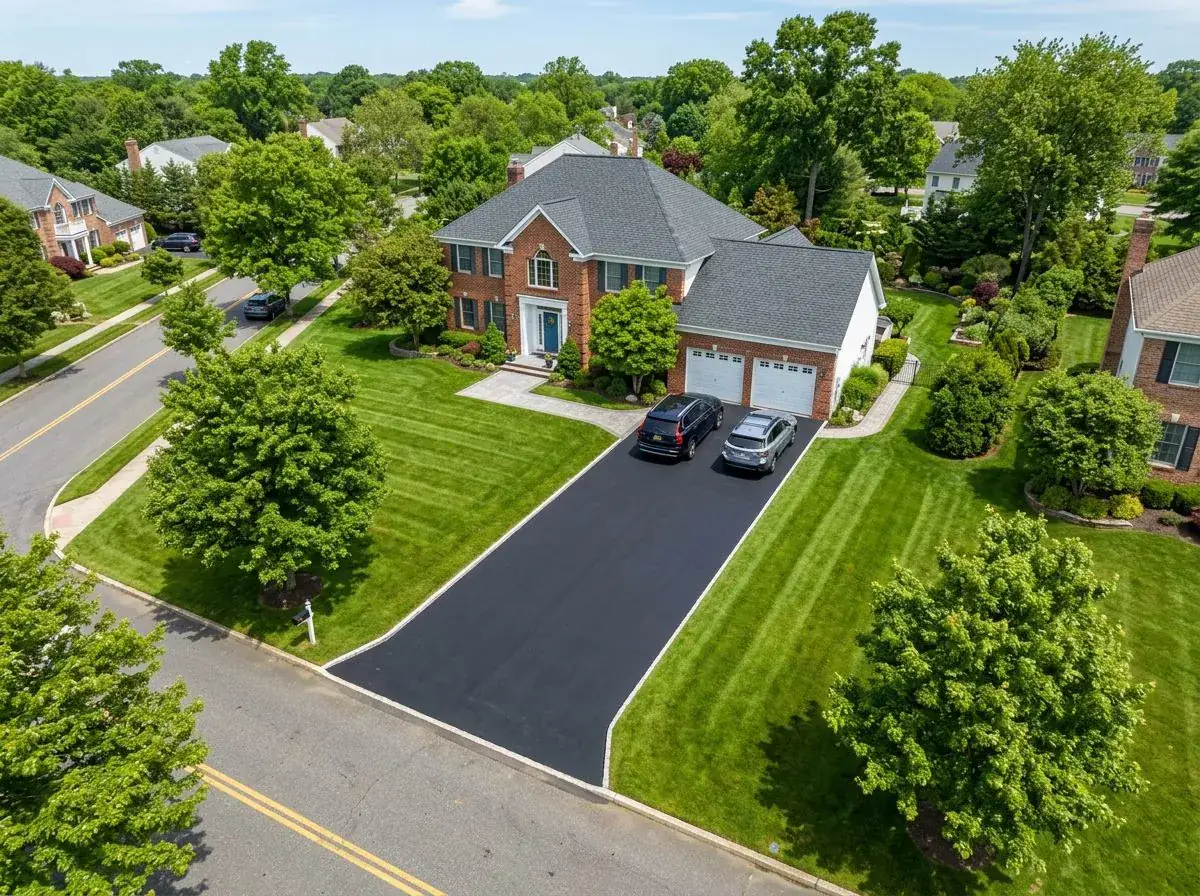
Bohemia is a Town of Islip hamlet wrapped around Long Island MacArthur Airport and the industrial and office corridor that grew with it. That mix is what makes paving here different from a purely residential hamlet.
Residential and commercial are different specifications
A residential driveway carrying two passenger cars and a light commercial lot carrying delivery trucks are not the same product with different square footage. They are different sections.
- Residential passenger use: roughly 4 inches compacted base, 3 inches asphalt
- Trucks, vans, trailers or box trucks: deeper base, thicker binder course
- Commercial lot with regular delivery traffic: engineered section, quoted specifically
- Dumpster pads and loading areas: reinforced, because point loads destroy standard mat
- Traffic lanes versus parking stalls, which can legitimately be different sections
A lot of Bohemia households park work vehicles at home because of the corridor. If you park a box truck, a loaded trailer or heavy equipment on your driveway, say so before we quote. Building the right section costs somewhat more up front and it is the entire difference between a driveway that holds and one that alligators in five years.
Flat, sandy and predictable
Bohemia sits on the outwash plain — sandy, fast-draining, and flat. The soil works in your favor because water moves down and away from the sub-base rather than sitting there to freeze and heave.
The flatness is the flip side. As with West Islip, there is no natural fall, so all the pitch on your driveway is something the installer builds. We shoot grades rather than eyeballing them.
Point loads are what actually break pavement
Homeowners think about weight. What breaks asphalt is weight concentrated in a small area — a trailer tongue jack, a dumpster corner, a boat trailer wheel sitting in one spot for a season. Those punch through a standard residential mat.
The fix is cheap if it is planned: a reinforced pad where the point load lands, or a thicker section in that zone. Retrofitting it after the hole appears is not cheap.
Frequently Asked Questions
I park a work truck at home. Does my driveway need a different build?
Yes, and it has to be specified before we build. A residential section built for passenger cars will alligator under regular truck, van or loaded-trailer use. Deeper base and a thicker binder course is the fix, and it costs far less to build correctly than to rebuild.
What actually breaks a driveway — total weight or something else?
Point loads. Weight concentrated in a small area — a trailer tongue jack, a dumpster corner, a boat trailer wheel parked in one spot all season — punches through a standard residential mat. A reinforced pad where the point load lands is cheap when planned and expensive to retrofit after the hole appears.
How long does a driveway take?
One day for a resurface on a typical residential driveway, one to two days for a full rip-out and repave. You can walk on it the same evening and park on it in 48 to 72 hours. Full cure takes about 30 days, which is why we ask you not to turn your wheels while stationary during the first month.
What time of year can you pave?
Roughly April through mid-November on Long Island. Hot-mix asphalt must be laid and compacted while hot, and once ground and air temperatures drop the mat cools before the roller can seat it. A driveway paved in December looks fine in December and ravels the following spring.
Related Reading
- How Thick a Driveway Should Be — the spec that decides how long it lasts
- Blacktop Driveway Cost on Long Island — real per-square-foot numbers
- How Long Blacktop Lasts Here — freeze-thaw, salt and the replacement window
- Driveway Drainage Done Right — where the water goes before it goes into your garage
- Driveway Paving on Long Island — the full homeowner guide
Also Serving Bohemia
- Attic Insulation in Bohemia — air sealing, baffles and R-49 depth
- Basement Finishing in Bohemia — egress, ceiling height and moisture
- Bathroom Remodeling in Bohemia — full gut renovations
- Fallen Tree Removal & Roof Repair in Bohemia — tree off the house, roof supported and repaired
- Flood & Water Damage Cleanup in Bohemia — wet material out, drying metered
- Gutter Installation in Bohemia — seamless gutters, fascia and drainage
- Hurricane & Storm Damage Repair in Bohemia — trees, flooding, cleanup and repairs
- Interior Painting in Bohemia — the right work for the cold months
- Kitchen Remodeling in Bohemia — cabinets, counters and layout
- Roofing in Bohemia — tear-offs, repairs and storm damage
- Storm Debris Removal & Cleanup in Bohemia — trees, building debris and hauling
- Storm Roof & Siding Repair in Bohemia — wind damage, tarped and rebuilt
Work With Alec's Construction
This guide is written by the crew that does the work. See Alec's Driveways & Blacktop service — asphalt paving, resurfacing and sealcoating. Licensed and insured on Long Island, one crew start to finish, free walkthrough and a written estimate inside 48 hours.
Booking the cold months now: we also handle Masonry & Pavers and Roofing.
We pull the permits on our own jobs — if you need the building department for your town, we keep a current directory of all 23 Long Island permit offices.
Ready to Get Started?
Free on-site measure and a written price that lists base depth, asphalt thickness and compaction lifts. Most residential driveways are a one-day install.