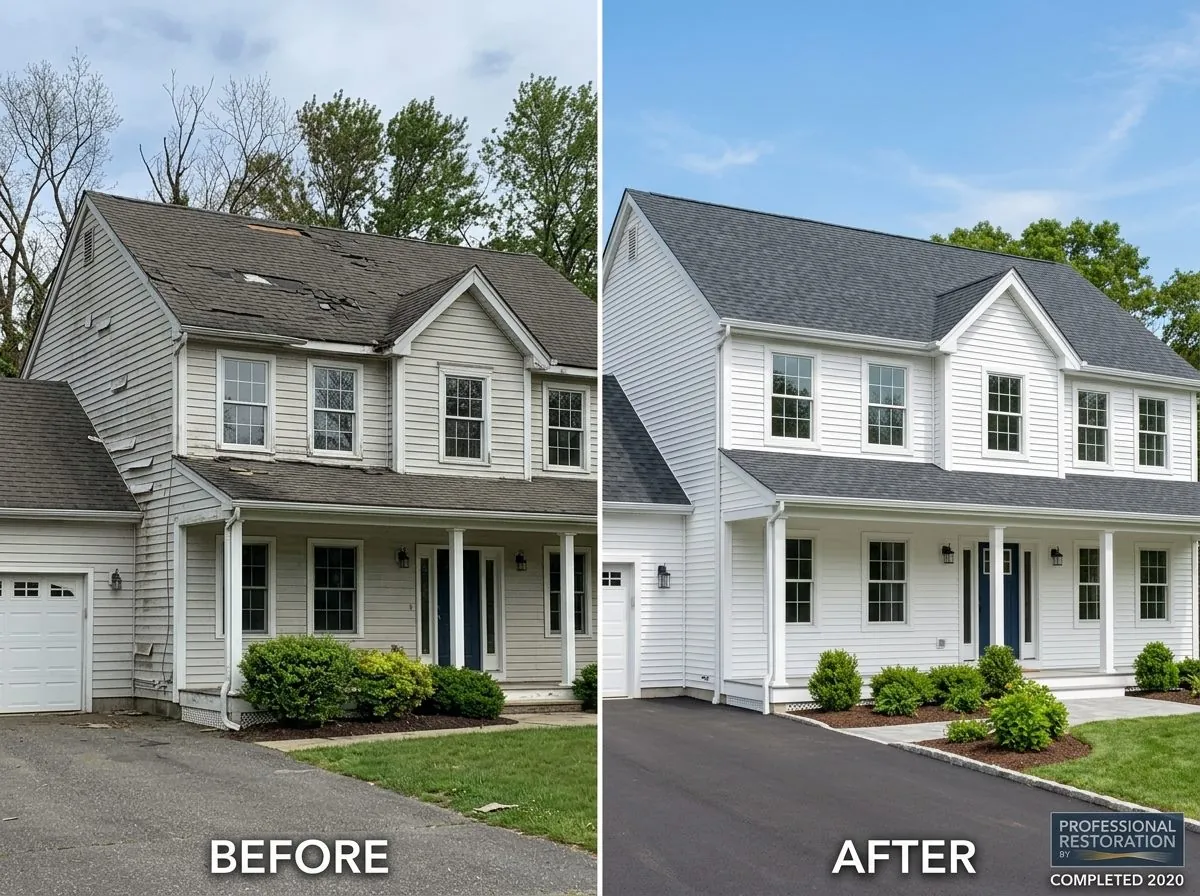
Holbrook is inland, so it does not take the surge and sustained onshore wind that Bellport and Sayville do. What it gets is straight-line wind, hail in the convective storms that develop over the island in summer, and tree fall.
A whole neighborhood of same-age roofs
Holbrook was built out largely in the 1960s and 1970s as planned subdivisions, and the roofs went on together. Fifty years later, entire streets sit in the same condition bracket at the same time.
That matters for a claim in a specific way. An adjuster looking at a 22-year-old roof with storm damage will apply depreciation heavily and may argue the roof was at end of life regardless. The counter is documentation: the roof was performing, it was not leaking, and here is what the storm did to it. That argument needs evidence gathered at inspection, not assembled afterward.
Hail on Long Island is real but under-diagnosed
Long Island is not the hail belt, so homeowners here rarely think of it. But summer convective storms do produce hail, and hail damage to asphalt shingles is close to invisible from the ground.
- Bruising — the granule layer is fractured and the mat is soft, with no obvious hole
- Granule loss in a scattered random pattern, not the uniform wear of age
- Granules collecting in the gutters and at the downspout outlets
- Dents in soft metal — gutters, vents, flashing, the AC condenser fins
- Split or cracked vent boots and skylight surrounds
The condenser fins and gutter dents are the useful tell, because they are easy to photograph from the ground and they corroborate that hail actually fell on the property on the date claimed.
Straight-line wind
Inland wind damage concentrates on the windward slope and on anything with an edge: ridge cap, rake edges, the first course above the eave, and ventilation. Because Holbrook is flat and open in the subdivision layouts, there is little terrain shielding — wind arrives at the house at full strength.
Do not wait for the neighbors
On streets where roofs are the same age, a single storm generates a cluster of claims, and out-of-area storm-chasing contractors follow that cluster. Some are legitimate. Many are not, and the tells are consistent: they knock the day after, they push you to sign immediately, and the agreement assigns your claim benefits to them. Do not sign an assignment of benefits. It hands your leverage over the claim to a company that will be gone next season.
Frequently Asked Questions
How do I know if I have hail damage?
It is very hard to see from the ground on shingles. Check for granules collecting in the gutters and at downspout outlets, and look for dents in soft metal — gutter faces, vents, flashing, and the fins on your AC condenser. Those dents are the easiest corroborating evidence that hail fell on your property, and they are photographable from the ground.
A contractor knocked on my door after the storm. Should I sign?
Not that day, and never an assignment of benefits. An AOB transfers control of your claim to the contractor, which removes your leverage if the work goes wrong. Get an inspection from a local company you can find again next year, and keep the claim in your own name.
Should I file a claim before or after getting an inspection?
Get the inspection first. You want to know whether the damage exceeds your deductible before a claim goes on your record, because a filed claim that pays nothing still counts as a claim at renewal. We inspect and document at no charge and tell you honestly whether it is worth filing.
How long do I have to file after a storm?
New York policies generally require prompt notice, and most carriers expect it within days to weeks — but the specific requirement is in your policy. Practically, file early. Damage that sits gets attributed to wear and neglect rather than to the storm, and that is the most common reason a legitimate claim gets reduced.
Do you tarp before the adjuster comes?
Yes, and you should want us to. Policies obligate you to prevent further damage once you know about it. We photograph everything before tarping, so the adjuster sees the original condition and you have met your duty to mitigate. Save every receipt — emergency mitigation is typically reimbursable.
Related Reading
- Storm Damage Roofs on Long Island — what wind actually does to a roof
- Roof Insurance Claims — how the process really runs
- Documenting Roof Damage for a Claim — what the adjuster needs to see
- Emergency Roof Repair — what to do in the first 24 hours
- Driveway Paving in Holbrook — the same streets, aging together
Also Serving Holbrook
- ADUs in Holbrook — accessory apartments and grants
- Attic Insulation in Holbrook — air sealing, baffles and R-49 depth
- Basement Finishing in Holbrook — egress, ceiling height and moisture
- Bathroom Remodeling in Holbrook — full gut renovations
- Chimney Repair in Holbrook — repointing, crowns, caps and flashing
- Driveway Paving in Holbrook — blacktop, resurfacing and repairs
- Emergency Roof Repair in Holbrook — tarping, leaks and storm response
- Fallen Tree Removal & Roof Repair in Holbrook — tree off the house, roof supported and repaired
- Flood & Water Damage Cleanup in Holbrook — wet material out, drying metered
- Garage Conversion in Holbrook — turning the garage into living space
- Gutter Installation in Holbrook — seamless gutters, fascia and drainage
- House Painters in Holbrook — exteriors while the fall window holds
- Hurricane & Storm Damage Repair in Holbrook — trees, flooding, cleanup and repairs
- Interior Painting in Holbrook — the right work for the cold months
- Kitchen Remodeling in Holbrook — cabinets, counters and layout
- Masonry & Pavers in Holbrook — patios, walkways and retaining walls
- Roofing in Holbrook — tear-offs, repairs and storm damage
- Siding in Holbrook — James Hardie, vinyl and cedar
- Storm Debris Removal & Cleanup in Holbrook — trees, building debris and hauling
- Storm Roof & Siding Repair in Holbrook — wind damage, tarped and rebuilt
- Windows & Doors in Holbrook — insert and full-frame replacement
Work With Alec's Construction
This guide is written by the crew that does the work. See Alec's Storm Damage & Insurance Restoration service — emergency tarping, documentation and the claim itself. Licensed and insured on Long Island, one crew start to finish, free walkthrough and a written estimate inside 48 hours.
Booking the cold months now: we also handle Roofing and Siding.
Every town here has villages inside it running their own building department. Our directory sorts out which counter your address actually files at.
Ready to Get Started?
Storm damage moves fast and so do we. Free damage inspection, documentation for your carrier, and emergency tarping across Suffolk County.