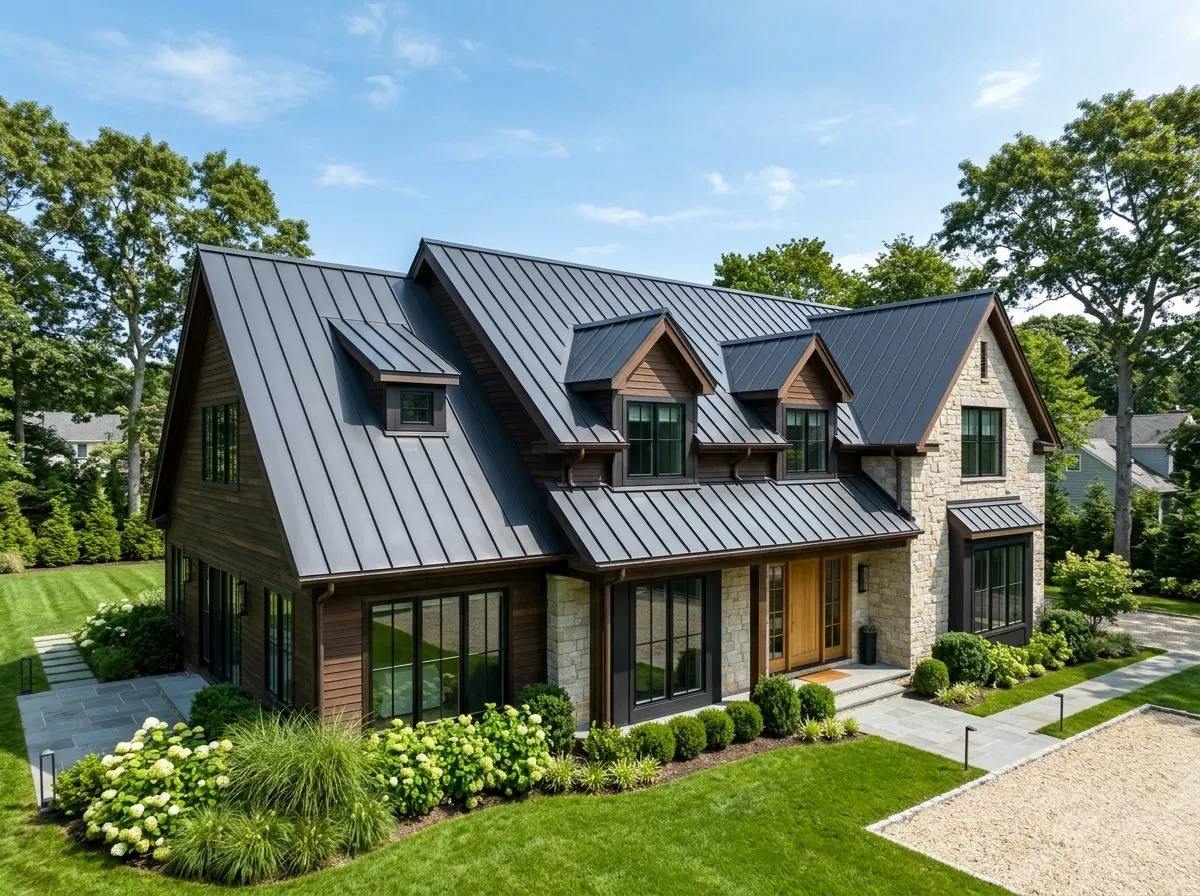
Farmingville sits on the Ronkonkoma moraine, and the housing that went up here in the 1960s and 1970s took advantage of the grade. Split-levels and high ranches are everywhere, and both produce a roof geometry that behaves differently from the simple gable on a flat south-shore lot.
More planes means more valleys
A split-level roof is two or three roof planes at different heights, joined by valleys and wall-to-roof transitions. Every one of those junctions is a place water concentrates and a place a roof can fail. The field of a roof almost never leaks. Valleys, flashings and penetrations do.
- Open metal valleys versus woven or closed-cut — we spec which and why
- Step flashing at every wall-to-roof transition, replaced not reused
- Kick-out flashing where a roof edge dies into a wall, which is the single most common source of hidden wall rot on split-levels
- Ice-and-water shield running the full length of every valley
- Counter flashing cut into masonry rather than surface-sealed
Kick-out flashing deserves the emphasis. When a roof edge terminates against a wall without one, every rainfall dumps water behind the siding at that exact point. The roof looks perfect. The wall sheathing rots for a decade. We find missing kick-outs on split-levels constantly.
Grade, shade and ice damming
The moraine terrain means many Farmingville houses have a genuinely shaded north-facing slope that barely sees winter sun. Snow sits there. If the attic below is leaking heat, that snow melts from underneath, runs down to the cold eave, and refreezes into an ice dam that backs water up under the shingles.
Homeowners treat this as a roof problem and buy heat cables. It is a ventilation and insulation problem wearing a roof problem's clothes. The fix is balanced intake and exhaust ventilation so the attic stays close to outside temperature, plus adequate ice-and-water shield at the eaves as insurance.
Ventilation is where corners get cut
Nearly every cheap roof quote on Long Island has the same hole in it: a ridge vent gets added with no matching soffit intake. Exhaust without intake does almost nothing — the ridge vent pulls its air from the path of least resistance, which is often the house itself.
We do the math on your roof and write both numbers on the proposal. An under-vented attic cooks shingles from below and takes years off a roof you just paid for.
Frequently Asked Questions
Why does my split-level roof keep leaking in the same spot?
Almost certainly a flashing detail, not the shingles. Split-levels have multiple roof planes meeting walls, and the failure is usually step flashing that was reused instead of replaced, or a missing kick-out flashing where a roof edge dies into a wall. Re-shingling around a bad flashing detail reproduces the leak.
I get ice dams every winter. Will a new roof fix it?
Not by itself. Ice dams come from attic heat melting snow that then refreezes at the cold eave. The fix is balanced ventilation and insulation so the attic runs near outside temperature, plus proper ice-and-water shield at the eaves. A new roof without addressing ventilation gets you the same ice dam on newer shingles.
How long does a roof replacement take?
One to two days for a typical Long Island house. Tear-off and dry-in happen the same day — we never leave a roof open overnight. Larger or steeper roofs with multiple planes run to a third day.
Do I need a permit to replace my roof?
A like-for-like re-roof generally does not require a building permit in most Suffolk towns, but that changes if the deck is being replaced, the structure is altered, or the property sits in a historic district or an incorporated village with its own code. We confirm which applies to your address before scheduling.
Related Reading
- General Contractor in Farmingville — one crew for roof, siding, masonry and more
- Metal Roofing Installation — standing seam and metal shingles, priced
- Roof Ventilation — the thing that quietly kills roofs early
- What a Real Roof Inspection Covers — and what a sales call covers instead
- Roof Replacement Cost on Long Island — what actually drives the number
- Signs You Need a New Roof — what to look for before it leaks
- Hiring a Roofing Contractor on Long Island — the questions that separate the bids
Also Serving Farmingville
- ADUs in Farmingville — accessory apartments and grants
- Attic Insulation in Farmingville — air sealing, baffles and R-49 depth
- Basement Finishing in Farmingville — egress, ceiling height and moisture
- Bathroom Remodeling in Farmingville — full gut renovations
- Chimney Repair in Farmingville — repointing, crowns, caps and flashing
- Driveway Paving in Farmingville — blacktop, resurfacing and repairs
- Emergency Roof Repair in Farmingville — tarping, leaks and storm response
- Fallen Tree Removal & Roof Repair in Farmingville — tree off the house, roof supported and repaired
- Flood & Water Damage Cleanup in Farmingville — wet material out, drying metered
- Garage Conversion in Farmingville — turning the garage into living space
- Gutter Installation in Farmingville — seamless gutters, fascia and drainage
- House Painters in Farmingville — exteriors while the fall window holds
- Hurricane & Storm Damage Repair in Farmingville — trees, flooding, cleanup and repairs
- Storm Damage & Insurance Restoration in Farmingville — emergency tarping and the claim
- Interior Painting in Farmingville — the right work for the cold months
- Kitchen Remodeling in Farmingville — cabinets, counters and layout
- Masonry & Pavers in Farmingville — patios, walkways and retaining walls
- Siding in Farmingville — James Hardie, vinyl and cedar
- Storm Debris Removal & Cleanup in Farmingville — trees, building debris and hauling
- Storm Roof & Siding Repair in Farmingville — wind damage, tarped and rebuilt
- Windows & Doors in Farmingville — insert and full-frame replacement
Work With Alec's Construction
This guide is written by the crew that does the work. See Alec's Roofing service — tear-offs, repairs, flashing and storm damage across Suffolk and Nassau. Licensed and insured on Long Island, one crew start to finish, free walkthrough and a written estimate inside 48 hours.
Booking the cold months now: we also handle Seamless Gutters and Storm Damage & Insurance Restoration.
Filing something yourself? Our Long Island building department directory lists the address, phone and counter hours for all 23 permit offices in Nassau and Suffolk.
Ready to Get Started?
Free roof inspection with photos of what we find, and a written scope that lists underlayment, ice-and-water coverage and ventilation. Same-day response on active leaks.