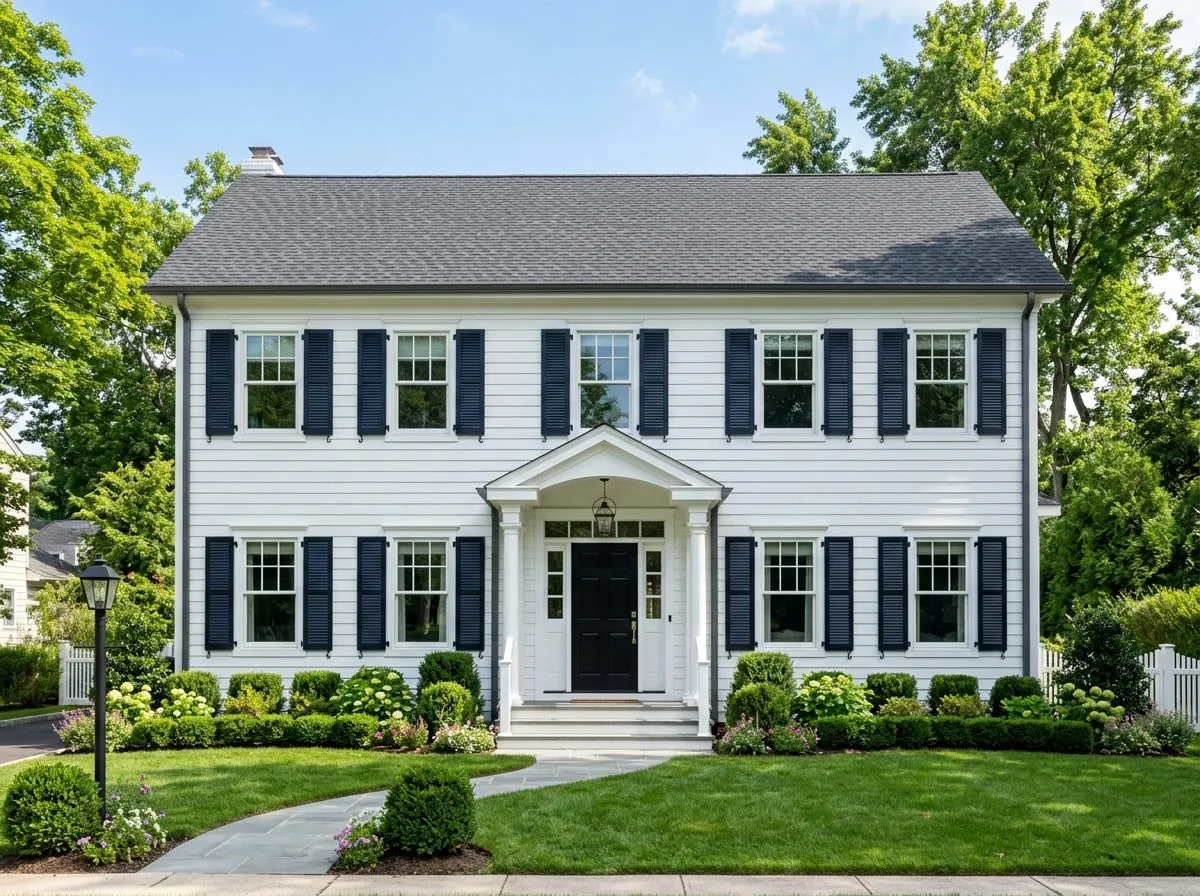
Garden City is an incorporated village with its own building department and its own property standards, and the housing it protects is genuinely architectural — Tudors, Colonials and large center-hall houses from the 1900s through the 1930s.
The trim is the house
On this kind of facade the siding field is the cheap part. What makes the house read correctly is the trim: corner boards, frieze, rake detail, window casing, water table, brackets and, on the Tudors, half-timber work over stucco.
The standard budget approach is to wrap all of that existing wood in aluminum coil and hang siding to it. It looks acceptable on day one. It also traps whatever moisture is in the wood, and it flattens the profile of every detail it covers — the shadow lines that make the facade work simply disappear.
On a Garden City house that is not a saving. It is a visible devaluation of the thing people are paying for when they buy here.
What we do instead
- Replace trim in fiber cement or PVC rather than capping it, keeping the profiles
- Match the original exposure on lap or shingle siding rather than defaulting to a standard reveal
- Repair stucco and half-timber as stucco and half-timber, not by covering it
- Retain and restore original detail wherever it is sound
- Keep the water table, frieze and casing proportions the architect actually drew
The village has a say
Garden City maintains property standards and pays attention to facades. Before anything is ordered we confirm what applies to your property, because reversing a material decision after installation is the most expensive possible way to learn the rules.
Old walls, real discoveries
Houses of this era have plank sheathing, balloon framing, no housewrap, and frequently no insulation in the cavities. Stripping to sheathing is revealing and almost always turns up rot at sills, band joists and window openings that has been progressing quietly for decades.
It is also the one cheap moment to address what is inside the wall — insulating empty stud bays and adding fire blocking in balloon-framed cavities that currently run uninterrupted from floor to roof. A large 1920s Garden City house with empty cavities is expensive to heat, and you will not have this access again.
Mature canopy means damp elevations
The village's protected street trees produce north and east elevations that never fully dry after rain, which grows algae and mildew on any siding product. Pruning back, keeping gutters clear and holding plantings eighteen inches off the wall does more than any product choice — though tree work here has its own rules.
Frequently Asked Questions
Should the trim be capped in aluminum or replaced?
On a Garden City facade, replaced. Capping wraps existing wood in coil stock — fine on day one, but it traps moisture in that wood and flattens the profile of every detail it covers. The shadow lines that make a Tudor or Colonial read correctly disappear, and that is a visible devaluation of exactly what people pay for here.
Should I insulate while the siding is off?
On a 1920s house with empty stud bays, strongly consider it. This is the cheapest access to those walls you will ever have, and a large house of that era is expensive to heat. It is also the moment to add fire blocking in balloon-framed cavities that currently run uninterrupted from floor to roof.
Do you have to remove the old siding?
We recommend it and quote it that way. Siding over siding hides whatever is wrong with the sheathing, adds thickness that throws off every window and door detail, and makes proper housewrap and flashing impossible.
How long does a siding job take?
Three to six days on a typical house depending on size, stories and how much trim and flashing work comes with it. Fiber cement runs longer than vinyl because the material is heavier and slower to cut and hang.
Related Reading
- James Hardie Fiber Cement — HZ5 spec, real costs, and where vinyl still wins
- Brick and Stone Veneer — where masonry beats siding on a facade
- Siding Replacement Cost in Nassau County — what drives the number on a real house
- Roofing in Nassau County — roof and siding sell together for a reason
- Storm Damage on Long Island — wind, siding and the insurance path
Also Serving Garden City
- Basement Finishing in Garden City — egress, ceiling height and moisture
- Chimney Repair in Garden City — repointing, crowns, caps and flashing
- Driveway Paving in Garden City — blacktop, resurfacing and repairs
- Emergency Roof Repair in Garden City — tarping, leaks and storm response
- Gutter Installation in Garden City — seamless gutters, fascia and drainage
- House Painters in Garden City — exteriors while the fall window holds
- Interior Painting in Garden City — the right work for the cold months
- Masonry & Pavers in Garden City — patios, walkways and retaining walls
- Roofing in Garden City — tear-offs, repairs and storm damage
Work With Alec's Construction
This guide is written by the crew that does the work. See Alec's Siding service — James Hardie, vinyl and cedar with the rot behind it repaired first. Licensed and insured on Long Island, one crew start to finish, free walkthrough and a written estimate inside 48 hours.
Booking the cold months now: we also handle Roofing and Painting.
We keep a permit office directory for Nassau and Suffolk, checked against each jurisdiction's own site, because we file in these counters constantly.
Ready to Get Started?
Free exterior walkthrough and a written proposal listing product spec, fastener type, housewrap and every flashing detail. Nassau and Suffolk County.