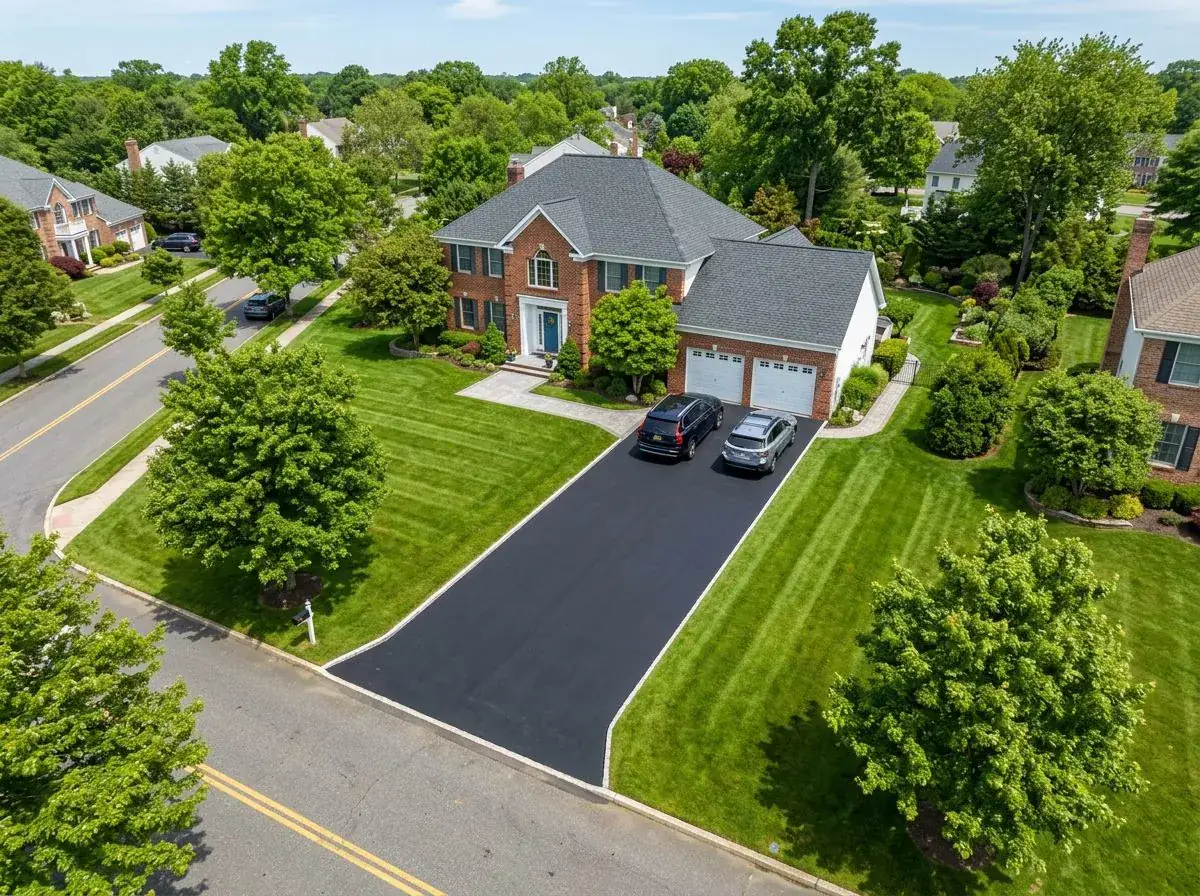
Garden City is an incorporated village with its own building department, its own property standards, and an active opinion about how the streetscape reads. A driveway here is not just paving — it is the largest hard surface visible from the street on most lots, and the village treats it accordingly.
What the village cares about
- Curb cuts and apron work run through village process, not a formality to skip
- Widening and coverage rules are enforced knowledgeably — the coverage math happens at design, not at inspection
- The street trees are protected, and excavation near their roots is watched; we plan the dig around the critical root zones because killing a village oak is an expensive way to save a yard of excavation
- Materials get noticed: a raw asphalt sheet to the curb reads wrong on these blocks, and the village's own details lean brick and block at the transitions
The apron is where the money shows
The most Garden City driveway detail is the dressed transition: a brick or Belgian block apron at the street, block edging up the sides, asphalt or chip-seal field between. It is not decoration — the apron takes the turning loads and the snowplow hits, brick and granite carry both better than an asphalt feather edge, and the banded edge keeps the field from crumbling outward. But it is also what makes a driveway here look like it belongs to the house.
We build the apron and edging as masonry — proper concrete setting bed, compacted base, sand-set or mortared per the design — and pave the field to meet it. The two trades on one crew is the whole reason the joint lines up.
Estate lots and circular drives
The larger blocks carry circular and horseshoe drives, and those are their own discipline: continuous curvature means short paver passes and real hand work, the entire perimeter is unsupported edge, and the geometry has to actually work for a modern SUV's turning radius — plenty of 1930s circles do not. We check the radii before quoting, because widening a circle is a design change, not a change order.
Old drives over old base
Houses from the 1910s through the 1930s frequently sit on their third or fourth driveway surface, stacked over a base nobody has seen since the Hoover administration. We core before quoting: sound old base earns a resurface, and stacked overlays on dust earn an honest rip-out. On lots this visible, the wavy half-measure shows from the sidewalk.
Frequently Asked Questions
Does Garden City review driveway work?
The apron and curb cut run through village process, coverage rules are enforced knowledgeably, and excavation near the protected street trees is watched. None of it is difficult if it is planned — we handle the village side and design the dig around the critical root zones.
Why do so many Garden City driveways have brick or block aprons?
Because the apron takes the hardest loads — turning tires and snowplow hits — and brick and granite block carry both better than an asphalt feather edge. The banded edge also keeps the asphalt field from crumbling outward, and it is what makes the driveway read as part of the house rather than a parking surface.
How long does a driveway take?
One day for a resurface on a typical residential driveway, one to two days for a full rip-out and repave. Park on it in 48 to 72 hours; full cure takes about 30 days.
Do you work in Nassau County?
Yes. We are based in East Patchogue and pave across both counties. On Nassau jobs we confirm village versus town jurisdiction from the parcel first, because Nassau has a far higher density of incorporated villages than Suffolk.
Related Reading
- Belgian Block Edging and Aprons — the most Long Island driveway detail there is
- Driveway Curb Appeal — what buyers notice from the street
- Paver Driveways vs. Asphalt — cost, lifespan and resale
- Blacktop Driveway Cost on Long Island — real per-square-foot numbers
- Driveway Paving on Long Island — the full homeowner guide
Also Serving Garden City
- Basement Finishing in Garden City — egress, ceiling height and moisture
- Chimney Repair in Garden City — repointing, crowns, caps and flashing
- Emergency Roof Repair in Garden City — tarping, leaks and storm response
- Gutter Installation in Garden City — seamless gutters, fascia and drainage
- House Painters in Garden City — exteriors while the fall window holds
- Interior Painting in Garden City — the right work for the cold months
- Masonry & Pavers in Garden City — patios, walkways and retaining walls
- Roofing in Garden City — tear-offs, repairs and storm damage
- Siding in Garden City — James Hardie, vinyl and cedar
Work With Alec's Construction
This guide is written by the crew that does the work. See Alec's Driveways & Blacktop service — asphalt paving, resurfacing and sealcoating. Licensed and insured on Long Island, one crew start to finish, free walkthrough and a written estimate inside 48 hours.
Booking the cold months now: we also handle Masonry & Pavers and Roofing.
Not sure whether the town or village files your permit? That question trips up more Long Island projects than any other — the directory sorts it out.
Ready to Get Started?
Free on-site measure and a written price that lists base depth, asphalt thickness and compaction lifts. Most residential driveways are a one-day install.