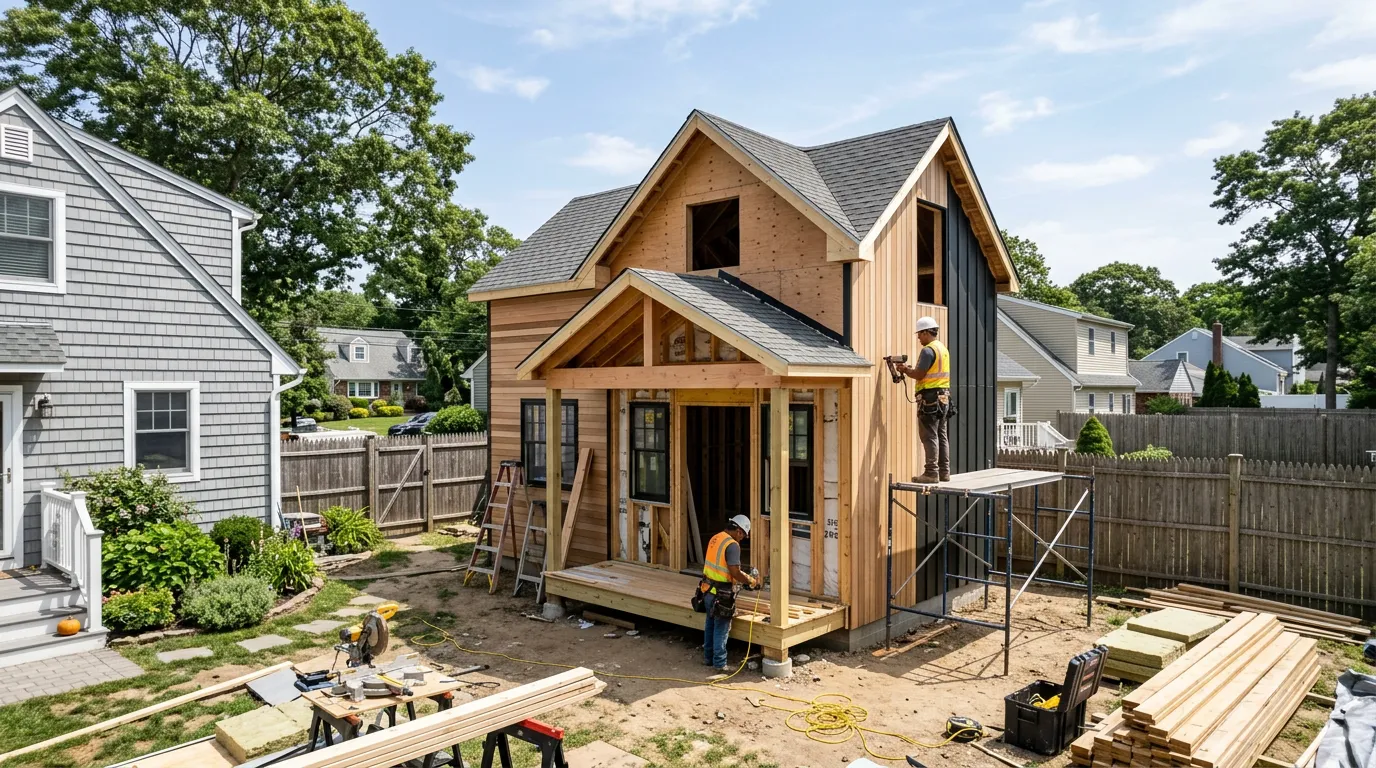
Accessory dwelling units are the most-asked-about project we handle, and the questions repeat. Homeowners want to know whether an ADU is legal on their lot, what it really costs, how long it takes, and whether the rental income justifies the build.
Below are the questions we field most often from Suffolk County homeowners, answered plainly. Alec's Construction is a licensed Suffolk County general contractor serving Babylon, Islip, Brookhaven, Smithtown, Huntington, Riverhead and the East End.
Can I build an ADU in my backyard?
Yes, in most towns — but not automatically. Long Island towns permit accessory dwellings under defined conditions rather than as of right, and each town sets its own. Expect requirements around owner-occupancy, one accessory unit per lot, a size cap relative to the main house, minimum lot area, off-street parking, separate legal egress, and a rental permit that renews on a cycle. Villages inside a town frequently impose stricter standards than the town itself. The first question is always which authority governs your parcel.
How much does an ADU cost to build?
For permitted, code-compliant work, a basement or lower-level conversion typically runs $80,000 to $150,000, a garage conversion $105,000 to $200,000, an attached addition $150,000 to $275,000, and a detached new-build cottage $200,000 to $350,000. The spread inside each range comes down to how much structural, electrical, plumbing and egress work the existing conditions demand. Septic upgrades, where required, are additional.
Do I need a permit to build an ADU?
Always. Creating a second dwelling unit is a change of occupancy, not a renovation. It requires a building permit, inspections, and in most Suffolk cases county health department approval as well. Unpermitted units are common and they cause real problems: fines, difficulty refinancing, complications at sale, and potential insurance denial on a claim.
Will I need to upgrade my septic system?
In Suffolk County, very likely. Most of the county is unsewered and additional bedrooms increase sanitary flow, which triggers Suffolk County Department of Health Services review. Many properties need an innovative/alternative on-site wastewater treatment system that reduces nitrogen discharge. Budget $25,000 to $50,000 for that work before any grant offset, and get a septic evaluation before you commit to a floor plan — it is the constraint most likely to kill a project.
What is the Plus One ADU Program?
It is a New York State program administered by Homes and Community Renewal through regional partners, providing up to $125,000 per project to help eligible homeowners build or rehabilitate an accessory dwelling unit. It targets low-to-moderate income owner-occupants. Income limits, availability and application windows vary by administering partner and funding round, so confirm current status before building it into a budget.
How long does it take to build an ADU?
Plan on several months of approvals before construction starts — health department review is usually what sets the schedule — then three to six months to build depending on type and scope. A basement conversion is at the short end; a detached cottage with new septic is at the long end. Anyone promising a permitted ADU in a few weeks has not built one here.
How much rent can an ADU generate?
It depends heavily on location, size and finish. What matters more than the headline number is that the income is legal, reportable and durable. A permitted unit can be advertised openly, insured properly, and disclosed at sale as legal living space. An unpermitted unit cannot, and the discount you take at closing usually exceeds whatever you saved by skipping permits.
Is it worth it to build an ADU?
Legal, permitted accessory units generally add value, both as additional living area and as a documented income stream. Unpermitted units frequently reduce value, because a buyer's attorney will find them and either demand a price reduction or require legalization before closing. The permit is the asset.
Can I convert my garage into an ADU?
Often yes. Garage conversions are among the more affordable routes because the structure, foundation and roof already exist. The recurring obstacles are parking — you are removing a parking space while adding a unit that requires one — plus insulation, ceiling height, egress and bringing electrical up to residential standard.
Can I convert my basement into an apartment?
Frequently, if three things work: ceiling height, light and ventilation, and a legal second means of egress. A basement apartment generally needs a proper egress window or exterior door rather than just the interior stairs. Fire separation between units and adequate headroom are the other common obstacles. In flood-prone areas, elevation requirements can rule a basement unit out entirely.
Do I have to live on the property?
Almost certainly. Accessory apartment approvals across Long Island generally require the owner to occupy one of the two units. The intent is to keep these units in owner-occupied housing rather than converting neighborhoods to absentee-landlord rentals. Confirm the current requirement with your town before planning.
What is the first step?
A feasibility review before you spend anything on drawings: confirm whether a town or a village governs your parcel, then check lot size, coverage, setbacks, parking, egress potential and sewer or septic capacity. That combination determines what is actually buildable. Designing first and checking later is how projects die expensively.
Can I build my own ADU?
Legally you can act as your own general contractor in most cases, but it is rarely the bargain it looks like. An ADU touches structural, plumbing, electrical, mechanical and often health-department work, each with its own inspection. Homeowners who self-manage typically underestimate the coordination, and mistakes at rough-in are expensive to unwind after inspection. If you do proceed, the permit still has to be pulled properly and every stage still has to pass inspection.
Is it worth building an ADU for rental income?
For most Suffolk homeowners with the lot to support one, the numbers work over a multi-year horizon rather than immediately. The build is a substantial capital outlay recovered through rent, and the return depends on what you can charge locally against what the unit cost. The two factors that most often decide it are whether you need a septic upgrade and whether you qualify for grant funding.
Related Guides
- Full ADU cost breakdown
- Suffolk County septic requirements
- Plus One ADU grant program
- ADU permit process
- Suffolk County ADU laws
Work With Alec's Construction
This guide is written by the crew that does the work. See Alec's ADUs service — accessory apartments, garage conversions and grant paperwork. Licensed and insured on Long Island, one crew start to finish, free walkthrough and a written estimate inside 48 hours.
Booking the cold months now: we also handle Additions & New Construction and Bathroom Remodeling.
Every town here has villages inside it running their own building department. Our directory sorts out which counter your address actually files at.
Also Serving Questions Long Island
- Bathroom Remodeling in Questions Long Island — full gut renovations
Have a Question We Did Not Answer?
Alec's Construction is a licensed Suffolk County general contractor. Tell us about your project and we will walk you through what is possible on your property, what it costs, and how long it takes.
Get a Free Consultation