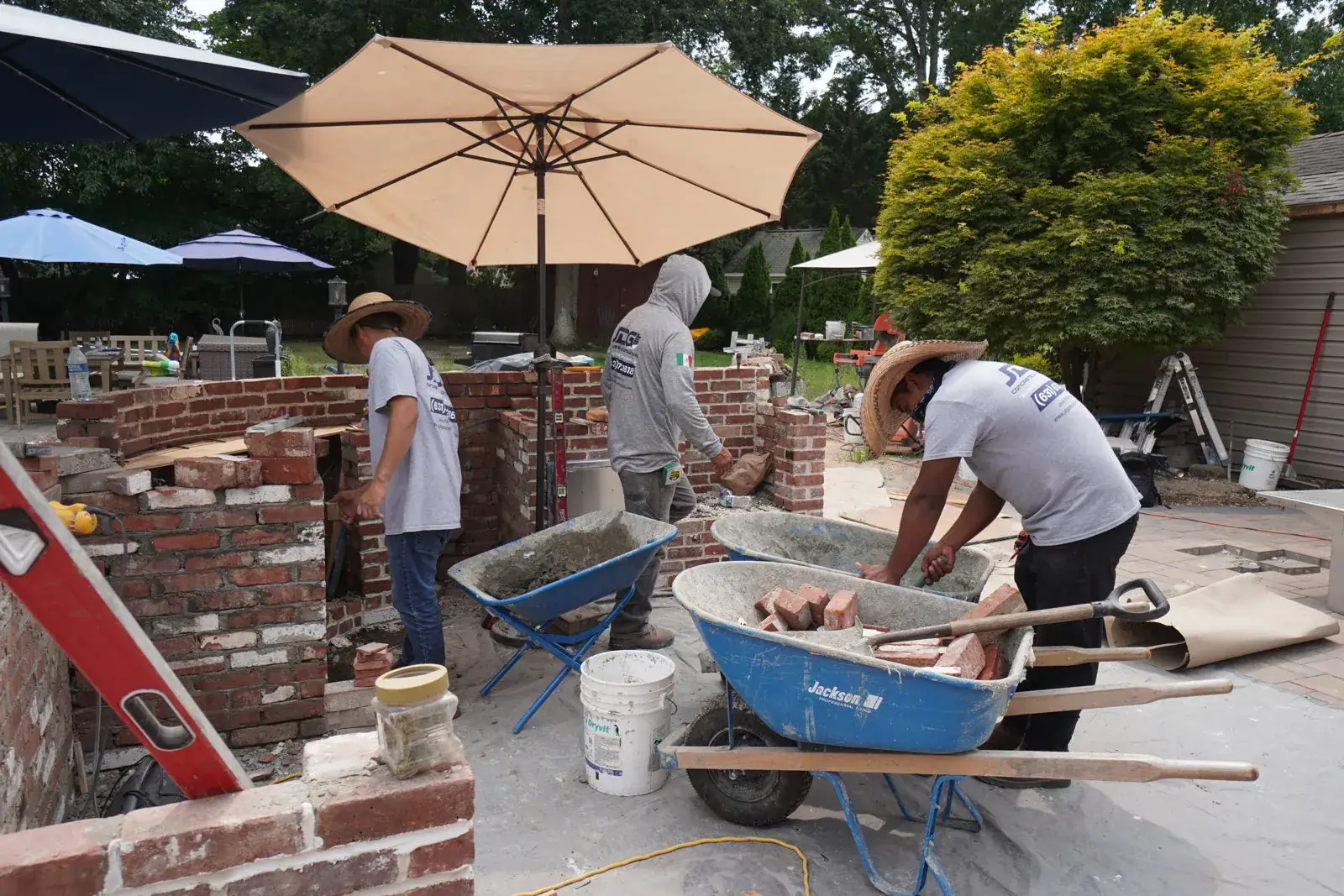
“Brick driveway” means two different things on Long Island, and the difference is thousands of dollars. Some people mean true clay brick pavers — fired clay, the deep red that never fades because the color is the material. Most people mean concrete pavers made to look like brick, which is what the overwhelming majority of the driveways we install actually are. Both are laid the same way, both outlast asphalt, and only one of them is worth arguing about at the estimate stage.
This page covers what a brick-look paver driveway costs here, why the base matters more than the brick, and what changes when the driveway is in Sayville versus Massapequa versus Coram.
What a brick paver driveway costs on Long Island
Budget $22 to $45 per square foot installed. A standard two-car driveway of roughly 800 square feet lands between $17,500 and $36,000 depending on the paver line, the pattern, the amount of cutting, and what has to come out first.
For context on the same driveway: asphalt runs $6 to $12 per square foot, poured concrete $12 to $20. There is no honest way to make pavers sound cheap. What you get for the gap is a surface that lasts 30 to 50 years instead of 15 to 20, and one that can be lifted and reset in a single afternoon when a root or a settled patch needs attention — try that with asphalt.
- Clay brick pavers — $9 to $16 per square foot in material alone. The color is permanent because it is fired in, not pigmented on. Narrower size range and less forgiving of poor base work.
- Concrete pavers in a brick profile — $4 to $7 per square foot for standard lines, more for premium manufacturers. Far more sizes, colors, and textures. This is what most Long Island brick driveways actually are.
- Tear-out of the old surface — $500 to $1,500 for asphalt, more for old concrete with wire mesh in it.
- Belgian block apron or border — commonly $3,000 to $9,000 depending on run length. Nearly every driveway we do gets one, because it is the edge restraint and the visual frame at the same time.
The base is the whole job
Almost every failed paver driveway on Long Island failed at the base, not at the paver. A patio can get away with 4 to 6 inches of compacted stone. A driveway carrying a loaded SUV, an oil truck, and a snowplow cannot.
- 8 to 12 inches of compacted 3/4-inch crushed stone, placed and compacted in lifts, not dumped in one pass and rolled once.
- Geotextile fabric between subsoil and stone where the ground is silty or clay-heavy. Parts of Coram, Selden, and Holtsville have enough clay to justify it every time.
- Proper pitch away from the house — roughly a quarter inch per foot. Get this wrong and you have moved your water problem to the foundation.
- Herringbone in the drive lanes. Running bond looks fine on a walkway and creeps under vehicle turning loads. A 45 or 90 degree herringbone interlocks and stays put.
- Rigid edge restraint plus polymeric joint sand. The edge is what stops the field from spreading; the sand is what stops the weeds and the shifting.
If an estimate does not name a base depth, it is not an estimate. Ask for the number in writing. Our step-by-step of how pavers actually go in walks the sequence if you want to know what to watch for while the crew is on site.
Brick pavers versus blacktop, decided honestly
We install both, which means we have no reason to sell you the expensive one. The decision usually comes down to how long you are staying.
- Staying 10+ years: pavers generally win. Lifespan, repairability, and the fact that you will never re-seal them.
- Selling within 3 years: blacktop is the rational choice. A fresh asphalt driveway photographs well and costs a third as much. See what a new driveway actually returns at resale.
- Steep slope or heavy plow use: asphalt is easier to plow blind. Pavers handle it fine with the shoe set high or a rubber-edged blade, but it takes a little care.
- Town impervious-surface limits: this is where pavers can be the only option that gets approved. Permeable interlocking pavers count differently toward coverage in several Suffolk jurisdictions.
What goes wrong, and what it costs to fix
Settling in a wheel path, a sunken spot at the apron where the town paving meets yours, joints washing out at the low end of the drive. All three trace back to base or drainage, and all three are fixable without replacing the driveway.
Lifting and resetting a settled section runs a few hundred to a couple thousand dollars depending on area — the pavers come out, the base gets rebuilt and recompacted, the same pavers go back down. More on diagnosing settling. If water is the root cause, fix that first: driveway drainage on Long Island covers the usual culprits.
Want a number on your own driveway or patio?
We measure on site and price it in writing. Free, no obligation.
Brick driveway paving by town
Driveway work is local in a way most trades are not — soil, apron rules, and what the neighbors already have all change block to block. These are the towns we install brick paver driveways in most often, with what tends to be specific to each.
- Sayville — older narrow lots where the apron and the Belgian block run matter more than the field
- West Sayville — same lot pattern as Sayville, often with a longer run to a detached garage
- Holbrook — our densest paver market; sandy base that compacts well and drains
- Massapequa — Nassau permit and apron rules, plus tight side-yard access on many lots
- Massapequa Park — incorporated village — village approval is separate from the town
- North Massapequa — wider driveways, frequent turnaround aprons
- East Massapequa — mixed lot sizes, often paired with a walkway rebuild
- Selden — clay-heavier subsoil; this is where geotextile fabric earns its keep
- Coram — same clay consideration as Selden, plus longer driveways on newer subdivisions
- Mastic — flatter grades, drainage planning matters at the street end
- Mastic Beach — low elevation near the water — pitch and outfall get worked out first
- Shirley — large lots, often a full driveway plus walkway package
- East Patchogue — mature trees; root management is usually part of the base plan
- Holtsville — newer construction, straightforward grades
- Garden City — brick is the local vernacular here; clay pavers get specified more often than anywhere else we work
If your town is not on the list, call anyway — the list is where we work most, not a boundary. Anything from Nassau through the Twin Forks is fair game; we tell you honestly if travel makes a small job uneconomical.
Frequently Asked Questions
How much does a brick paver driveway cost on Long Island?
Budget $22 to $45 per square foot installed, so roughly $17,500 to $36,000 for a standard 800 square foot two-car driveway. Blacktop on the same driveway runs $6 to $12 per square foot.
Are brick pavers real clay or concrete?
Both exist. True clay brick pavers hold color permanently because it is fired in, and cost $9 to $16 per square foot in material. Most Long Island brick driveways are concrete pavers made in a brick profile, at $4 to $7 per square foot, with far more size and color options.
How deep does the base need to be under a paver driveway?
8 to 12 inches of compacted 3/4-inch crushed stone, placed in lifts. A patio can use 4 to 6 inches; a driveway carrying vehicles and a plow cannot. If an estimate does not name a base depth, ask for it in writing.
Can you plow a brick paver driveway?
Yes. Set the plow shoe slightly high or use a rubber-edged blade. Pavers with correct edge restraint and joint sand handle plowing season after season.
How long does a brick paver driveway last?
30 to 50 years with an adequate base, against roughly 15 to 20 for asphalt. And a settled section can be lifted and reset rather than replaced.
Related Reading
- Paver Driveways — the wider cost and material comparison
- How Pavers Are Installed — the base work step by step
- Belgian Block Edging — why nearly every driveway gets one
- Blacktop Driveway Cost — the cheaper option, priced honestly
- Permeable Pavers — when impervious coverage limits decide for you
- Paver Patterns — why herringbone matters in a drive lane
Work With Alec's Construction
This guide is written by the crew that does the work. See Alec's Driveways & Blacktop service — asphalt paving, resurfacing and sealcoating. Licensed and insured on Long Island, one crew start to finish, free walkthrough and a written estimate inside 48 hours.
Booking the cold months now: we also handle Masonry & Pavers and Roofing.
We keep a permit office directory for Nassau and Suffolk, checked against each jurisdiction's own site, because we file in these counters constantly.
Ready to Get Started?
Comparing a brick paver driveway against blacktop? Call Alec's Construction at (631) 312-7441. We install both, so you get a straight comparison with real numbers on your actual driveway — Nassau and Suffolk County.