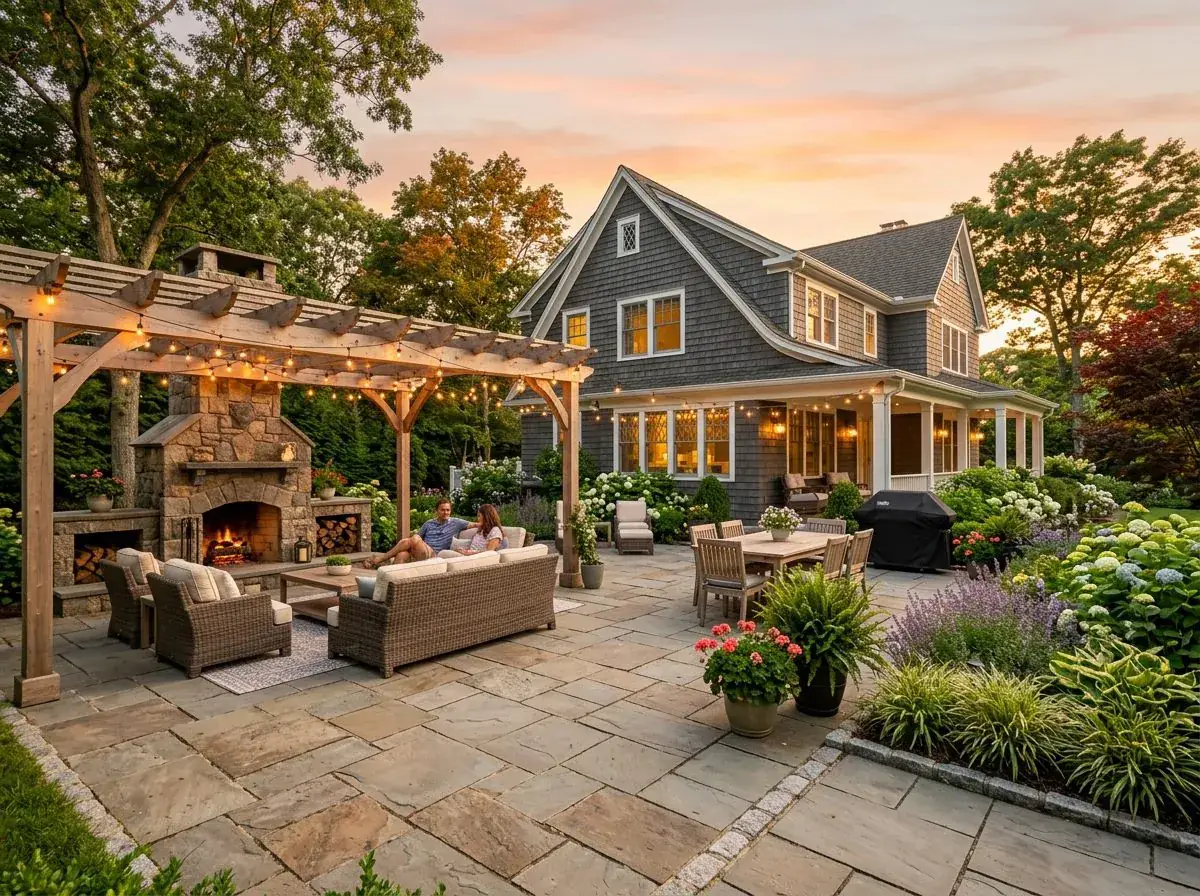
Pattern is the design decision with the biggest hidden effect on price. Two patios with identical pavers, identical square footage and identical base can differ by several thousand dollars in labor purely because of how the units are laid. Here is what each pattern costs you and where it actually belongs.
Running Bond
Rows of rectangular pavers offset by half a unit, like a brick wall laid flat. The simplest and fastest pattern to install.
Labor impact: baseline. Cuts only at the borders. Clean, quiet, works with almost any architecture. On a large patio it can read as slightly plain, which a contrasting soldier course border fixes immediately.
Use it for: patios where budget matters, walkways, large fields, anywhere you want the pavers to be a surface rather than a feature. Do not use it for: driveways, where it lacks the interlock to resist turning tires.
Herringbone
Pavers set at angles to each other in an interlocking V. Available at 90 degrees or 45 degrees to the primary edge.
Labor impact: roughly 15 to 30 percent more than running bond, and 45-degree herringbone sits at the top of that because every border meeting is a diagonal cut.
This is the correct pattern for driveways, and not for looks. The interlock distributes load laterally and resists the rotational forces of a turning vehicle far better than any other pattern. A running-bond driveway develops creep and rutting in the wheel tracks; herringbone does not.
On patios it reads as more crafted and traditional. 45-degree herringbone against the house line is a classic look on Long Island colonials.
Basketweave
Pairs of pavers alternating direction in a checkerboard. Traditional, strongly associated with older brick work.
Labor impact: roughly 10 to 20 percent over running bond. Requires pavers with a precise 2:1 length-to-width ratio, which limits your product choices.
Use it for: smaller patios, courtyards, and homes with a traditional or historic character where the pattern reinforces the architecture. On a very large field it can feel busy.
Random or Ashlar Pattern
Multiple paver sizes combined in a repeating but non-obvious layout. Most manufacturers sell these as a coordinated kit with a specified repeat.
Labor impact: roughly 15 to 25 percent over running bond — more layout thinking, more sorting, more staging of different units.
Use it for: a natural stone look at concrete paver pricing. This is the most popular choice for large Long Island patios right now because it reads as bluestone from a distance at meaningfully lower cost. Insist the crew follows the manufacturer repeat; laid carelessly it develops visible clusters of the same size.
Circle and Radius Kits
Pre-engineered kits producing a true circular field, often used as a feature around a fire pit or table.
Labor impact: significant. The kit itself installs reasonably, but the transition where the circle meets the surrounding field generates dozens of custom curved cuts. Budget an extra $1,500 to $4,000 for a circle feature depending on size.
Borders, Bands and Inlays
A soldier course — pavers laid perpendicular around the perimeter — is the highest-value detail in hardscape. It costs relatively little, frames the field, hides the transition, and is the clearest visual signal of professional work. Nearly every patio benefits from one.
A contrasting band in a second color adds definition. A double soldier course in two tones suits larger patios.
Inlays and medallions are beautiful and expensive. They are also the element most likely to date the patio in fifteen years. Use restraint.
Practical Guidance
- Driveways: herringbone. Non-negotiable for performance.
- Large patios: random/ashlar or running bond with a strong border. Best value and best proportion.
- Small patios and courtyards: basketweave or 45-degree herringbone. The pattern has room to be seen.
- Walkways: running bond with a soldier course border. Efficient and it reads correctly at walking speed.
- Around pools: random/ashlar with a bullnose coping edge.
- Run the long dimension of the pattern away from the house on narrow patios; it makes the space read deeper.
One last thing: pattern complexity does not compensate for a thin base. If the budget is tight, take running bond with a proper base over herringbone on a shortcut base every single time.
Frequently Asked Questions
Which paver pattern is strongest?
Herringbone, by a clear margin, because the interlocking geometry distributes load laterally and resists rotational forces. It is the standard for driveways and any vehicular surface.
Which paver pattern is cheapest to install?
Running bond. It generates the fewest cuts and lays fastest. A soldier course border makes it look considerably more finished for modest additional cost.
Does pattern affect how long a patio lasts?
On patios, not much — the base determines longevity. On driveways it matters significantly, because non-interlocking patterns creep under vehicle loads.
Can I mix patterns on one patio?
Yes, and it works well when there is a reason for it — for example a random field with a herringbone inset under a dining table, framed by a soldier course. Arbitrary mixing looks unresolved.
Related Reading
- Paver Patio Cost — how pattern shows up in the labor line
- Paver Driveways — why herringbone is required here
- Paver Walkways — borders and widths that work
- How Pavers Are Installed — the steps behind the pattern
- Pavers vs. Concrete — the material decision first
Work With Alec's Construction
This guide is written by the crew that does the work. See Alec's Masonry & Pavers service — patios, walkways, steps, stoops and retaining walls. Licensed and insured on Long Island, one crew start to finish, free walkthrough and a written estimate inside 48 hours.
Booking the cold months now: we also handle Chimney Repair and Driveways & Blacktop.
Every town here has villages inside it running their own building department. Our directory sorts out which counter your address actually files at.
Ready to Get Started?
Want to see patterns on your actual space? Call Alec's Construction at (631) 312-7441 for a free design consultation — Nassau and Suffolk County.