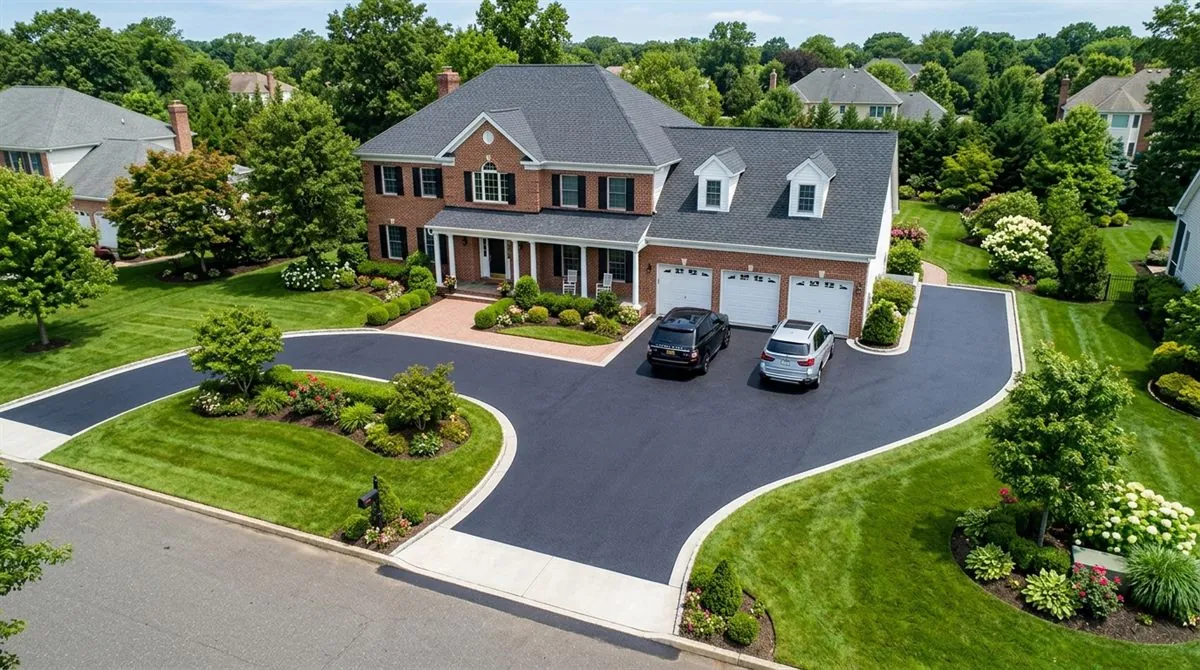
Oakdale was estate country before it was suburbia, and the bones of that are still in the ground. Idle Hour, the Vanderbilt property that became Dowling College, set the pattern — deep parcels, formal approaches, stone entrance work and mature specimen trees planted a century ago. Paving here runs into all of it.
Know who owns the road before you quote the driveway
This is the question we settle first in Oakdale and almost nowhere else. A good number of properties here sit on private lanes or association-maintained roads rather than a Town of Islip street.
That changes the job. On a town road, the apron and curb cut are Islip Highway Department. On a private lane, there is no town apron — the transition is between your driveway and a road surface somebody else maintains, and the association may have its own rules about materials, colors and how the tie-in is built. We have seen homeowners pave beautifully and then be asked to change the entrance because nobody read the covenants.
Entrance columns and gates are fixed points
Masonry piers, gate posts and stone walls at the head of the drive are common here and they are not movable. Paving up to them is detail work, not production paving.
- Asphalt shrinks slightly as it cures, so a butt joint against masonry opens — the joint needs to be cut and sealed, not just rolled tight
- Gate swing radius has to be checked against the finished surface height, because adding an inch and a half of new pavement can stop a gate closing
- Buried gate hardware, conduit and low-voltage lighting runs near the columns
- A paver or cobble apron between the columns is common and reads better than asphalt right up to the stone
Specimen trees are worth more than the driveway
The mature trees along these approaches were planted deliberately and a good number of them are irreplaceable in any practical sense. Excavating a driveway through a critical root zone can kill a tree slowly enough that nobody connects the two events three years later.
We look at where the drive sits relative to the trunks before we set the excavation depth. Sometimes the answer is a shallower section with a root barrier through that stretch; sometimes it is shifting the alignment a few feet. On a property where the trees are the reason it looks the way it does, that is the right trade.
Near the Connetquot, water is close
The river and the surrounding parkland mean ground water sits higher on parts of these properties than the sandy south-shore soil would suggest. A drywell that is undersized for saturated ground simply fills and stops working in the storm you actually needed it for.
We size drainage for a wet-season condition rather than a dry-day observation, and on properties adjacent to protected land we keep the runoff on your parcel rather than routing it toward the boundary.
Asphalt is not automatically the right surface here
On a formal approach with stone columns and a period house, a large expanse of fresh black asphalt can read wrong no matter how well it is built. Chip seal, permeable paver fields and a cobble or paver apron at the entrance all sit better against that architecture.
We install all of it and we will tell you honestly which we would put on your property. If blacktop is right, we pave it. If it is going to fight the house, better to hear that at the estimate than after.
Frequently Asked Questions
My driveway meets a private road, not a town street. Does that change anything?
Yes. There is no Town of Islip apron to permit, but the association or road owner may have its own rules on materials, color and how the tie-in is built. We confirm who maintains the road and what the covenants say before quoting — homeowners here have paved beautifully and then been asked to redo the entrance.
Will paving hurt the big trees along my driveway?
It can, if the excavation cuts through a critical root zone — and the tree can die slowly enough that nobody connects it to the driveway three years later. We look at the drive's position relative to the trunks before setting excavation depth, and where needed we use a shallower section with a root barrier or shift the alignment a few feet.
How long does a driveway take?
One day for a resurface on a typical residential driveway, one to two days for a full rip-out and repave. You can walk on it the same evening and park on it in 48 to 72 hours. Full cure takes about 30 days, which is why we ask you not to turn your wheels while stationary during the first month.
What time of year can you pave?
Roughly April through mid-November on Long Island. Hot-mix asphalt must be laid and compacted while hot, and once ground and air temperatures drop the mat cools before the roller can seat it. A driveway paved in December looks fine in December and ravels the following spring.
Related Reading
- Permeable Paving — when coverage limits decide the design
- Paver Driveways vs. Asphalt — cost, lifespan and resale
- Driveway Curb Appeal — what buyers notice first from the street
- Driveway Drainage Done Right — where the water goes before it goes into your garage
- Driveway Paving on Long Island — the full homeowner guide
Also Serving Oakdale
- Attic Insulation in Oakdale — air sealing, baffles and R-49 depth
- Basement Finishing in Oakdale — egress, ceiling height and moisture
- Bathroom Remodeling in Oakdale — full gut renovations
- Fallen Tree Removal & Roof Repair in Oakdale — tree off the house, roof supported and repaired
- Flood & Water Damage Cleanup in Oakdale — wet material out, drying metered
- Gutter Installation in Oakdale — seamless gutters, fascia and drainage
- Hurricane & Storm Damage Repair in Oakdale — trees, flooding, cleanup and repairs
- Interior Painting in Oakdale — the right work for the cold months
- Kitchen Remodeling in Oakdale — cabinets, counters and layout
- Roofing in Oakdale — tear-offs, repairs and storm damage
- Storm Debris Removal & Cleanup in Oakdale — trees, building debris and hauling
- Storm Roof & Siding Repair in Oakdale — wind damage, tarped and rebuilt
Work With Alec's Construction
This guide is written by the crew that does the work. See Alec's Driveways & Blacktop service — asphalt paving, resurfacing and sealcoating. Licensed and insured on Long Island, one crew start to finish, free walkthrough and a written estimate inside 48 hours.
Booking the cold months now: we also handle Masonry & Pavers and Roofing.
Filing something yourself? Our Long Island building department directory lists the address, phone and counter hours for all 23 permit offices in Nassau and Suffolk.
Ready to Get Started?
Free on-site measure and a written price that lists base depth, asphalt thickness and compaction lifts. Most residential driveways are a one-day install.