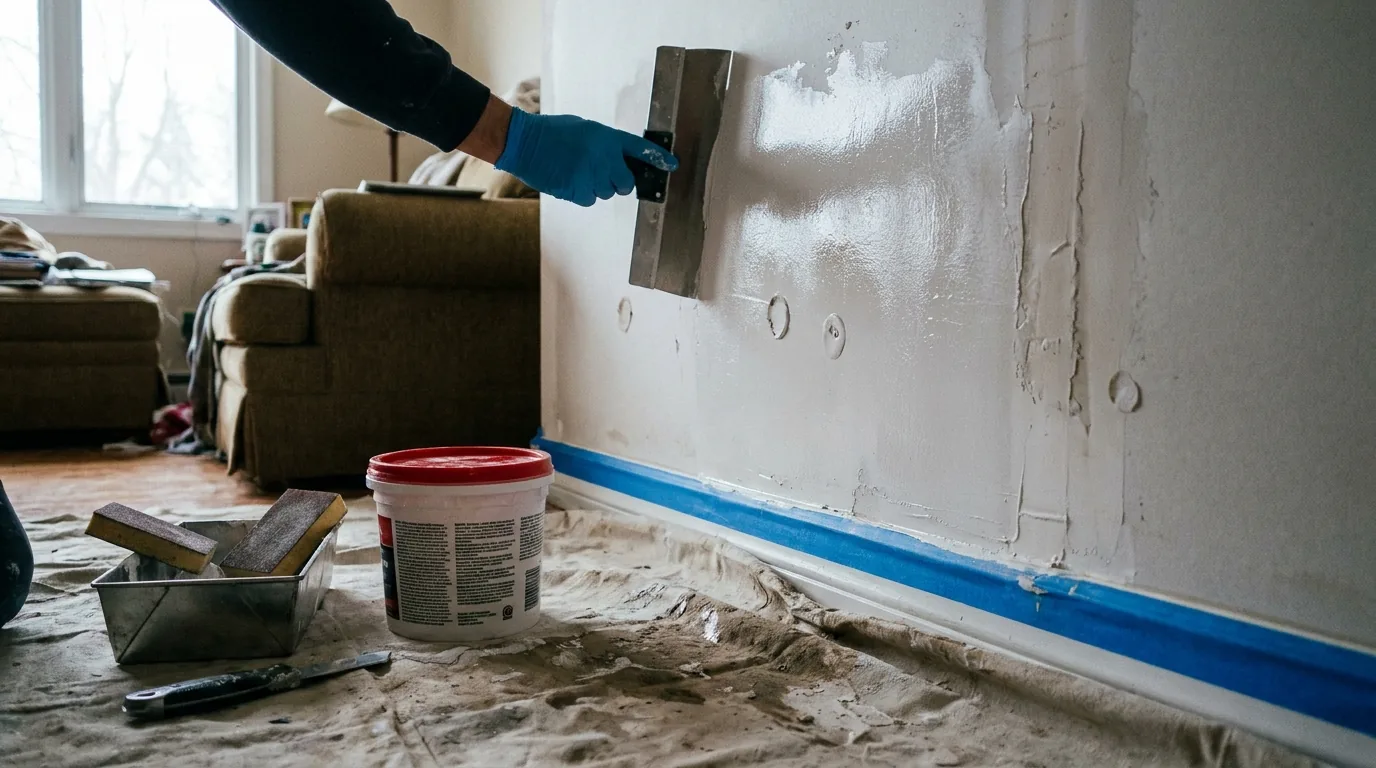
Almost every disappointing paint job is actually a disappointing repair job. The paint went on fine. The wall underneath was not ready, and six weeks later the crack came back, the patch flashed a different sheen, or the stain bled through.
This is what actually needs to happen before a brush touches a Long Island wall.
Nail Pops: The Most Common Defect on the Island
If you have a house built between roughly 1960 and 1995, you have nail pops — small round bumps or cracked circles along the studs, usually in rows.
They happen because the framing lumber dried and shrank after the drywall went on, pushing the nail head out through the compound. Long Island's seasonal humidity swing, from 70 percent in August to under 30 percent in January, drives decades of expansion and contraction that keeps producing them.
The wrong fix is filling over the bump. The nail is still proud and it will push through again by next winter.
The right fix: drive a drywall screw an inch or two above and below the pop to re-secure the board to the stud, then either reset or remove the offending nail, then three progressively wider coats of compound, sanded, and spot-primed.
Corner Bead Cracks
Vertical hairline cracks running down an outside corner, usually at door openings or hallway corners. The metal or vinyl corner bead has come loose from the framing, generally from impact — furniture, vacuum cleaners, twenty years of a hallway.
Filling the crack does nothing; the bead is still loose. It has to be re-fastened or, where it is damaged, cut out and replaced, then re-taped and floated out fifteen to eighteen inches so the repair does not read as a hump.
Plaster Cracks in Older Long Island Homes
The village housing stock in Patchogue, Bay Shore, Northport, Sayville, Babylon, Huntington and the older sections of most South Shore towns is real plaster over wood lath. It is a better wall than drywall and it fails differently.
Hairline map cracking is usually surface-level and can be skim-coated.
Straight cracks radiating from door and window corners are stress cracks from building movement. They come back if you simply fill them. They need to be cut out into a V, bridged with mesh or fiberglass tape, and floated wide.
Plaster that sounds hollow when tapped has separated from the lath. Filling the crack on the surface of a section that has lost its keys is pointless — it needs to be re-secured with plaster washers and screws, or that section removed and re-hung.
Anyone who proposes to fix a plaster wall with a tube of lightweight spackle is going to leave you exactly where you started.
Water Stains: Fix the Cause First
A brown or yellow ring on a ceiling is not a paint problem. It is a report.
Before anything gets covered, the source needs to be found — a roof leak, an ice dam backing water under the shingles, a failed flashing at a chimney or valley, a bathroom supply line, or condensation from an uninsulated duct running through an unconditioned space. On Long Island the January and February ceiling stains are very often ice dams rather than roof failures, and the two get fixed completely differently.
Once the source is repaired and the area is fully dry, the stain gets sealed with a stain-blocking primer — shellac-based or a quality oil or water-based stain blocker. Latex primer will not hold it back. Water stains bleed through standard primer and reappear within weeks, and homeowners assume the leak came back when it never left the drywall.
If the drywall is soft, crumbling or has visible mold growth, it comes out. It does not get painted.
Failed Seams and Ceiling Cracks
Long straight cracks along a drywall joint, usually on ceilings. The paper tape has debonded, often from a combination of movement and, in unheated-attic-adjacent ceilings, moisture cycling.
The tape has to come out — the whole failed run of it — and be replaced, then floated in three coats. Skimming over lifted tape guarantees a return visit.
Popcorn Ceiling Removal
Very common in Long Island houses built or renovated from the 1960s through the 1980s, and one of the most transformative interior changes available.
Important caution: popcorn texture applied before roughly 1980 may contain asbestos. It should be tested before disturbance. If it tests positive, removal is licensed abatement work, not a weekend project and not something a painting crew should be scraping.
Where it is clear, the process is: mask everything, wet the texture, scrape, repair the damage that scraping reveals, skim coat the entire ceiling to a flat plane, sand, prime, and paint flat white. It is more work than most people expect and it is worth every hour.
Why a General Contractor Rather Than a Painter
This is the practical case, not a sales pitch. When we open a wall and find the reason the corner keeps cracking is a settled beam, or the reason the ceiling keeps staining is a flashing detail at the chimney, we can fix that. A painting-only crew has to stop, tell you to call someone else, and come back — or worse, paint over it.
Alec's Construction handles the repair and the finish as one job across Suffolk and Nassau County. Winter is our best availability for interior repair work.
Call (631) 312-7441.
Frequently Asked Questions
What causes nail pops in drywall?
Framing lumber shrinking and moving after the drywall was hung, which pushes the nail head out through the compound. Long Island's swing from around 70 percent indoor humidity in August to under 30 percent in January drives the cycle. They are most common in houses built between 1960 and 1995.
Can you just paint over a water stain?
No. You have to find and fix the source first, let the area dry completely, then seal it with a stain-blocking primer. Latex primer will not hold back a water stain — it bleeds through within weeks and homeowners assume the leak returned when it never left the drywall.
Why does the same crack keep coming back after repair?
Because the underlying cause was not addressed. A corner crack usually means the corner bead is loose and needs re-fastening. A plaster crack from a door corner is a movement crack that needs to be cut out, bridged with tape and floated wide, not filled.
Is popcorn ceiling on Long Island dangerous?
Texture applied before roughly 1980 may contain asbestos and should be tested before it is disturbed. If it tests positive, removal is licensed abatement work. Where it tests clear, it is scraped, the ceiling is skim coated flat, primed and painted.
Do I need to repair walls before painting?
Yes, and it is where most of the visible quality of a finished job comes from. Nail pops, loose corner bead, failed seams, plaster cracks and old wallpaper adhesive all have to be dealt with, and every patch needs to be spot-primed or it will flash a different sheen in raking light.
How long does drywall repair take before painting?
A few nail pops and small patches can be done and primed in a day. A full skim coat of a room, or repair of a plaster wall that has lost its keys, needs multiple coats with drying time and typically runs two to four days before paint.
Related Guides
- Fall Home Maintenance Checklist for Long Island
- Winterizing Your Long Island Home
- Gutter Cleaning on Long Island
- Ice Dams on Long Island Roofs
- Deck Staining and Sealing in Fall
Get a Free Estimate from Alec's Construction
Licensed and insured, working across Nassau and Suffolk County since 2018. We come out, look at the actual job, and put a written number in your hand — no pressure, no obligation.
Book a Free WalkthroughOr call (631) 312-7441