A brown ring on the ceiling means water got through somewhere above it. The paint job is the last step, not the first. Fix the leak, let the drywall dry, prime the stain with a stain-blocking primer, then paint the whole ceiling so the patch disappears. Skip any one of those and the ring comes back within a few weeks, usually right after the next rain.
We see this every fall on the South Shore. A nor'easter pushes rain under a shingle or past a piece of flashing, a week later there is a yellow-brown blotch on the bedroom ceiling, and the homeowner asks whether a painter can just cover it. This guide is what we tell people on the phone: why the leak comes first, why ordinary ceiling paint fails over a stain, when the drywall has to be cut out, how a patched ceiling is matched so it does not show, and what to photograph if the storm damage might be an insurance claim. It is written for interior painting on Long Island, where the roof and the ceiling are often the same job.
Send us a photo of the stain. Free quote on the leak and the ceiling.
One visit covers the roof or plumbing fix, the drywall, and the paint. We call back the same business day.
Stop the Leak First, or the Stain Comes Back
Every ceiling stain has a source, and painting over it does nothing about the source. The first thing we do at a walkthrough is figure out where the water came from, because that decides who does the first part of the job.
- Top-floor ceiling, stain appears after heavy rain or wind. This is almost always the roof. Lifted shingles, cracked pipe-boot gaskets, loose step flashing at a chimney or sidewall, or a nail that backed out. Our guide to finding and fixing roof leaks walks through how we trace it from the attic side.
- Top-floor ceiling, stain appears in January or February with snow on the roof. That is an ice dam. Melt water backs up under the shingles at the eave and runs down the inside of the wall or ceiling. The roof itself may be fine. Read why Long Island roofs get ice dams before you book a roofer.
- Ceiling directly below a bathroom or kitchen. Usually a plumbing leak: a failed shower pan, a toilet wax ring, a supply line or a drain joint. The roof is innocent. This one needs the fixture checked before anything else.
- Stain spreads or drips while it is not raining. Plumbing or condensation on an uninsulated duct or pipe in the attic. Still an active leak, still fixed before paint.
If the stain is already dry, flat, and has not grown in a month or two, there is a decent chance the leak was a one-time event, such as a storm that drove rain sideways. We still check the attic above it. A stain that is not fully dry, that grows, or that feels soft is an active problem, and we treat it as water damage rather than a paint job.
Why Regular Paint Won't Cover a Water Stain
Homeowners try this all the time, and it fails for a specific reason. The brown in a water stain is not dirt sitting on top of the paint. It is tannin and mineral residue that the water carried out of the drywall paper, the joint compound and sometimes the framing above, and left behind as it dried. Those residues are water-soluble. Ordinary latex ceiling paint is water-based. When you roll it on, the water in the paint reactivates the residue and pulls it right up through the new coat. The ring is back before the paint is dry, just slightly lighter.
The fix is a stain-blocking primer, which is a different product from the primer in a paint-and-primer-in-one can. Shellac-based primers are the most reliable: they dry fast, they are not water-based, and nothing bleeds through them. Oil-based stain blockers also work and are a little easier to handle. Water-based stain-blocking primers exist and are fine on light staining, but on a dark, well-established ring we do not gamble with them. The sequence is simple: the ceiling is fully dry, the stain gets one or two coats of blocker and is allowed to cure, then the ceiling is painted.
One more point, because it gets skipped. Priming only the stain and then dabbing paint over that spot leaves a visible patch even if the stain itself is gone, for reasons we cover below. The blocker goes on the stain. The finish coat goes on the whole ceiling.
When the Drywall Has to Be Cut Out
A stain on firm, flat drywall is a cosmetic repair. The following are not, and we will say so at the walkthrough rather than paint over them.
- Sagging. Drywall that has bellied down between the joists has lost its strength. It will not flatten out as it dries. The wet section gets cut back to sound board at the framing, and a new piece goes in.
- Soft or crumbling. Press gently with a finger. If the surface gives, the gypsum core is saturated and breaking down. Same answer: cut it out.
- Peeling paint or bubbling paper. Sometimes the board underneath is sound and the surface can be scraped, skimmed and primed. Sometimes the paper face has delaminated across the whole area. We find out when we scrape.
- Any sign of mold. Dark spotting, a fuzzy texture, or a musty smell from the ceiling. The affected board comes out, the cavity above is checked and dried, and nothing is closed up until it is dry.
- Wet insulation above. If the attic insulation over the stain is soaked, it stays wet long after the ceiling looks dry, and it will keep the drywall damp. We pull and replace the wet section.
Plaster ceilings in older Patchogue and Bellport houses behave differently. Plaster can take a stain without failing, but if the keys that hold it to the lath have broken, the ceiling will be loose and may need to be re-secured or replaced in that area. Our guide to drywall and plaster repair before painting covers the difference in more detail.
Matching a Patched Ceiling So It Doesn't Flash
Flashing is the painter's word for a patch that is invisible head-on and obvious the moment light rakes across the ceiling from a window. It happens because the patched area has a different texture and a different sheen from the rest of the ceiling, and ceilings get more raking light than any wall in the house. Avoiding it is most of the skill in this job.
- Feather the compound wide. A repair a foot across gets skimmed two to three feet across, so the transition is too gradual to see.
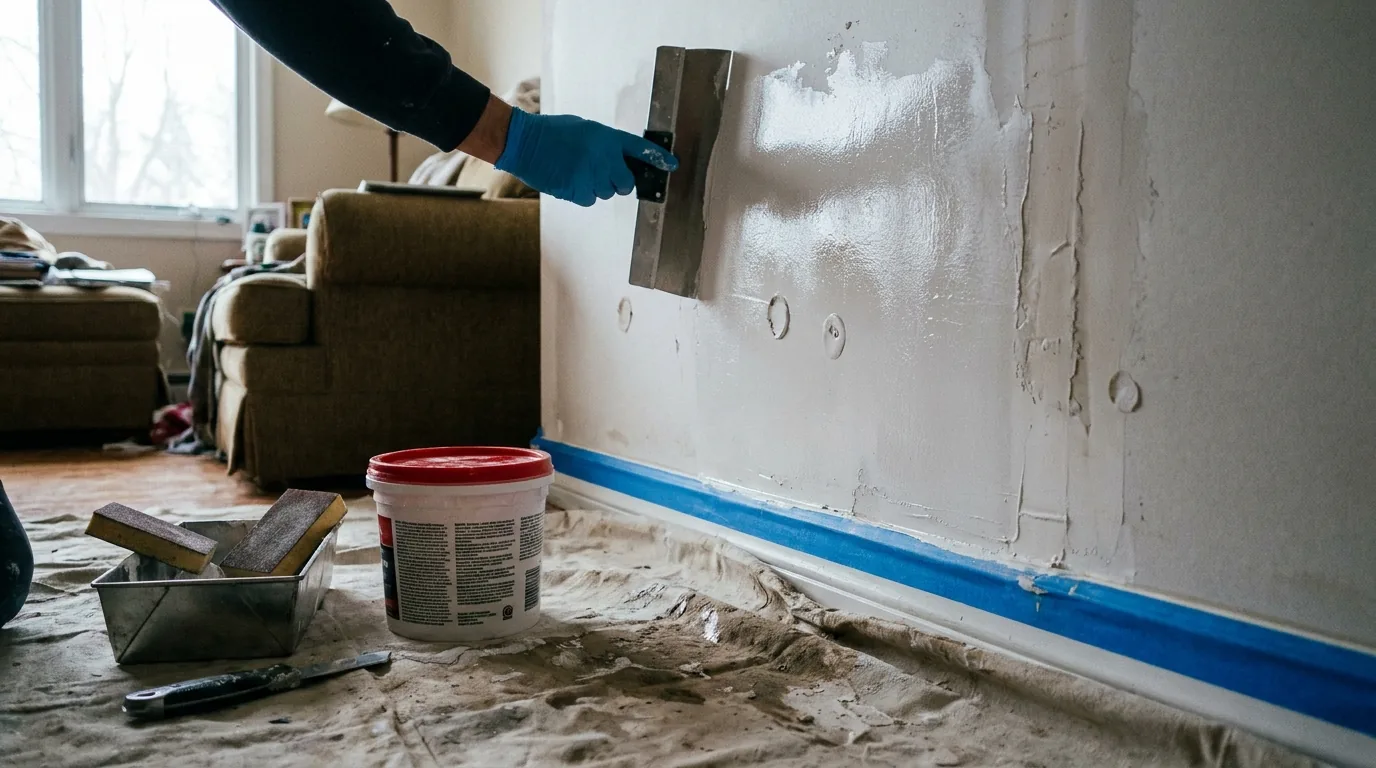
- Match the texture. Most Long Island ceilings from the 1950s through the 1980s have some texture: a light stipple from a roller, a knockdown, or a full popcorn finish. A smooth patch in a textured ceiling flashes no matter how well it is painted. We re-texture the patch to match before priming.
- Prime the whole repair, not just the stain. New compound and new drywall soak up paint differently from old painted surface. Primer evens that out.
- Paint corner to corner. This is the step people want to skip. Old ceiling paint has yellowed and dulled over the years, and no touch-up matches it. The ceiling gets painted wall to wall in flat ceiling white, and the patch is gone. A bedroom ceiling is a short job; it is not worth leaving a visible square to save it.
Is It an Insurance Claim? What to Photograph Before We Touch It
Sudden storm damage is often covered by a homeowner's policy. Long-term seepage from a roof that has been failing for years usually is not. We are not your adjuster and we do not tell people what their policy covers. What we can tell you is what we have seen adjusters ask for, so you have it before anything is repaired.
- The stain itself, from a few feet back so the room is recognizable, and close up with something for scale.
- The source, if you can see it safely from the ground or the attic hatch: lifted shingles, a missing piece of flashing, a branch on the roof. Do not climb onto a wet roof for a photo.
- Anything wet below it: flooring, furniture, belongings, the inside of a closet.
- The date. Note the storm date and when you first noticed the stain. Weather records for that date are what make a claim a storm claim.
- Any emergency work, such as a tarp on the roof. Keep the receipt and photograph the tarp in place.
Then call. Alec's does storm damage repair and insurance restoration as well as the interior finish work, so the roof repair, the ceiling and the paint can be written up as one scope for the adjuster and done by one crew. The estimate is itemized so the insurer sees exactly what each part is.
Where We Work
Alec's is based in East Patchogue and covers Suffolk County. The towns where we handle the most storm-related ceiling work are the ones along the South Shore east of us, where wind-driven rain and the bays do their worst: Mastic, Mastic Beach, Shirley and Bellport, plus our own East Patchogue and Patchogue. We take ceiling and interior work anywhere in the county.
Frequently Asked Questions
Can I just paint over a water stain on the ceiling?
Not with regular ceiling paint. The stain is water-soluble residue in the drywall, and water-based paint reactivates it and pulls it back through. It needs a shellac- or oil-based stain-blocking primer first, and only after the leak is fixed and the ceiling is fully dry. Then the whole ceiling gets a finish coat so the repair does not show.
How do I know if the leak is fixed before painting?
Wait through at least one good rain after the roof or plumbing repair and check that the stain has not grown or darkened. A moisture meter reading on the drywall should match the dry ceiling around it. If you are not sure, we check the attic above the stain at the walkthrough before any paint is scheduled.
How long does the ceiling need to dry before it can be painted?
It depends on how wet it got and whether the insulation above is wet. A light one-time stain may be dry in a few days with the heat running. Saturated drywall or wet insulation can take a week or more, and if the board is sagging or soft it is replaced rather than dried.
Will the patch be visible after painting?
Not if it is done right. The repair is feathered wide, re-textured to match the existing ceiling, primed, and then the entire ceiling is painted corner to corner. A touched-up spot in the middle of an old ceiling almost always shows under raking light, which is why we do not do it that way.
Is a ceiling water stain covered by homeowners insurance?
Sudden storm damage often is; long-term seepage usually is not. We do not interpret policies, but we do photograph and document the source and the damage, write an itemized estimate the adjuster can follow, and handle the roof repair and the interior work as one scope.
Do you fix the roof leak as well as the ceiling?
Yes. Alec's does roofing, storm damage repair and interior painting, so one crew can trace the leak, repair it, replace or patch the ceiling and paint it. That matters on a time-sensitive claim and it means nobody is pointing at another contractor.
Related Guides
- How to Find and Fix a Roof Leak on Long Island
- Water Damage Restoration on Long Island
- Drywall and Plaster Repair Before You Paint
- Ice Dams on Long Island Roofs: Cause, Cure and Prevention
- Interior Painting on Long Island
- Winter Interior Painting on Long Island
Work With Alec's Construction
This guide is written by the crew that does the work. See Alec's Painting service for interior work all winter, and Roofing for the leak that caused the stain in the first place. One crew start to finish, a free walkthrough, and a written estimate inside 48 hours. Working across Suffolk County since 2018.
Booking the cold months now: we also handle Basement Finishing and Bathroom Remodeling through the winter.
Get the Leak and the Ceiling Fixed in One Visit
Working across Suffolk County since 2018. We trace the water to its source, tell you what has to come out and what can stay, and put a written, itemized number in your hand. No pressure, no obligation.
Call (631) 312-7441 or use the quick form above.