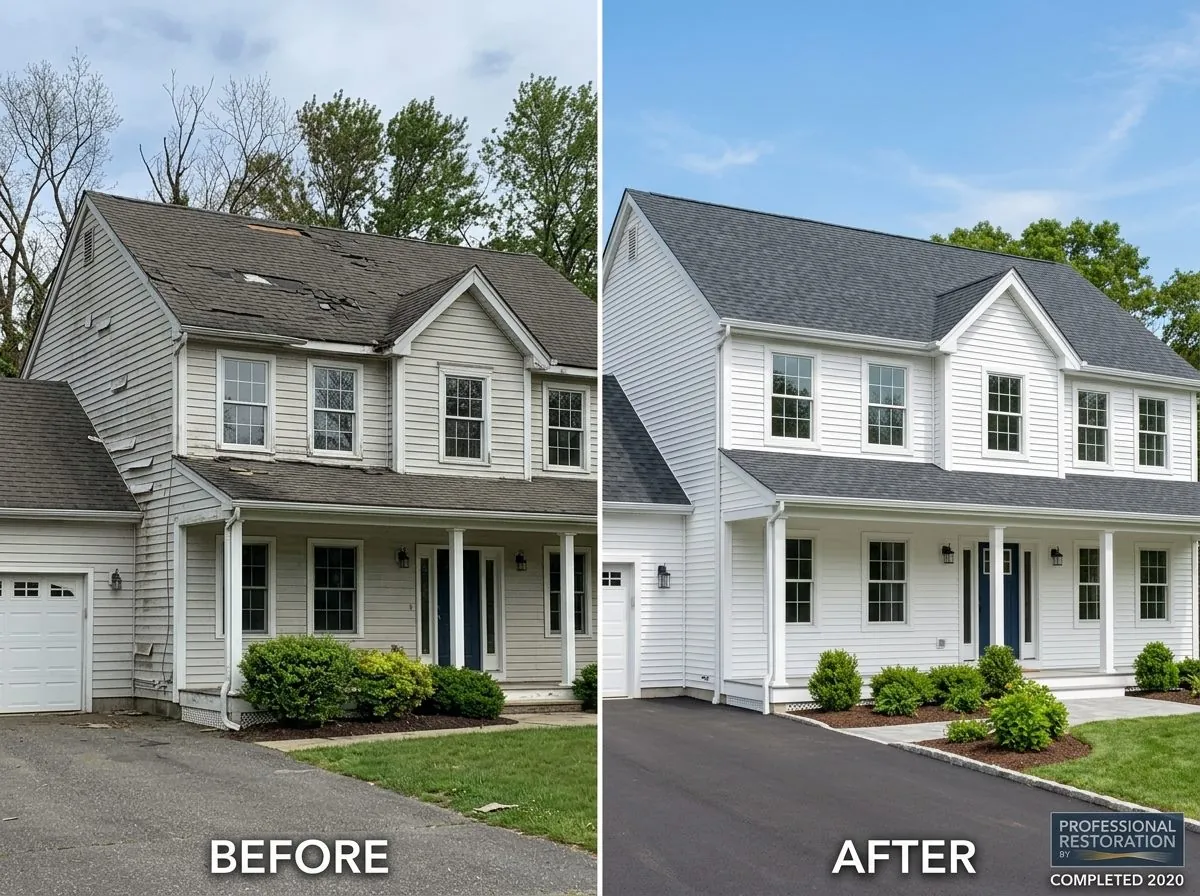
Bellport sits directly on the Great South Bay, and the barrier island south of it takes the first hit but does not absorb everything. When a nor'easter or a hurricane remnant tracks up the coast, Bellport gets sustained onshore wind with very little between it and open water.
What the wind does here
Sustained onshore wind attacks a roof differently than a summer thunderstorm does. It works at the same edge for hours. The failures we find on Bellport roofs after a storm are consistent: lifted shingles along the windward rake and eave, ridge cap gone, flashing pulled at the chimney and at every wall-to-roof junction, and gutters torn loose at the fascia.
A lot of that damage is not visible from the ground. A shingle that was lifted and reseated by the wind looks intact from the driveway and has a broken seal underneath. The next driving rain finds it.
The historic village complication
Properties inside the Village of Bellport, particularly in the historic core, carry a complication most storm claims do not: what goes back on the house may be subject to review. Cedar, slate and specific architectural profiles are not always replaceable with the standard architectural shingle a carrier prices by default.
This has to be raised early, in writing, in the claim. Carriers estimate on like-kind-and-quality, and if the village requires a material that costs three times the default, that argument is far easier to make before the adjustment is settled than after. We document the requirement as part of the initial submission.
Wind and flood are separate policies
This catches homeowners near the bay every single storm. Wind damage — roof, siding, trees — is homeowners coverage. Rising water is not. Storm surge and flooding are covered only under a separate NFIP or private flood policy.
After a coastal storm both can be present on one property, and how the loss is characterized determines who pays. Photograph everything before touching anything, and photograph water lines specifically. The distinction between wind-driven rain entering through a roof breach and rising water entering at grade is worth thousands and it is decided by evidence.
First 24 hours
- Photograph everything before any cleanup — wide shots and close shots, with water lines visible
- Call your carrier and open the claim, even before you know the extent
- Get emergency tarping on any breach; policies require you to prevent further damage
- Keep every receipt, including hotel and mitigation costs
- Do not sign a contractor agreement that assigns your claim benefits away
Frequently Asked Questions
My house is in the Bellport historic district. Will insurance pay for matching materials?
It has to be argued, and argued early. Carriers estimate on like-kind-and-quality and default to standard architectural shingle. If the village requires a specific material or profile, that requirement needs to be documented in writing as part of the initial claim submission — it is far harder to add after the adjustment is settled.
Storm surge flooded my property. Is that covered?
Not under homeowners insurance. Rising water and storm surge are covered only by a separate flood policy through NFIP or a private carrier. Wind damage to the roof and siding is homeowners. After a bay storm both often occur on one property, so photograph water lines carefully — how the loss is characterized decides who pays.
Should I file a claim before or after getting an inspection?
Get the inspection first. You want to know whether the damage exceeds your deductible before a claim goes on your record, because a filed claim that pays nothing still counts as a claim at renewal. We inspect and document at no charge and tell you honestly whether it is worth filing.
How long do I have to file after a storm?
New York policies generally require prompt notice, and most carriers expect it within days to weeks — but the specific requirement is in your policy. Practically, file early. Damage that sits gets attributed to wear and neglect rather than to the storm, and that is the most common reason a legitimate claim gets reduced.
Do you tarp before the adjuster comes?
Yes, and you should want us to. Policies obligate you to prevent further damage once you know about it. We photograph everything before tarping, so the adjuster sees the original condition and you have met your duty to mitigate. Save every receipt — emergency mitigation is typically reimbursable.
Related Reading
- Storm Damage Roofs on Long Island — what wind actually does to a roof
- Roof Insurance Claims — how the process really runs
- Emergency Roof Repair — what to do in the first 24 hours
- Documenting Roof Damage for a Claim — what the adjuster needs to see
- Driveway Paving in Bellport — village review and bayfront drainage
- Storm damage restoration in Center Moriches — east-end wind fetch and claims
Also Serving Bellport
- ADUs in Bellport — accessory apartments and grants
- Attic Insulation in Bellport — air sealing, baffles and R-49 depth
- Basement Finishing in Bellport — egress, ceiling height and moisture
- Bathroom Remodeling in Bellport — full gut renovations
- Chimney Repair in Bellport — repointing, crowns, caps and flashing
- Driveway Paving in Bellport — blacktop, resurfacing and repairs
- Emergency Roof Repair in Bellport — tarping, leaks and storm response
- Fallen Tree Removal & Roof Repair in Bellport — tree off the house, roof supported and repaired
- Flood & Water Damage Cleanup in Bellport — wet material out, drying metered
- Front Steps & Stoops in Bellport — rebuilds, treads and railings
- Garage Conversion in Bellport — turning the garage into living space
- Gutter Installation in Bellport — seamless gutters, fascia and drainage
- House Painters in Bellport — exteriors while the fall window holds
- Hurricane & Storm Damage Repair in Bellport — trees, flooding, cleanup and repairs
- Interior Painting in Bellport — the right work for the cold months
- Kitchen Remodeling in Bellport — cabinets, counters and layout
- Masonry & Pavers in Bellport — patios, walkways and retaining walls
- Roofing in Bellport — tear-offs, repairs and storm damage
- Siding in Bellport — James Hardie, vinyl and cedar
- Storm Debris Removal & Cleanup in Bellport — trees, building debris and hauling
- Storm Roof & Siding Repair in Bellport — wind damage, tarped and rebuilt
- Windows & Doors in Bellport — insert and full-frame replacement
Work With Alec's Construction
This guide is written by the crew that does the work. See Alec's Storm Damage & Insurance Restoration service — emergency tarping, documentation and the claim itself. Licensed and insured on Long Island, one crew start to finish, free walkthrough and a written estimate inside 48 hours.
Booking the cold months now: we also handle Roofing and Siding.
Filing something yourself? Our Long Island building department directory lists the address, phone and counter hours for all 23 permit offices in Nassau and Suffolk.
Ready to Get Started?
Storm damage moves fast and so do we. Free damage inspection, documentation for your carrier, and emergency tarping across Suffolk County.