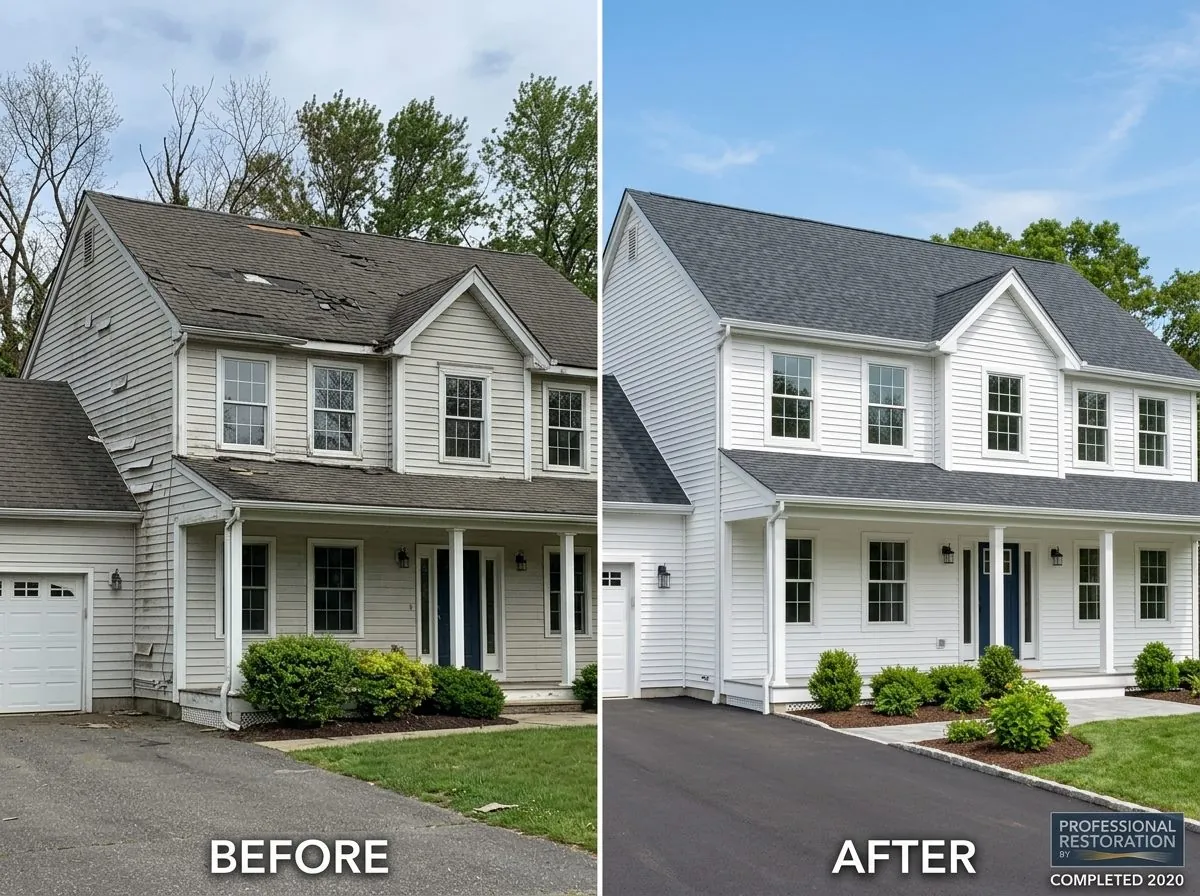
The Village of Lindenhurst is incorporated inside the Town of Babylon, and the blocks south toward the canals are dense, uniform, and built in one postwar push. That uniformity produces the specific claim fight this page is about.
The matching problem is the Lindenhurst claim
A nor'easter strips eleven panels of vinyl off the windward side of your house. The siding went on in 1998 and the profile was discontinued years ago. The carrier offers to pay for eleven panels of the closest current equivalent — which does not match your house in color, texture or panel height.
Whether the carrier owes you a whole elevation, or the whole house, is the matching question, and it is negotiated on evidence, not on principle:
- Manufacturer discontinuation documented in writing — not asserted, shown
- Photos of the mismatch a "closest equivalent" actually produces in daylight
- A siding-supplier search record proving the original profile is unobtainable
- The policy's own language on matching and on line-of-sight repairs
- New York's regulatory guidance on mismatched repairs, cited in the claim, because adjusters do not bring it up on their own
We assemble that package as part of the estimate on partial-loss siding claims. A letter that says "cannot be matched" with a supplier trail behind it settles very differently from a phone call that says the same thing.
Same fight, roof version
The identical argument runs on shingles. A wind-stripped slope in a discontinued color leaves a checkerboard repair on the most visible plane of the house. Photograph the existing shingle color in overcast light before any repair — matching arguments are won with photographs of what "repaired" would actually look like.
Village jurisdiction, tight blocks
Storm repairs in the village file with Lindenhurst, not the Town of Babylon. And the density that defines these blocks cuts both ways in a storm: houses shield each other from wind, but debris — a neighbor's trampoline, a fence panel, half a tree — travels between lots. Damage from a neighbor's airborne property still goes through your own policy first; your carrier chases theirs afterward if negligence is arguable.
The canal south end
Below Montauk Highway the canal blocks carry the standard south-shore double exposure — wind on the homeowners policy, rising water only on flood. Water lines photographed before cleanup are what keep the two files honest.
Frequently Asked Questions
The carrier will only pay for the siding panels that blew off. Is that right?
Not necessarily. If the profile is discontinued and the closest equivalent visibly mismatches, whether they owe an elevation or the whole house is the matching question — and it is negotiated on evidence: documented discontinuation, a supplier search trail, photos of what the mismatch actually looks like, and New York's guidance on mismatched repairs cited in the claim. We assemble that package with the estimate.
My neighbor's tree hit my house. Whose insurance pays?
Yours, first — file with your own carrier immediately rather than waiting out a liability debate between households. If the tree was visibly dead and the owner had been notified, your carrier can pursue theirs through subrogation afterward. The same applies to any airborne debris from a neighboring lot.
Should I file a claim before or after getting an inspection?
Inspection first. You want to know whether the damage exceeds your deductible before a claim goes on your record, because a filed claim that pays nothing still counts as a claim at renewal. We inspect and document at no charge and tell you honestly whether filing is worth it.
Related Reading
- Storm Damage Roofs on Long Island — what wind actually does to a roof
- Roof Insurance Claims — how the process really runs
- Documenting Roof Damage — what the adjuster needs to see
- Emergency Roof Repair — the first 24 hours
- Siding in Lindenhurst — the same blocks, the full replacement math
Also Serving Lindenhurst
- ADUs in Lindenhurst — accessory apartments and grants
- Attic Insulation in Lindenhurst — air sealing, baffles and R-49 depth
- Basement Finishing in Lindenhurst — egress, ceiling height and moisture
- Bathroom Remodeling in Lindenhurst — full gut renovations
- Chimney Repair in Lindenhurst — repointing, crowns, caps and flashing
- Emergency Roof Repair in Lindenhurst — tarping, leaks and storm response
- Fallen Tree Removal & Roof Repair in Lindenhurst — tree off the house, roof supported and repaired
- Flood & Water Damage Cleanup in Lindenhurst — wet material out, drying metered
- Garage Conversion in Lindenhurst — turning the garage into living space
- Gutter Installation in Lindenhurst — seamless gutters, fascia and drainage
- House Painters in Lindenhurst — exteriors while the fall window holds
- Hurricane & Storm Damage Repair in Lindenhurst — trees, flooding, cleanup and repairs
- Interior Painting in Lindenhurst — the right work for the cold months
- Kitchen Remodeling in Lindenhurst — cabinets, counters and layout
- Roofing in Lindenhurst — tear-offs, repairs and storm damage
- Siding in Lindenhurst — James Hardie, vinyl and cedar
- Storm Debris Removal & Cleanup in Lindenhurst — trees, building debris and hauling
- Storm Roof & Siding Repair in Lindenhurst — wind damage, tarped and rebuilt
- Windows & Doors in Lindenhurst — insert and full-frame replacement
Work With Alec's Construction
This guide is written by the crew that does the work. See Alec's Storm Damage & Insurance Restoration service — emergency tarping, documentation and the claim itself. Licensed and insured on Long Island, one crew start to finish, free walkthrough and a written estimate inside 48 hours.
Booking the cold months now: we also handle Roofing and Siding.
We keep a permit office directory for Nassau and Suffolk, checked against each jurisdiction's own site, because we file in these counters constantly.
Ready to Get Started?
Storm damage moves fast and so do we. Free inspection with full photo documentation for your carrier, and emergency tarping across Nassau and Suffolk County.