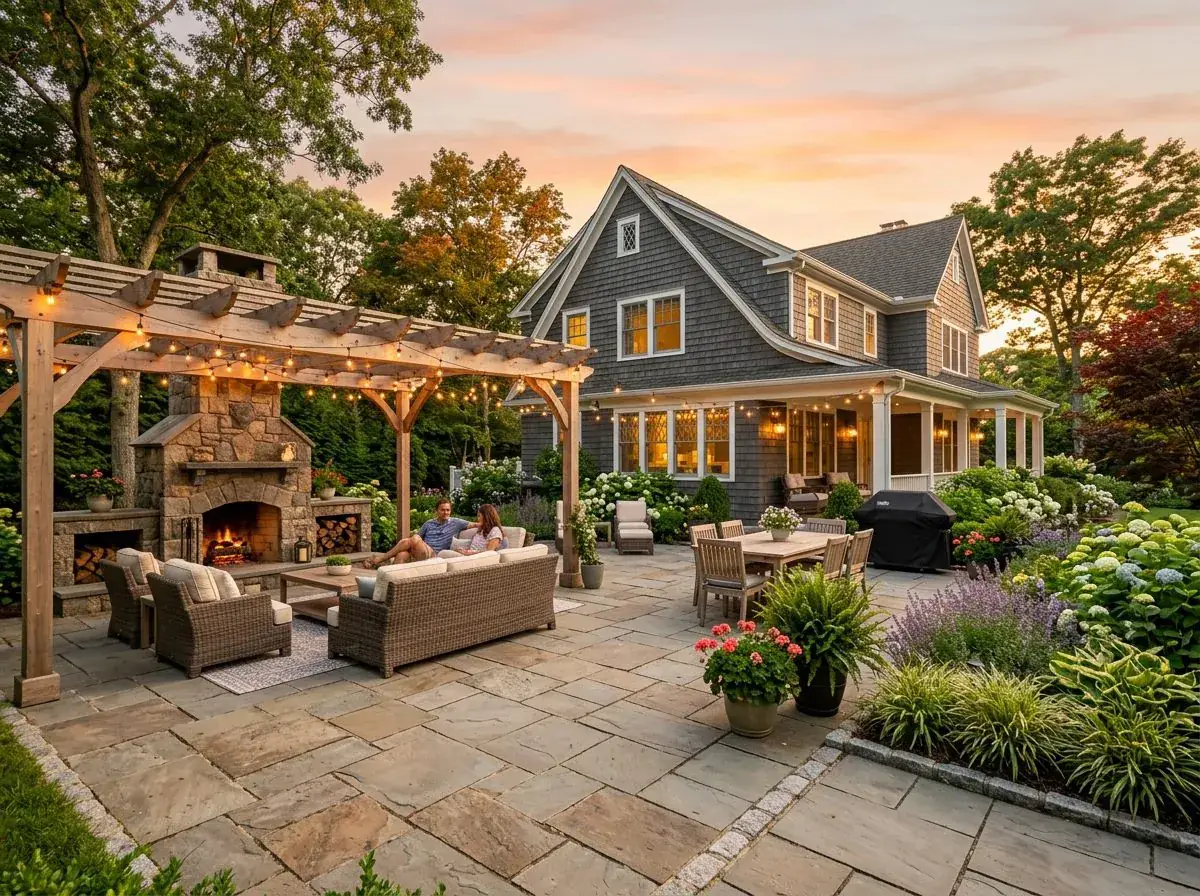
A pool deck has to do things no other hardscape does. It gets walked on barefoot by people who are wet, it sits in full sun all day, it takes chlorine or salt water splash constantly, and it has to stay comfortable enough to stand on in August. Material choice matters more here than anywhere else on the property.
Heat: The Test People Forget Until July
Dark surfaces in direct Long Island summer sun become genuinely unusable barefoot. This is the most common pool deck regret and it is entirely avoidable at the selection stage.
- Travertine: the coolest common option by a clear margin. Natural stone with high reflectivity and a porous structure that does not store heat.
- Light-colored concrete pavers: very good. Modern manufacturer lines include products specifically engineered for pool decks.
- Light bluestone or limestone: good, and a natural Long Island look.
- Dark charcoal or deep grey pavers: avoid on a full-sun deck no matter how good they look in the showroom.
Practical test: visit a supplier yard on a sunny afternoon and put your hand flat on the sample that has been sitting in the sun. That tells you more than any spec sheet.
Slip Resistance
You want texture, and you want it to survive. Tumbled, textured and lightly flamed finishes give reliable wet traction. Smooth, polished or high-gloss sealed surfaces are a hazard when wet.
Related and important: if you seal a pool deck, use a matte penetrating sealer, not a wet-look film-forming one. The wet-look finish is exactly the finish that gets slippery. Many pool deck installations are better left unsealed or treated only with a penetrating repellent.
Chlorine, Salt and Chemistry
Splash-out carries pool chemistry onto the deck constantly. Chlorine can lighten some materials over years. Salt systems — increasingly common on Long Island — are harder on masonry than chlorine is, because salt crystallization inside porous stone causes the same kind of expansion damage that ice does.
If you have or plan a salt system, favor dense, low-absorption materials and a good penetrating sealer, and rinse the deck periodically. Travertine is beautiful but porous, and around salt water it wants more attention.
Coping: The Edge That Matters Most
Coping is the capped edge where the deck meets the pool. It takes the most abuse of any element — constant wetting, hands gripping it, people sitting on it.
- Bullnose coping gives a rounded, comfortable edge and is the most common choice.
- Full-bullnose travertine is a Long Island favorite for the look and the comfort.
- Cantilevered coping overhangs the pool edge slightly and produces a clean modern line.
Coping should be set on a proper bond beam with the correct expansion joint between coping and deck field. That joint is what allows the deck and the pool structure to move independently. Skipping it cracks the coping.
Cost on Long Island
- Standard concrete pavers: roughly $28–50 per square foot installed
- Premium pool-rated paver lines: roughly $38–62 per square foot
- Travertine: roughly $40–70 per square foot installed
- Coping: roughly $60–140 per linear foot
- Removing an existing cracked concrete pool deck: roughly $4–9 per square foot
A typical 700 square foot pool deck with coping lands roughly in the $28,000 to $55,000 range on Long Island, depending heavily on material and whether there is demolition.
Drainage and Layout
A pool deck must drain away from the pool, generally at about one to two percent. Water running back into the pool carries dirt, grass clippings and lawn chemicals with it and works your filter harder. On tighter Long Island lots where the deck is close to a property line or the house, a channel drain at the low edge is often the right answer.
Leave enough deck. A four-foot walking width around the perimeter is a functional minimum. Where the loungers go, plan for eight to twelve feet of depth so a chair plus a walking lane fits without anyone edging past.
Why Pavers Beat Poured Concrete Here Specifically
Beyond the general freeze-thaw argument, pool decks have a particular advantage: equipment and plumbing run underneath. Skimmer lines, returns, autofill lines, and electrical for lights all pass under the deck. When something needs service, lifting thirty pavers and putting them back is a normal afternoon. Saw-cutting a concrete deck to reach a leaking line leaves a permanent visible scar and costs far more to restore.
Frequently Asked Questions
What is the coolest pool deck material for Long Island summers?
Travertine is the coolest common option, followed by light-colored concrete pavers engineered for pool use. Avoid dark charcoal and deep grey materials in full sun.
Should I seal a paver pool deck?
If you seal, use a matte penetrating sealer. Wet-look film-forming sealers become slippery when wet, which is the opposite of what a pool deck needs.
Are salt water pools harder on pavers than chlorine?
Generally yes. Salt crystallization inside porous stone causes expansion damage similar to freeze-thaw. Favor dense, low-absorption materials and rinse the deck periodically.
How much does a pool deck cost on Long Island?
A typical 700 square foot deck with coping runs roughly $28,000 to $55,000 installed, depending on material and whether an existing deck has to be removed.
Related Reading
- Paver Patio Cost — the broader cost picture
- Paver Patterns — layouts that suit a pool surround
- Sealing and Maintenance — choosing the right sealer
- Fixing Settled Pavers — repairs around pool equipment
- Outdoor Kitchens — extending the poolside space
- Patio Contractor on Long Island — pool patios and what makes them different
- Patio Covers & Pergolas — adding shade at the pool
Work With Alec's Construction
This guide is written by the crew that does the work. See Alec's Decks service — framing, composite and pressure-treated builds and repairs. Licensed and insured on Long Island, one crew start to finish, free walkthrough and a written estimate inside 48 hours.
Booking the cold months now: we also handle Roofing and Painting.
We keep a permit office directory for Nassau and Suffolk, checked against each jurisdiction's own site, because we file in these counters constantly.
Ready to Get Started?
Replacing a cracked pool deck? Call Alec's Construction at (631) 312-7441 for a free measure and material advice — Nassau and Suffolk County.