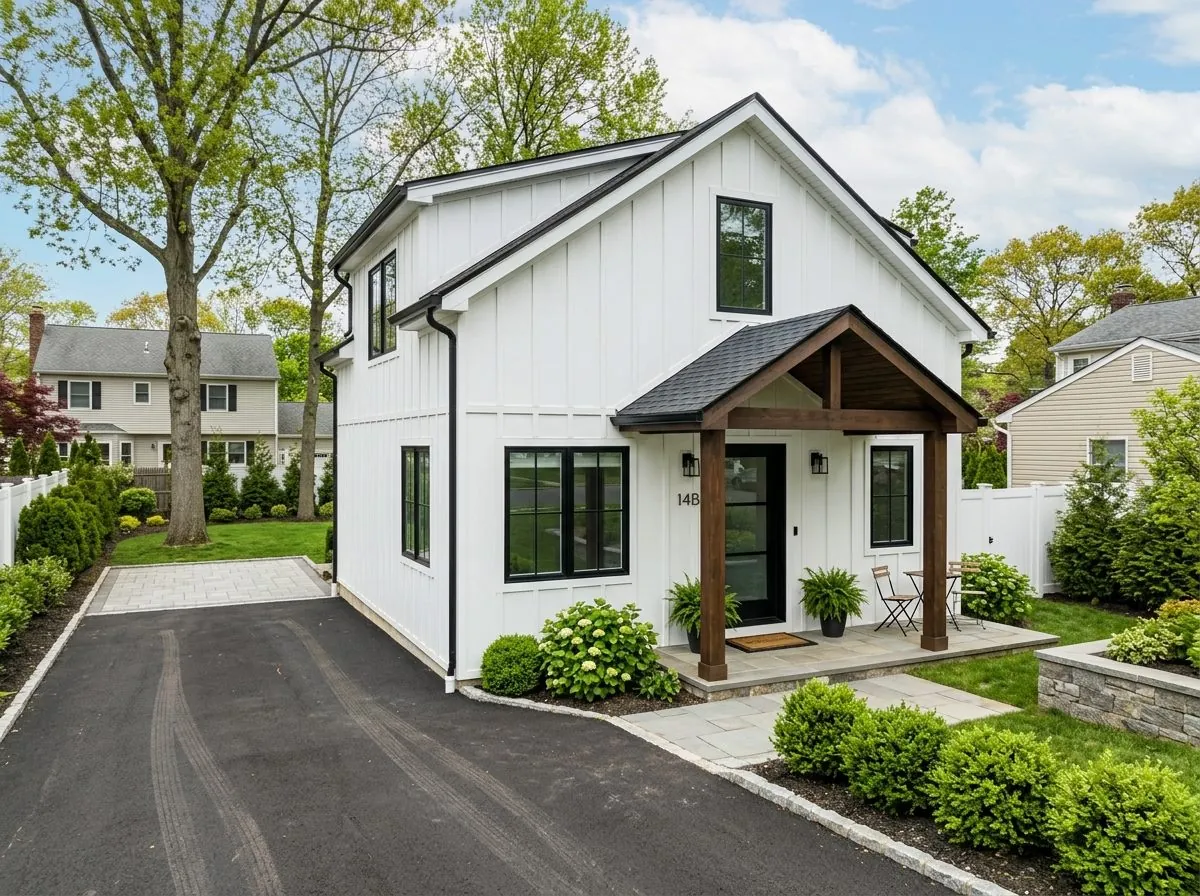
The Town of Hempstead is the largest town in New York State by population — larger than most American cities. It stretches across the south shore of Nassau County and contains an enormous range of housing stock, from Levittown capes to waterfront homes in the bay communities.
It is also under real housing pressure. Multigenerational households are common, adult children are staying home longer, and homeowners on fixed incomes are looking for legal rental income. Accessory dwelling units address all three. This guide explains how ADUs work in the Town of Hempstead, the jurisdictional trap that catches most Nassau homeowners, and what a project actually costs.
The Village Trap: Check Your Jurisdiction First
This matters more in Nassau County than anywhere else on Long Island, and it is where most homeowners waste their first month.
The Town of Hempstead contains a large number of incorporated villages — places like Rockville Centre, Garden City, Freeport, Lynbrook, Valley Stream, Hempstead Village, Malverne, Floral Park, Island Park and many more. Each incorporated village has its own zoning code, its own building department and its own rules on accessory dwellings. Town of Hempstead regulations do not govern properties inside them.
Only unincorporated areas — Levittown, Elmont, Franklin Square, Uniondale, Baldwin, Merrick, Bellmore, Wantagh, Seaford, East Meadow, Oceanside, Roosevelt, West Hempstead and others — fall under the Town itself.
So the first question is never 'what does the code say' — it is 'whose code applies to me'. Your tax bill will tell you. Getting this right first saves weeks.
Accessory Apartment Rules in the Town of Hempstead
The Town of Hempstead permits accessory apartments under defined conditions rather than by right. The conditions you should expect to satisfy, consistent with how Nassau towns generally handle these approvals, include owner-occupancy of one unit, one accessory unit per lot, limits on the unit's size relative to the principal dwelling, minimum lot area and setback compliance, dedicated off-street parking, separate egress and code-compliant ceiling heights, and a rental permit or registration renewed on a set cycle.
Illegal accessory apartments are common across Nassau and the town does enforce against them. Beyond the fines, an unpermitted unit creates real problems at refinancing and at sale, and it can void portions of your homeowner's insurance in the event of a claim. Legalizing an existing unit is frequently the highest-return ADU project a Hempstead homeowner can undertake.
Verify current requirements with the Town of Hempstead Building Department before committing to a design — we handle that as part of every project.
Basements: The Most Common Hempstead ADU
The single most common accessory apartment in the Town of Hempstead is a basement unit, and it is also the one most often built without permits.
The code issues are almost always the same: ceiling height, light and ventilation, and a legal second means of egress. A basement apartment generally needs a proper egress window or exterior door, not just the interior stairs. Fire separation between units, smoke and carbon monoxide detection, and adequate headroom are the other recurring obstacles.
Many south shore basements also sit in flood-prone areas, which brings FEMA flood zone requirements and elevation certificates into play. A basement that floods is not a legal dwelling unit and should not be one.
Plus One ADU Program
New York State's Plus One ADU Program provides funding to help eligible homeowners build or rehabilitate an accessory dwelling unit, with awards of up to $125,000 per project, administered through New York State Homes and Community Renewal via regional partners. It targets low-to-moderate income owner-occupants.
Program status — verified September 2026
Plus One ADU is a New York State program (an $85 million allocation through the Housing Trust Fund Corporation) but it is run town by town, and each town's intake opens and closes on its own schedule. As of September 2026 on Long Island: Huntington and Riverhead are accepting applications; Brookhaven, Islip and Southold are closed. Babylon, East Hampton, Shelter Island and Southampton run their programs through Community Development Long Island rather than the Long Island Housing Partnership.
The $125,000 is a cap, not an amount every applicant receives, and it is awarded as a grant. Huntington's published guidelines cap household income at 100% of Nassau/Suffolk area median income (2023 HUD limits: $109,400 for a one-person household, $156,300 for four) and require that you have owned and lived in the home for at least one year. Applications go on a first-come waitlist and are then re-ranked on priority points, including whether the unit will be affordable at or below 80% AMI and whether it can be permitted without a zoning variance. Municipal code always overrides the program guidelines. Verify your town's status before you budget around a grant: LIHP (631) 435-4710. We also check it for you on the walkthrough — see our Plus One ADU grant page for the eligibility checklist and what the build costs if your town's round is closed.
Because availability and income limits vary by administering partner and funding round, confirm current status before budgeting around it.
ADU Types That Work in Hempstead
Basement conversion. Lowest cost per square foot when the headroom and egress work. The dominant format across the town.
Attached addition. Shares foundation and utilities with the house; the cleanest path to a purpose-built unit on a typical Nassau lot.
Garage conversion. Common in Levittown-era housing stock, though parking requirements can complicate it since you are removing a parking space while adding a unit that needs one.
Detached cottage. Harder here than on the East End — Nassau lots are smaller and setback and lot coverage limits bite quickly.
What ADUs Cost in the Town of Hempstead
Typical ranges for permitted, code-compliant work:
Basement apartment: roughly $70,000 to $140,000, depending on how much egress, headroom and drainage work is required.
Garage conversion: roughly $100,000 to $180,000.
Attached addition: roughly $150,000 to $260,000.
Legalizing an existing unpermitted unit: highly variable, from around $25,000 for cosmetic and egress corrections to well over $100,000 where structural or systems work is needed. The only way to know is an inspection.
Where We Build
We are a Suffolk County licensed general contractor. This guide is published as a reference for Town of Hempstead homeowners researching accessory dwelling units; for construction work we serve Suffolk County, including Babylon, Islip, Brookhaven, Smithtown, Huntington and the East End.
Frequently Asked Questions
How do I know if I'm in a village or the Town?
Your property tax bill lists the taxing jurisdictions. If an incorporated village appears, that village's building department and zoning code govern your project, not the Town of Hempstead.
Can I legalize an existing basement apartment?
Often yes. It depends on ceiling height, egress, fire separation and whether the space can meet current code. An inspection is the only way to get a real answer, and it is worth doing before a refinance or sale.
Do I need owner-occupancy?
Accessory apartment approvals on Long Island generally require the owner to occupy one of the two units. Confirm the current requirement with the town.
Will an ADU raise my property taxes?
Adding legal living space typically affects assessed value. The rental income usually outweighs it, but factor both into your projection.
Related ADU Guides
- Legalizing a basement apartment
- Basement apartment conversions
- Nassau County ADU overview
- Plus One ADU grant program
- What ADUs cost on Long Island
Work With Alec's Construction
This guide is written by the crew that does the work. See Alec's ADUs service — accessory apartments, garage conversions and grant paperwork. Licensed and insured on Long Island, one crew start to finish, free walkthrough and a written estimate inside 48 hours.
Booking the cold months now: we also handle Additions & New Construction and Bathroom Remodeling.
We keep a permit office directory for Nassau and Suffolk, checked against each jurisdiction's own site, because we file in these counters constantly.
Planning an ADU Project?
Contact Alec's Construction for a free consultation. Alec's Construction is licensed in Suffolk County. If your project is in Suffolk, we will confirm which authority governs your property, review lot size, coverage, parking, egress and sewer or septic capacity, and give you a detailed estimate.
Get a Free Consultation