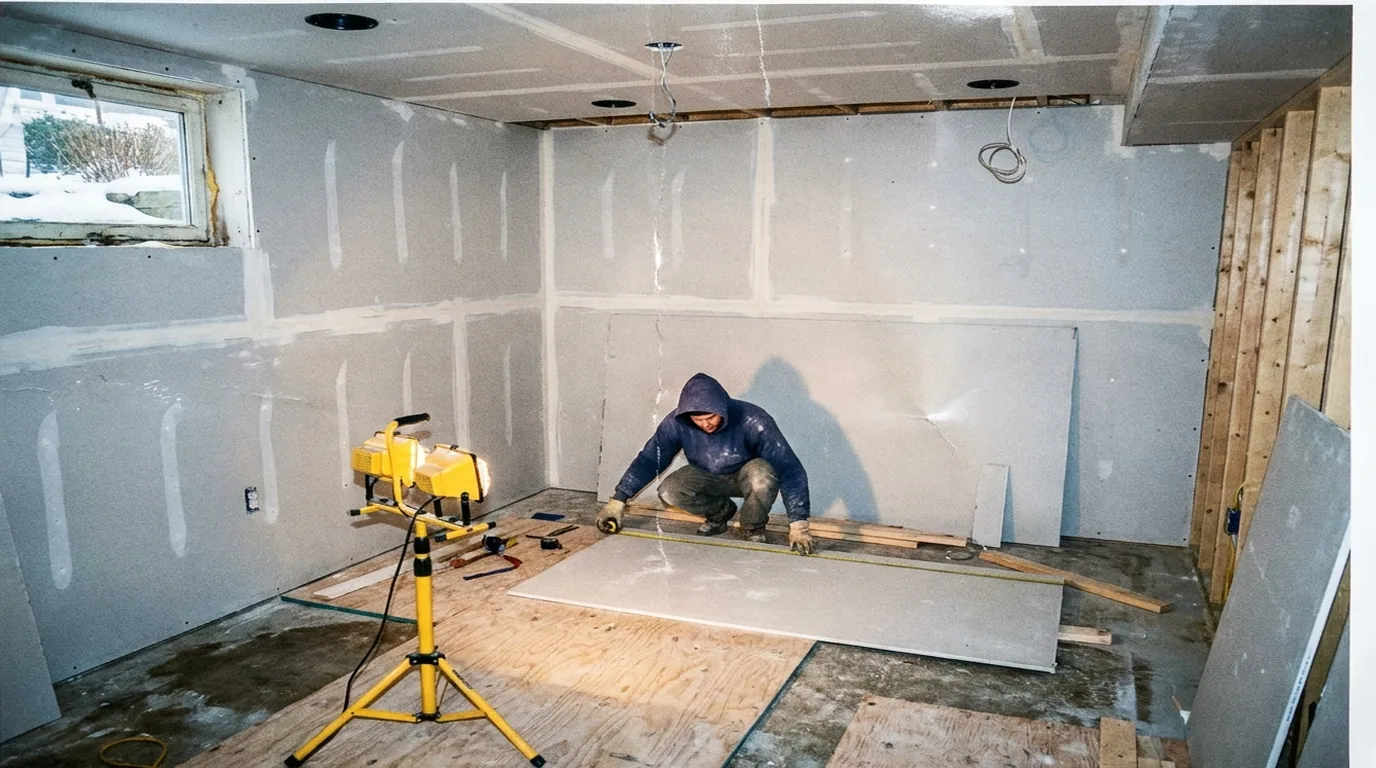
A finished basement is the cheapest square footage you will ever add to a Babylon house. There is no foundation to pour, no roof to frame, no siding to match — the box already exists. That is why the numbers work, and it is why this is the job to book in the cold months, when the crew is inside anyway and the weather has no vote.
But three things decide whether a Babylon basement can legally and sensibly be finished, and all three get answered before anyone talks about flooring. Height, water, and exit.
What Is Under a Babylon House
Village houses on brick and block, post-war capes on poured walls, and post-Sandy elevated houses where the old basement was abandoned or filled.
Low, flat and close to the water, with a high table and canal blocks where a basement is either shallow or absent.
Height: The 7-Foot Rule
This is the one that ends projects, and it is worth measuring on your own before you call anybody.
New York's Residential Code requires seven feet of clear ceiling height in habitable space — floor to the bottom of the finished ceiling, not to the underside of the joists. Beams and ducts are allowed to project below that to a point, but the general field has to make seven feet.
Measure from the slab to the bottom of the floor joists. Then subtract what the finish costs you:
- A drop ceiling eats three to four inches, more under a duct run
- Drywall glued directly to the joists costs you about half an inch
- Any subfloor system over the slab takes another three quarters to an inch and a half
So a Babylon basement measuring 7'4" to the joists is comfortable. One measuring 7'0" to the joists is a drywall-tight-to-the-joists job with the mechanicals boxed individually, and it will not tolerate a drop ceiling. Under about 6'10" the honest answer is that it cannot be a legal habitable room without lowering the slab — an underpinning job that costs more than the finish itself and is rarely worth it on a house at this price point.
We measure this first. If it does not make height, we say so on the walkthrough rather than after a deposit.
Water Table Comes First in Babylon
Babylon sits low and close to the water, and that is the fact that decides whether this project is a good idea at all.
A seasonally high water table means the floor slab can be sitting near or below the water for part of the year. Come March you get seepage at the cold joint where the slab meets the wall, or damp coming up through the slab itself, in a basement that was bone dry all summer. Finishing over that is how you get mould behind new drywall in eighteen months.
The honest sequence is: watch it through a wet spring, then decide. A perimeter drain to a sump with a battery backup, and a sealed sump lid, handles a lot of it. What does not work is a coat of waterproof paint on the inside of a wall with a head of water behind it.
And check the flood map before anything else. If the house is in a mapped special flood hazard area, finishing the lowest floor can run into FEMA's substantial-improvement rule and can affect what a flood policy will pay. That question gets answered before we price finishes, not after.
Exit: Egress Is Not Optional
A basement with habitable space needs an emergency escape and rescue opening, and every sleeping room below grade needs one of its own. This is code, and it is also the difference between a room that appraises and a room that does not.
The requirement is a net clear opening of 5.7 square feet, at least 24 inches high and 20 inches wide, with the sill no more than 44 inches above the floor. If it opens into a window well, the well needs about 9 square feet of area, a minimum 36-inch dimension, and a permanently attached ladder if it is deeper than 44 inches.
On a Babylon house with a full below-grade foundation that means cutting the foundation wall, setting a header, installing the window and building the well with proper drainage at the bottom — because a window well without a drain is a bucket that fills against your new window. It is real work and it is a real line item, and it is not the place to save money.
A Bathroom Down There Is Realistic in Babylon
Babylon is on sewers, and that removes the biggest obstacle to a basement bathroom in Suffolk County.
You still need an ejector pump, because the fixtures sit below the sewer line and gravity does not run uphill. That is a sealed basin set into the slab with a pump and a vented lid — a normal part of the job, not an exotic one.
What you do not need is a Health Department review of your sanitary system's capacity. In unsewered parts of the Island, adding a basement bath means Suffolk County Health Services looking at whether your cesspool can carry another fixture and, if the space will read as a bedroom, another bedroom's worth of flow. In Babylon that conversation does not happen.
Permits and Who Issues Them in Babylon
Village of Babylon for village addresses, Town of Babylon outside. The town has an accessory apartment law; the village adds its own layer.
A basement finish is a permitted job. Framing, electrical, insulation and any plumbing all get inspected, and the certificate at the end is what makes the space count. Unpermitted finished basements are the single most common thing that blows up a closing on Long Island — the buyer's attorney asks for the CO, there is not one, and the seller is suddenly negotiating against their own improvement.
If the intention is a rental apartment rather than a rec room, that is a different and larger permit, with its own owner-occupancy conditions, fire separation, and a second means of egress. It is worth doing properly. See our ADU and accessory apartment guide for Babylon if that is the direction — and note that New York's Plus One program has offered forgivable grants of up to $125,000 toward exactly this kind of conversion.
How We Build It
The order matters more than the products.
- Water and air first. Any drainage or sump work, then the rim joist sealed and insulated with closed-cell foam. The rim joist is the biggest single air leak in most Long Island houses and it is only reachable while the basement is open.
- Foundation walls insulated correctly. Long Island is Climate Zone 4A, and code wants continuous rigid or closed-cell foam against the concrete. Never fibreglass batts straight against a foundation wall — it holds the moisture the concrete gives off and it will grow mould behind the drywall. That is the most common defect we tear out of previously finished basements.
- Framing held off the wall, treated bottom plate on the slab, no wood in contact with concrete.
- Mechanicals planned, not squeezed. Ductwork rerouted where it kills headroom, panel capacity checked before we start adding circuits, and dedicated circuits where they belong.
- Egress cut and the well built and drained.
- Then finishes — and only then.
- Inspections at each stage, and the paperwork closed out at the end.
Why the Cold Months Are the Right Time
This is entirely interior work. Rain does not stop it, cold does not stop it, and nothing about it depends on a weather window.
It is also when a general contractor's schedule opens up. Roofs, siding, decks and driveways compress into the warm half of the year, which means December through March is when a good crew has room and when the same crew costs you less waiting. A basement started in January is finished, inspected and adding usable square footage before anyone in Babylon thinks about the spring.
What You Get Out of It
Square footage in a Babylon house is expensive. A finished basement is the one way to add real living space without touching the envelope — a family room, a home office that is actually quiet, a gym, a guest suite, or a legal accessory apartment that pays for itself.
Done with permits, it counts. Done without them, it is a liability that surfaces at the closing table.
Frequently Asked Questions
How much does it cost to finish a basement in Babylon?
It depends almost entirely on three things: whether the space makes the seven-foot code height without work, whether the basement is dry or needs drainage first, and whether you are adding a bathroom. A straightforward open rec room in a dry Babylon basement with good headroom is at the low end. Add egress cutting, drainage, a full bath and a kitchenette and you are in a different bracket. We measure the height, look at the walls after a rain, and put a written number in your hand within 48 hours — no charge for the walkthrough.
What ceiling height do I need to finish a basement in Babylon?
New York's Residential Code requires seven feet of clear height in habitable space, measured to the finished ceiling — not to the joists. Because a drop ceiling costs three to four inches and drywall about half an inch, a basement measuring 7'4" to the joists is comfortable and one at 7'0" is tight but workable with drywall tight to the joists. Under roughly 6'10" it cannot be a legal habitable room without lowering the slab, which is almost never worth it.
Do I need a permit to finish my basement in Babylon?
Yes. Village of Babylon for village addresses, Town of Babylon outside. The town has an accessory apartment law; the village adds its own layer. Framing, electrical, insulation and plumbing are all inspected, and the sign-off at the end is what makes the space legal square footage. Unpermitted finished basements are the most common thing that derails a Long Island house sale — the buyer's attorney asks for the certificate and there is not one.
Does a finished basement in Babylon need an egress window?
Any basement with habitable space needs an emergency escape and rescue opening, and every below-grade sleeping room needs its own. The opening has to give 5.7 square feet net clear, at least 24 inches high and 20 inches wide, with the sill no more than 44 inches off the floor. A window well needs roughly 9 square feet, a 36-inch minimum dimension, drainage at the bottom, and a ladder if it is deeper than 44 inches.
Can I put a bathroom in a Babylon basement?
Yes. The fixtures sit below the sewer line so it needs a sewage ejector pump — a sealed basin in the slab with a pump and a vent. Because Babylon is on sewers, there is no Health Department capacity review to clear, which makes it a normal plumbing scope.
Is winter a bad time to finish a basement in Babylon?
It is the best time. The work is entirely interior, so weather has no say in it, and December through March is when a general contractor's schedule actually has room — roofing, siding, decks and paving all compress into the warm months. Starting in January means the space is finished, inspected and usable before spring.
Can I turn my Babylon basement into a legal rental apartment?
That is a different and larger permit than a rec room — it carries owner-occupancy conditions, fire separation between units, and a second means of egress. Village of Babylon for village addresses, Town of Babylon outside. The town has an accessory apartment law; the village adds its own layer. It is worth doing properly rather than working around, and New York's Plus One Accessory Dwelling Unit program has offered forgivable grants of up to $125,000 toward this kind of conversion.
Related Guides
- Basement Finishing in Lindenhurst, NY
- Basement Finishing in Commack, NY
- What Finishing a Basement Costs on Long Island
- Basement Ceiling Height and the 7-Foot Rule
- Egress Windows for Long Island Basements
Work With Alec's Construction
This guide is written by the crew that does the work. See Alec's Basement Finishing service — height, water and egress answered before a dollar is spent. Licensed and insured on Long Island, one crew start to finish, free walkthrough and a written estimate inside 48 hours.
Booking the cold months now: we also handle ADUs and Bathroom Remodeling.
Also Serving Babylon
- ADUs in Babylon — accessory apartments and grants
- Chimney Repair in Babylon — repointing, crowns, caps and flashing
- Emergency Roof Repair in Babylon — tarping, leaks and storm response
- Front Steps & Stoops in Babylon — rebuilds, treads and railings
- Gutter Installation in Babylon — seamless gutters, fascia and drainage
- House Painters in Babylon — exteriors while the fall window holds
- Storm Damage & Insurance Restoration in Babylon — emergency tarping and the claim
- Interior Painting in Babylon — the right work for the cold months
- Masonry & Pavers in Babylon — patios, walkways and retaining walls
- Roofing in Babylon — tear-offs, repairs and storm damage
- Siding in Babylon — James Hardie, vinyl and cedar
Get a Free Estimate from Alec's Construction
Licensed and insured, working across Nassau and Suffolk County since 2018. We come out, look at the actual job, and put a written number in your hand — no pressure, no obligation.
Book a Free WalkthroughOr call (631) 312-7441