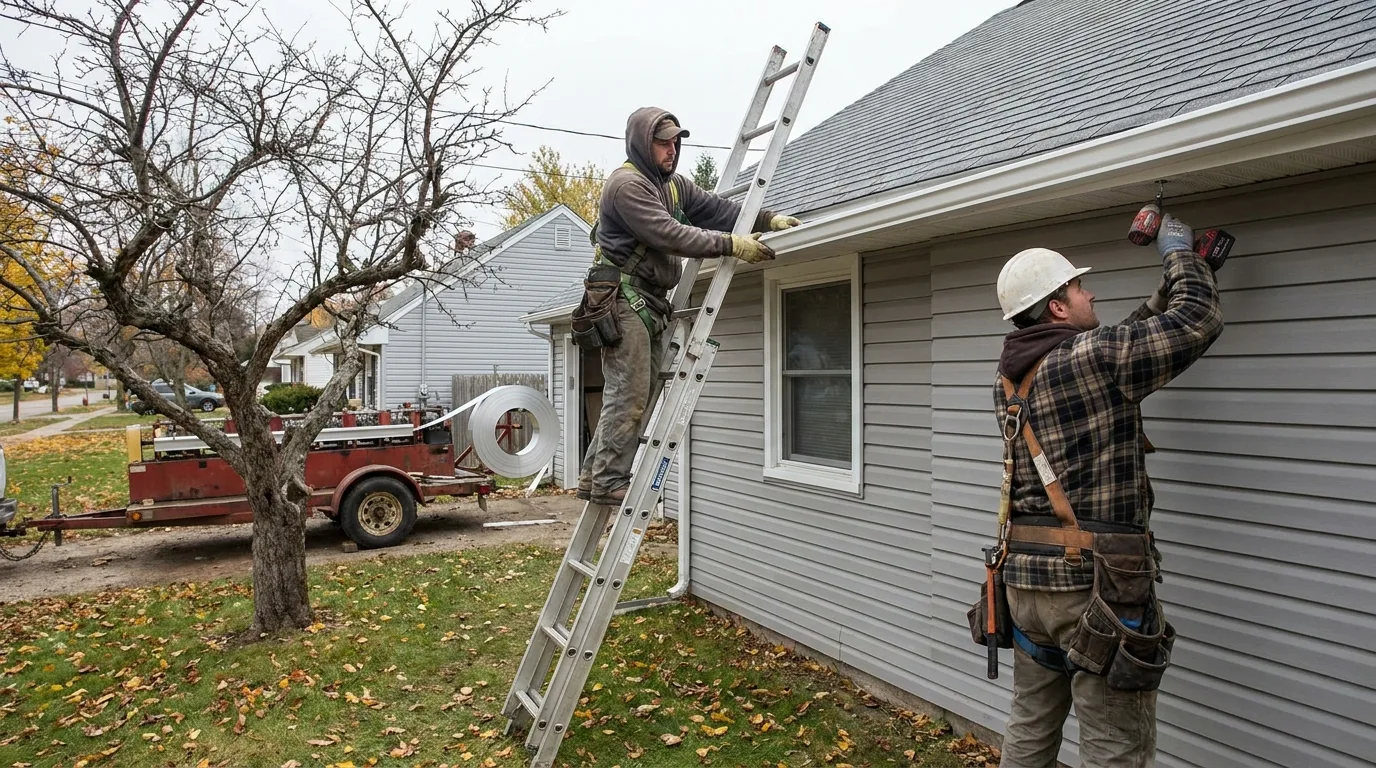
A gutter is the cheapest part of a roof and the one that decides whether the expensive parts last. Every dollar of rot repair we do on fascia, soffit, sill and rim joist on Long Island traces back to water that was supposed to leave the roof in a controlled way and did not.
Most homeowners here call about gutters for one of three reasons: they are overflowing, they are pulling off the house, or the roof is being replaced and it makes no sense to hang thirty-year-old aluminum back on a new roof. All three end up at the same set of decisions.
Seamless Means One Continuous Run
Sectional gutter comes in ten-foot lengths from a home center and gets joined with sealed connectors. Every one of those joints is a future leak. Sealant is a consumable — it hardens, shrinks and lets go, and on Long Island it does that faster because it goes through roughly sixty freeze-thaw cycles a winter.
Seamless gutter is roll-formed on site from a coil of flat aluminum. The machine sits on a trailer in your driveway and extrudes the profile in one unbroken piece the full length of the run. The only joints in the entire system are at inside and outside corners and at the downspout outlets, and those get riveted and sealed properly rather than snapped together.
On a 1,800 to 2,400 square foot Long Island house you are typically looking at 150 to 220 linear feet of gutter. Sectional would put twenty or more joints in that. Seamless puts four to eight.
Sizing Is Where Most Long Island Installs Go Wrong
Standard residential gutter is 5-inch K-style with 2x3-inch downspouts. That is what came on most Long Island houses and it is adequate for a modest roof with a modest pitch.
It is not adequate for:
- Large two-story colonials in Smithtown, Commack, Syosset, Huntington and Garden City, where a single roof plane can shed more water than a 5-inch run can carry
- Steep roofs. Pitch accelerates the water. A 10/12 roof delivers water to the gutter with real velocity and a shallow 5-inch profile lets it shoot straight over the front lip
- Expanded capes and additions — Ronkonkoma and Massapequa are full of houses where dormers and additions doubled the roof area feeding the same original downspout
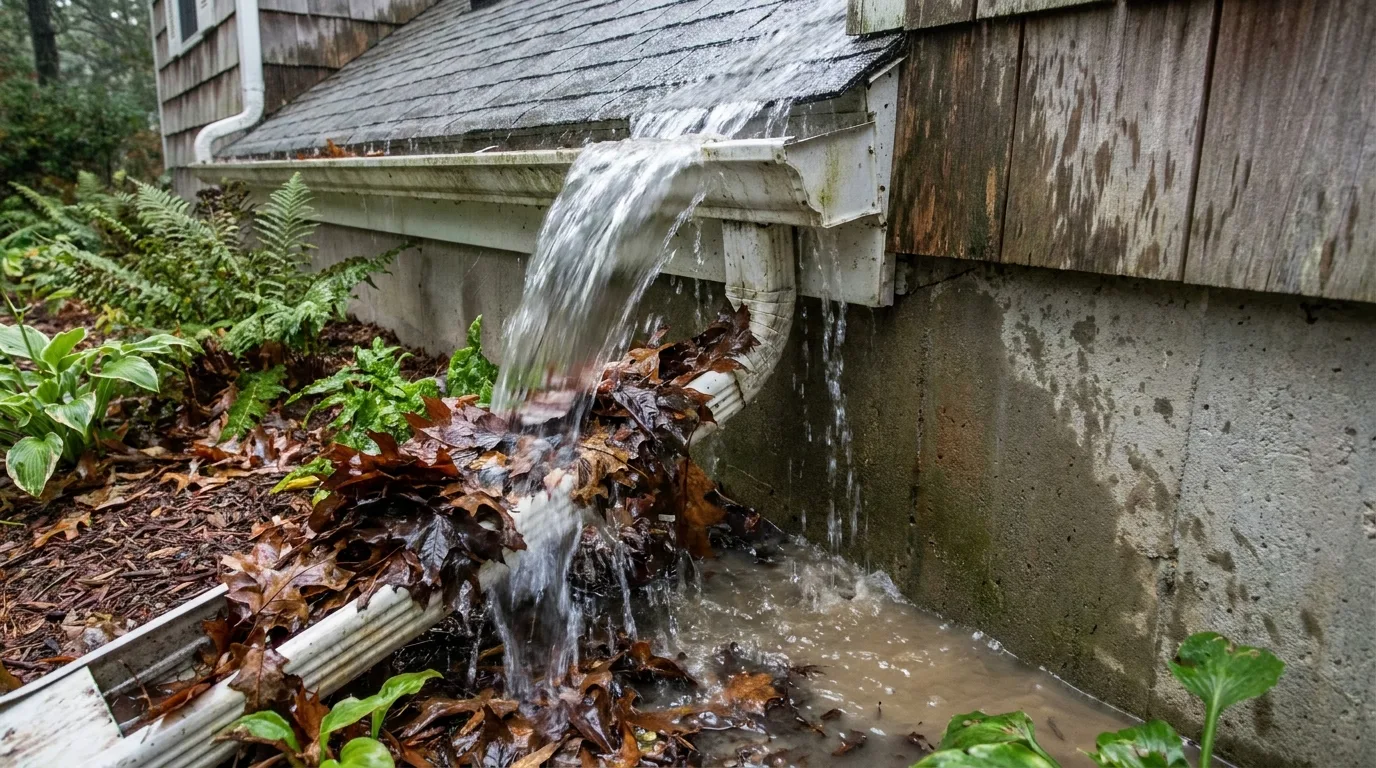
- Long runs with one outlet. The recurring find on Long Island is 45 feet of back gutter running to a single 2x3 downspout that overflows in every real storm
The fix is 6-inch K-style with 3x4-inch downspouts. A 6-inch gutter carries roughly 40 percent more water than a 5-inch, and a 3x4 downspout carries a bit over twice what a 2x3 does — and it is far less likely to clog, because the shingle grit and needles that jam a 2x3 pass straight through.
The rule of thumb we work to: one downspout for every 30 to 35 feet of run, more where the roof is steep or the drainage area is large. If a quote does not tell you how many downspouts it includes, it is not a quote.
Aluminum, Copper, and What to Ignore
.032 aluminum is the correct default for Long Island. Not .027 — the thinner coil is what discount installers use and it dents when a ladder leans on it and oil-cans between hangers on long runs. Ask which gauge is in the quote. If the answer is vague, that tells you the answer.
Copper is real and beautiful and appropriate on the historic housing in Garden City, Northport, Port Jefferson, Bellport and the village cores. It costs roughly three to four times aluminum and it is a specialist install — half-round profiles and built-in box gutters are not a job for a standard seamless crew. If your house has half-round or built-in gutters, replacing them with 5-inch K-style aluminum will visibly cheapen it.
Vinyl gutter should not go on a Long Island house. It becomes brittle in cold, sags between hangers under snow load and cracks. It exists to be cheap.
Galvanized steel rusts, and near salt water it rusts fast.
Hangers, Not Spikes
The old system was a spike driven through the gutter, through a ferrule, into the fascia. Wood expands and contracts, the spike works loose, and the gutter starts to droop and then pull away. If you have ever pushed a gutter back up against the house and driven the nail in again, that was a spike system telling you it was done.
Hidden hangers are a bracket that clips inside the gutter and screws into the fascia — no fastener through the face of the gutter, far better holding power, and nothing visible from the ground. Spacing should be 24 inches, and 16 to 18 inches where snow and ice load is a concern, which on Long Island means the north-facing runs and anywhere ice dams have formed before.
Near the water — Babylon, Lindenhurst, Massapequa, Bay Shore, Northport, the canals and harbours — fastener choice matters more. Salt air eats plain steel screws. Stainless fasteners cost a rounding error more and they are what should be in the quote.
Pitch: A Quarter Inch Per Ten Feet
Gutters are not level. They are pitched toward the outlet at roughly a quarter inch of fall per ten feet — enough that water moves, little enough that the run still looks level from the street.
Too little pitch and water stands in the gutter, which breeds mosquitoes, holds leaf debris in place, adds dead weight, and freezes into a solid block in January. Too much and it looks wrong on the fascia line. On a long run with the outlet in the middle, the gutter is pitched from both ends toward it.
Re-pitching an existing gutter that is standing water is often a repair rather than a replacement, and it is worth having someone actually look before you buy 200 feet of new aluminum.
What Is Behind the Gutter Matters More Than the Gutter
We are a licensed general contractor, not a gutter company, and this is the part where that changes the outcome. When the old gutter comes down we see the fascia. On Long Island, on any house where the gutters have been overflowing or clogged for a few seasons, some of that fascia is soft.
Hanging new gutter on rotten fascia is money set on fire — the hangers have nothing to bite into, and within two or three years the new run is sagging exactly the way the old one did. The right sequence is: gutter off, fascia probed, rot cut out and replaced, drip edge checked and corrected, then new gutter hung.
Drip edge is the other thing to check. Water should leave the roof edge, pass over the metal drip edge, and land in the gutter. On a lot of older Long Island houses there is no drip edge at all, and water wicks backward along the underside of the shingle and down the fascia behind the gutter. You can install a perfect gutter system and still rot the fascia if that detail is wrong.
A Real Install, Step by Step
- Remove and haul away the existing gutter and downspouts
- Probe the full fascia run for rot; replace what is soft rather than covering it
- Correct or install drip edge where it is missing
- Roll-form each run on site in one continuous piece
- Rivet and seal corners and outlets; hidden hangers at 24 inches, tighter on ice-prone runs
- Pitch to a quarter inch per ten feet toward the outlets
- Downspouts every 30 to 35 feet, secured to the wall, elbows to grade
- Extend discharge away from the foundation — this is the step that is skipped most often and matters most
- Water-test the runs with a hose before the trailer leaves
And Then Get the Water Away From the House
An excellent gutter system that dumps 800 gallons of roof water three feet from your foundation has not solved the problem, it has concentrated it. See downspouts and drainage on Long Island for where the water should actually go — including the mistake we find constantly in Medford, Farmingville and Coram, where a downspout discharges directly over a cesspool field.
Licensed, Insured, Local
Alec's Construction Inc. is based on Barton Avenue in East Patchogue and works across Suffolk and Nassau County. Suffolk County Home Improvement License HI-68303, general liability and workers compensation, certificates on request.
Because we do the roofing, siding and carpentry as well, gutters get installed as part of a working roof edge rather than as a bolt-on. See our gutter service page, or call (631) 312-7441 for a free walkthrough.
Frequently Asked Questions
What size gutters do I need on Long Island?
Five-inch K-style with 2x3 downspouts handles a modest roof. Six-inch with 3x4 downspouts is the right call on large two-story colonials, steep roofs, expanded capes where additions doubled the roof area, and any long run served by a single outlet. A 6-inch gutter carries about 40 percent more water and a 3x4 downspout carries a bit over twice what a 2x3 does.
Are seamless gutters better than sectional?
Yes, and the reason is joints. Sectional gutter has a sealed joint every ten feet and sealant fails, especially through sixty freeze-thaw cycles a Long Island winter. Seamless is roll-formed on site in one continuous run, so the only joints are at corners and outlets.
How many downspouts should a house have?
One for every 30 to 35 feet of gutter run, and more where the roof is steep or the drainage area is large. The most common defect we find on Long Island is 45 feet of back gutter running to a single downspout.
What gauge aluminum should gutters be?
Point-oh-three-two aluminum. The thinner .027 coil is what discount installers use; it dents under a ladder and oil-cans between hangers on long runs. Ask which gauge is in your quote.
Should gutters be installed with spikes or hidden hangers?
Hidden hangers, screwed into the fascia, at 24-inch spacing and 16 to 18 inches on ice-prone runs. Spikes work loose as the fascia moves seasonally, which is why old gutters sag and pull away from the house.
Can vinyl gutters work on Long Island?
They should not be used here. Vinyl becomes brittle in cold, sags between hangers under snow load and cracks. Aluminum is the correct default; copper is appropriate on historic village housing.
Do you replace rotted fascia when you install gutters?
Yes, and it should be non-negotiable. Hangers screwed into soft fascia have nothing to hold, so the new run sags within a few years. We are a licensed general contractor, so cutting out and replacing fascia is part of our scope rather than something we hand off.
Related Guides
- What Gutter Installation Costs on Long Island
- Are Gutter Guards Worth It on Long Island?
- Gutter Repair or Replacement
- Downspouts and Drainage on Long Island
- Fascia and Soffit Repair on Long Island
Get a Free Estimate from Alec's Construction
Licensed and insured, working across Nassau and Suffolk County since 2018. We come out, look at the actual job, and put a written number in your hand — no pressure, no obligation.
Book a Free WalkthroughOr call (631) 312-7441