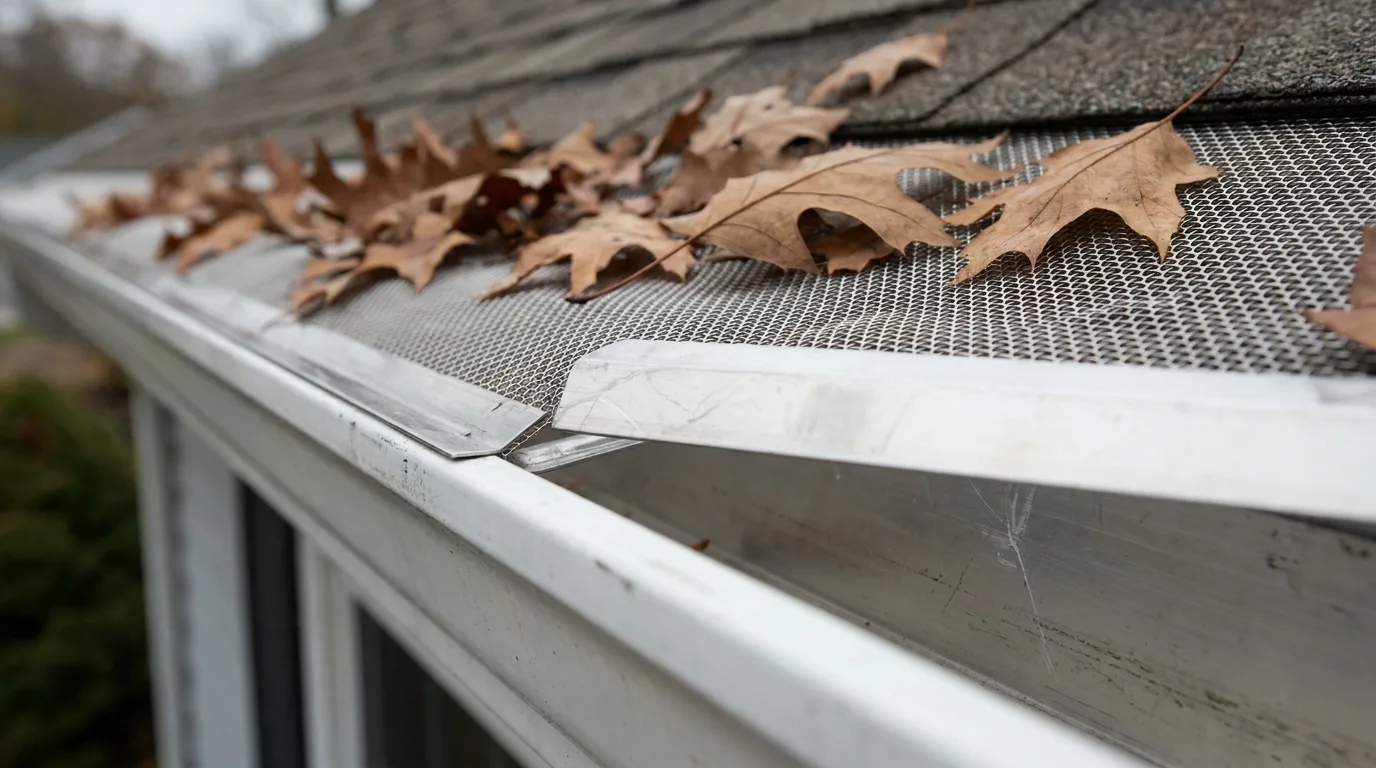
The honest answer is: it depends entirely on what falls on your roof, and that varies more across Long Island than most people expect. A guard that solves the problem in Smithtown makes it worse in Shirley.
No guard is maintenance-free, whatever the ad says. A good one turns two ladder days a year into one inspection every couple of years. That is a real win — it is just not the win being advertised.
First: What Is Landing on Your Roof
Heavy broadleaf canopy — oak, maple, hickory, beech. This is Smithtown, Commack, Huntington, Syosset, Garden City, Port Jefferson, the older village blocks in Bellport, Bay Shore and Patchogue. Leaves are large and they sit on top of a guard rather than getting through it. Almost any guard helps here. Micro-mesh helps most.
Pine needles. This is East Patchogue, Shirley, parts of Holbrook and the pine barrens edge. Needles are the hardest thing to guard against, because they are thin, they thread through screen apertures and then mat into a dense felt that water cannot pass. A screen guard in a pine area is worse than no guard, because now the clog is on top of the gutter where you cannot reach it and where it dams water back onto the roof edge. Only fine micro-mesh handles needles.
Maple seeds and oak tassels. The spring problem everyone forgets. Helicopters and oak catkins are small, wet and sticky, and they will pass through anything with an aperture larger than a fine mesh and then germinate in the gutter. If you have found seedlings growing in your gutter in June, this is why.
Shingle grit. Every asphalt roof sheds granules for its whole life, heaviest in the first year and again in the last. Grit settles into the bottom of the gutter and, on a fine mesh, can gradually blind it from underneath.
The Types, Ranked Honestly
Foam inserts. Do not. They fill the gutter channel with open-cell foam. Debris lands on top, holds moisture, and within two seasons you have a saturated sponge full of decomposing leaf litter and, quite often, plant growth. Removing them is filthy work. They are cheap and they are the worst option available.
Plastic or aluminum screens. The clip-in mesh sold at home centers. The apertures are too large for needles, seeds and tassels, they pop loose in wind, and they sag under wet leaf weight. In a broadleaf-only yard they are marginally better than nothing. In a pine yard they actively cause damage.
Perforated aluminum covers. Solid aluminum with small punched holes, properly fastened. A real step up — they handle leaves well and survive weather. Fine debris and shingle grit still get through, so the gutter needs checking every two to three years. Reasonable value at $6 to $12 a foot.
Micro-mesh stainless steel. Fine surgical-grade mesh over a rigid frame, fastened to the gutter, usually with a lip under the first shingle course. This is the category that actually works on Long Island, and it is the only one that handles pine needles. Water passes; needles, seeds, tassels and leaves do not. Good ones cost $12 to $25 per foot installed. This is what we put on houses where guards make sense.
Reverse-curve / surface-tension systems. The nose-forward hoods the national companies sell door to door, at $25 to $45 per foot. The physics is real — water clings around the curve and into a slot while debris falls past. Two problems on Long Island: in a heavy downpour, water coming off a steep roof overshoots the curve entirely and sheets straight over the front, and the slot itself clogs with the fine grit and pollen we have plenty of. They are also the most expensive option by a wide margin, and many of them require lifting the shingle course, which can affect a roof warranty. Ask before you sign.
Where Guards Genuinely Pay for Themselves
- Two and three-story houses. The value is not the cleaning cost, it is that nobody has to go up a 28-foot ladder twice a year. On the North Shore hills in Huntington, Northport and Port Jefferson, that is the entire argument.
- Houses under heavy canopy. Smithtown, Commack, Syosset, Garden City. If you are cleaning gutters twice every fall and once in spring, guards change your life.
- Steep or complex roofs where walking or laddering safely is genuinely hard.
- Owners who are not going to do it themselves and will not remember to book it. A clogged gutter that nobody notices for three years costs far more than the guards would have.
Where They Are Not Worth It
- A single-story ranch in Holbrook or Medford with two trees and clear access. Two cleanings a year at $180 to $400 apiece, against $2,400 to $5,000 for quality guards, takes a decade to break even.
- Any house getting cheap screens or foam. You will pay twice — once for the guard, again to have it removed and the gutter cleaned properly.
- A house whose gutters are undersized, sagging or unpitched. Fix the system first. Guards on a gutter that already overflows because it is one 2x3 downspout serving 45 feet of run will change nothing, and you will have spent thousands proving it.
The Thing Guards Do Not Fix
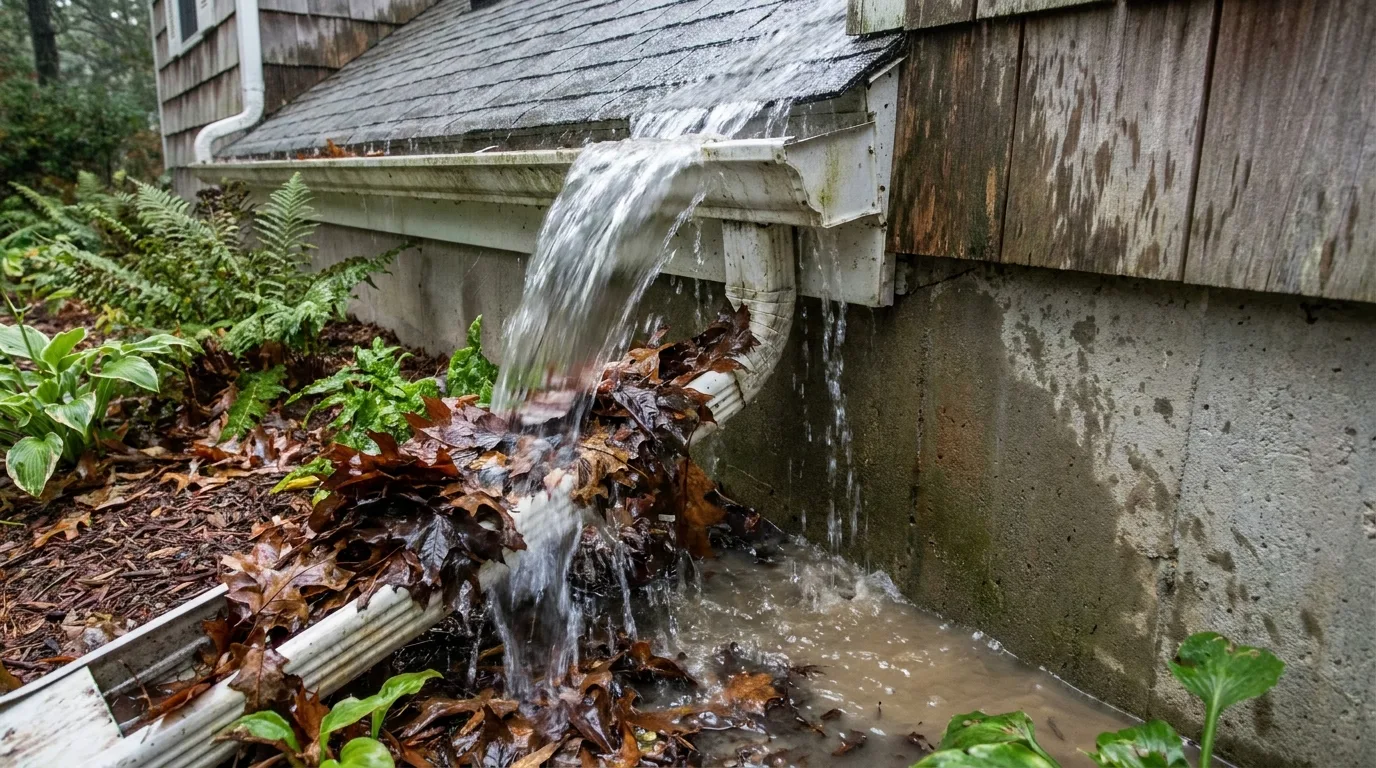
Guards keep debris out of the channel. They do not size your gutter, they do not pitch it, they do not add a downspout, and they do not move water away from your foundation.
If your gutter overflows during heavy rain, the cause is more often undersizing or downspout count than clogging — see seamless gutters for how a Long Island roof should actually be sized. And if your basement is damp after a storm, the problem is almost certainly where the downspouts discharge, not what is on top of the gutter.
Ice and Guards
A fair question every Long Island winter. Guards do not cause ice dams — ice dams are an attic heat and insulation problem, full stop. But a guard that holds standing debris will hold standing water, and standing water freezes and adds serious weight to the run. That is another argument against foam and cheap screens specifically, and an argument for tighter hanger spacing on north-facing runs.
What We Do
We install quality micro-mesh where the house and the tree cover justify it, and we tell people when it does not. We would rather clean your gutters twice a year for a decade than sell you $6,000 of hardware you do not need — and if your gutter system is undersized, we will tell you that first, because guards on the wrong system are money wasted.
Free walkthrough: (631) 312-7441, or see the gutter service page.
Frequently Asked Questions
Are gutter guards worth it on Long Island?
On two and three-story houses, under heavy oak and maple canopy, or where ladder access is genuinely difficult — yes. On a single-story ranch with two trees and easy access, two cleanings a year is cheaper for a decade. And they are never worth it on a gutter system that is undersized or unpitched; fix that first.
What is the best gutter guard for pine needles?
Fine micro-mesh stainless steel is the only category that reliably handles needles. Screen guards are actively worse than no guard in a pine area, because needles thread through the apertures and mat into a felt on top of the gutter where you cannot reach it.
Do gutter guards need to be cleaned?
Yes, just far less often. Quality micro-mesh needs an inspection every two to three years and an occasional brush-off of the surface. Nothing is maintenance-free, whatever the advertising says.
Are foam gutter inserts any good?
No. Debris lands on top, holds moisture, and within two seasons you have a saturated sponge full of decomposing leaf litter, often with plants growing in it. They are the worst option available.
Do gutter guards cause ice dams?
No. Ice dams are caused by heat escaping into the attic and melting snow that refreezes at the cold eave. A guard that holds standing debris will hold standing water that freezes and adds weight, which is an argument against foam and cheap screens, but the dam itself is an attic problem.
Are the branded reverse-curve gutter systems worth the price?
Rarely, at $25 to $45 per foot. Water coming off a steep roof in a downpour can overshoot the curve entirely, the intake slot clogs with fine grit and pollen, and many of them are installed under the first shingle course, which can affect a roof warranty. Ask about that before signing.
Will gutter guards stop my gutters from overflowing?
Only if clogging is the actual cause. On Long Island, overflow is at least as often undersized 5-inch gutter, too few downspouts, or a run with no pitch. Guards on that system change nothing.
Related Guides
- Seamless Gutters on Long Island
- What Gutter Installation Costs on Long Island
- Gutter Repair or Replacement
- Downspouts and Drainage on Long Island
- Fascia and Soffit Repair on Long Island
Get a Free Estimate from Alec's Construction
Licensed and insured, working across Nassau and Suffolk County since 2018. We come out, look at the actual job, and put a written number in your hand — no pressure, no obligation.
Book a Free WalkthroughOr call (631) 312-7441