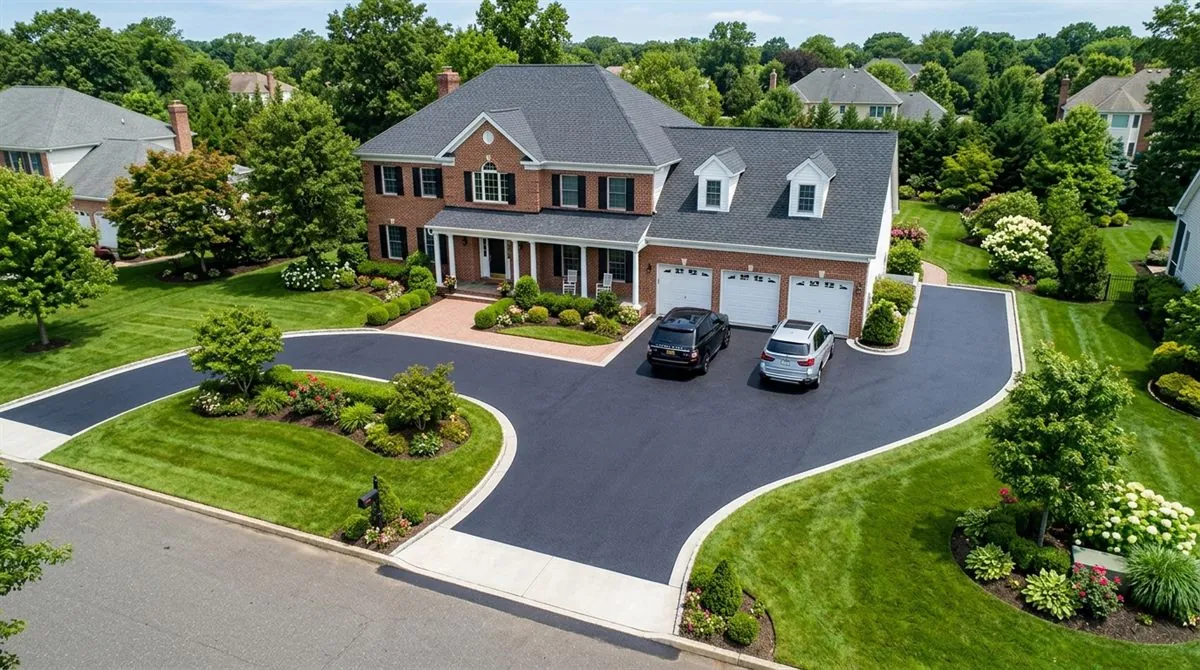
Islip hamlet is the seat of the Town of Islip, and everything files right here. Apron and curb-cut work goes through the Islip Highway Department, and having the department in the same hamlet does genuinely speed things up.
Older lots near Main Street
The housing along and just off Main Street runs older, and the driveways were laid out when one narrow car per household was the assumption. Eight or nine feet wide where a modern driveway is twelve, running close to the property line, sometimes shared.
Two consequences. First, access — a full-size paver may not fit, and where it does not the work is laid by hand and rolled with a walk-behind, which is a different labor line. Second, widening. A lot of homeowners here want the drive wider, and that runs into setback and impervious coverage before it runs into anything else.
Widening is where the rules bite
- Side-yard setback from the property line, which limits how far you can go
- Total impervious surface coverage on the lot, counting patio, shed pad and additions
- Apron width at the road, which is Highway Department territory
- Drainage — a wider driveway sheds more water and it has to go somewhere
- The neighbor, if the existing drive is shared or runs on a right-of-way
Where coverage is the binding constraint, permeable paving is worth pricing. It costs more per square foot than blacktop and it is sometimes the difference between an approvable plan and a rejected one.
South Islip and the bay
Below Montauk Highway the water table rises and the storm behavior changes. Drywells have to be sized for saturated ground or they fill and stop working, and pitch carries more of the load than it does inland. We look at where water goes during an actual storm rather than assuming a dry-day observation holds.
The soil is on your side inland
North of the highway you are on south-shore outwash — sandy, fast-draining glacial material that lets water move down and away from the sub-base instead of sitting there to freeze. It is a real advantage over the moraine towns north of the expressway, and a four-inch compacted base is generally appropriate.
Frequently Asked Questions
Can I widen my driveway?
Often, but it runs into rules before it runs into cost. Side-yard setbacks limit how far over you can go, total impervious coverage on the lot is capped and counts your patio and shed pad too, and apron width at the road is Highway Department territory. Where coverage is the binding constraint, permeable paving is worth pricing.
My driveway is too narrow for a paver. What happens?
It gets laid by hand and rolled with a walk-behind. That is a legitimate way to build a driveway and it is a different labor line — slower, more crew hours. We measure access before quoting so the price reflects how the work will actually be done, rather than discovering it on the morning of.
How long does a driveway take?
One day for a resurface on a typical residential driveway, one to two days for a full rip-out and repave. You can walk on it the same evening and park on it in 48 to 72 hours. Full cure takes about 30 days, which is why we ask you not to turn your wheels while stationary during the first month.
What time of year can you pave?
Roughly April through mid-November on Long Island. Hot-mix asphalt must be laid and compacted while hot, and once ground and air temperatures drop the mat cools before the roller can seat it. A driveway paved in December looks fine in December and ravels the following spring.
Related Reading
- Blacktop Driveway Cost on Long Island — real per-square-foot numbers
- Driveway Drainage Done Right — where the water goes before it goes into your garage
- Paver Driveways vs. Asphalt — cost, lifespan and resale
- How Thick a Driveway Should Be — the spec that decides how long it lasts
- Driveway Paving on Long Island — the full homeowner guide
Also Serving Islip
- ADUs in Islip — accessory apartments and grants
- Attic Insulation in Islip — air sealing, baffles and R-49 depth
- Basement Finishing in Islip — egress, ceiling height and moisture
- Bathroom Remodeling in Islip — full gut renovations
- Chimney Repair in Islip — repointing, crowns, caps and flashing
- Emergency Roof Repair in Islip — tarping, leaks and storm response
- Fallen Tree Removal & Roof Repair in Islip — tree off the house, roof supported and repaired
- Flood & Water Damage Cleanup in Islip — wet material out, drying metered
- Garage Conversion in Islip — turning the garage into living space
- Gutter Installation in Islip — seamless gutters, fascia and drainage
- House Painters in Islip — exteriors while the fall window holds
- Hurricane & Storm Damage Repair in Islip — trees, flooding, cleanup and repairs
- Storm Damage & Insurance Restoration in Islip — emergency tarping and the claim
- Interior Painting in Islip — the right work for the cold months
- Kitchen Remodeling in Islip — cabinets, counters and layout
- Masonry & Pavers in Islip — patios, walkways and retaining walls
- Roofing in Islip — tear-offs, repairs and storm damage
- Siding in Islip — James Hardie, vinyl and cedar
- Storm Debris Removal & Cleanup in Islip — trees, building debris and hauling
- Storm Roof & Siding Repair in Islip — wind damage, tarped and rebuilt
- Windows & Doors in Islip — insert and full-frame replacement
Work With Alec's Construction
This guide is written by the crew that does the work. See Alec's Driveways & Blacktop service — asphalt paving, resurfacing and sealcoating. Licensed and insured on Long Island, one crew start to finish, free walkthrough and a written estimate inside 48 hours.
Booking the cold months now: we also handle Masonry & Pavers and Roofing.
We keep a permit office directory for Nassau and Suffolk, checked against each jurisdiction's own site, because we file in these counters constantly.
Ready to Get Started?
Free on-site measure and a written price that lists base depth, asphalt thickness and compaction lifts. Most residential driveways are a one-day install.