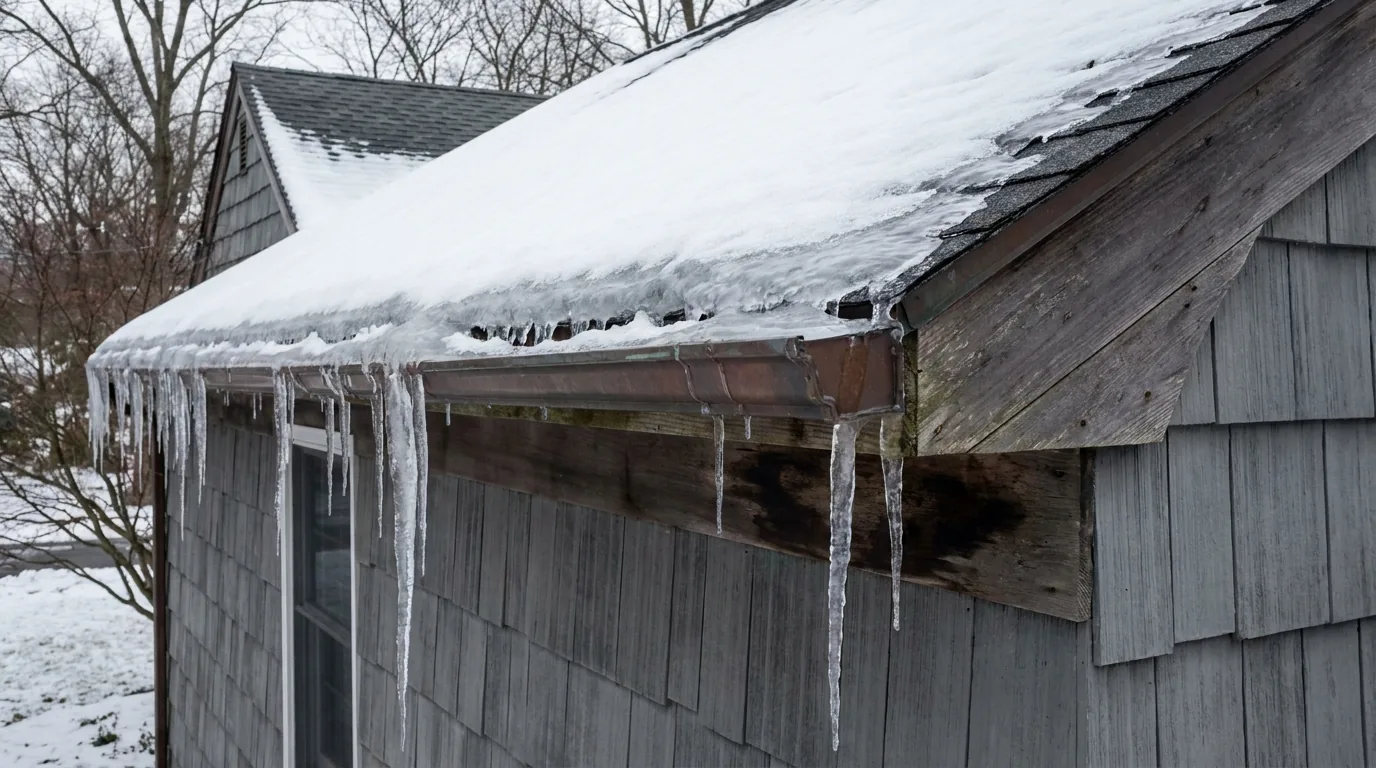
It is February, there is a ridge of ice along the eave, and there is a stain spreading across the bedroom ceiling. What you do in the next few hours decides whether this costs two thousand dollars or twenty.
First, What Is Actually Happening
The water is not coming through the roof because the roof failed. It is coming through because the water stopped moving.
Heat escaping from the living space into the attic warms the underside of the roof deck. Snow on that warm section melts. The meltwater runs down and reaches the eave, which overhangs unheated space and sits at outside temperature. There it refreezes. A few cycles of that builds a ridge of ice at the edge, and the meltwater behind the ridge has nowhere to go, so it stands.
Asphalt shingles are designed to shed water running downhill. They are not designed to hold back standing water. So it works its way up under the courses and into the house.
That is why the leak is at the exterior wall, why it appears days into a cold snap rather than during the storm, and why a brand new roof can do it just as readily as an old one.
What Not To Do
Do not chip at it. Hammer, hatchet, ice pick, shovel edge — every one of them lands on the shingles and the drip edge under the ice, and you cannot see what you are hitting. We have re-roofed sections that survived the winter perfectly well and were destroyed in twenty minutes by a homeowner with a hatchet.
Do not use a heat gun, torch or propane. Beyond the obvious fire risk in a soffit full of dry debris, direct heat on cold asphalt shingles cracks them.
Do not throw salt or ice-melt pucks up there. Calcium chloride does eventually cut a channel, but it also runs down over the shingles, the gutters, the fasteners, the flashing and whatever is planted below. Rock salt is worse. On a roof it is corrosive and it is not a plan.
Do not pressure-wash it. High pressure lifts shingles and drives water under them, which is precisely the problem you are trying to solve.
Do not get on the roof. Ice, wind, a ladder set on frozen ground and a hard surface below. Every winter, Long Island emergency rooms see more people hurt clearing snow and ice off roofs than hurt by the roofs themselves.
What Is Safe
Low-pressure steam. A steamer melts a channel through the dam without cutting into the roof, because it works by heat, not force. It is what a legitimate contractor uses and it is what we use. It opens a drainage path so the standing water behind the dam can get off the roof, which stops the leak.
Steaming is emergency work. It buys the roof time and it stops the water. It is not the fix.
A roof rake, from the ground. A telescoping roof rake pulled from ground level clears the bottom three or four feet of snow off the eave, which removes the fuel for the next dam. It works, it is cheap, and it is safe as long as you stay off the ladder and mind the power drop. It will not remove ice that has already formed.
Interior triage. Move things, put containers under the drips, and if the ceiling is bulging with trapped water, punch a small hole at the low point to drain it in a controlled way rather than letting the whole plane come down at once. Kill power to the area if water is near fixtures.
The Actual Fix Is in the Attic
An ice dam is a heat-loss problem that shows up on the roof. Which means the fix is upstairs, and it has three parts.
Air sealing the attic floor. This is the biggest lever and the one most often skipped. Every gap where warm air moves from the house into the attic — recessed light housings, the chimney chase, top plates, plumbing and wiring penetrations, the attic hatch — gets sealed. Air moving through insulation carries far more heat than conduction through it.
Insulation to depth. Long Island is Climate Zone 4A, and the attics on most houses here are under-insulated relative to current code, often with compressed or displaced batts and gaps around the perimeter where the insulation was pulled back from the eave.
Ventilation, soffit to ridge. The point of attic ventilation is to keep the roof deck at outside temperature. That needs a continuous intake at the soffit and an exhaust at the ridge, and it fails when insulation is stuffed into the eave and blocks the intake — which is extremely common on Long Island houses where somebody added insulation without adding baffles.
Do those three and the ice dams stop, the attic stops cooking the shingles in July, and the heating bill drops. Skip them, and you are steaming the same roof every February.
Where Ice-and-Water Membrane Fits
Modern code requires a self-adhering ice-and-water membrane at the eaves, extending up the roof past the interior wall line. It is a backstop — it means that when water does back up, it hits a waterproof layer instead of the deck.
Most Long Island roofs older than about twenty years do not have it, or have only a narrow strip. When a roof is replaced here it should be installed generously at eaves and in valleys, and that is a large part of why a re-roof often ends the ice dam leaks even when the attic work has not been done.
It is a backstop, not a solution. The attic is the solution.
What Insurance Usually Covers
Interior water damage from an ice dam is typically a covered loss under a standard homeowners policy. Removing the ice usually is not, and neither is the insulation and ventilation work that prevents the next one — those read as maintenance.
Which means: document the interior damage thoroughly, photograph the dam and the staining with timestamps, keep the mitigation receipts, and report it promptly. Your policy requires you to prevent further damage once you know about it, and a steaming invoice is evidence you did.
Ice dam emergency on Long Island: (631) 312-7441. We steam it, dry the inside, and then tell you honestly what the attic needs so it does not happen again.
Frequently Asked Questions
How do you safely remove an ice dam?
Low-pressure steam is the only method that opens a drainage channel without damaging the roof, because it works by heat rather than force. A roof rake used from the ground clears the snow that feeds the next dam. Everything else — chipping, hatchets, heat guns, salt, pressure washing — damages the shingles, the drip edge or the flashing under the ice.
Will salt or ice melt pucks get rid of an ice dam?
Calcium chloride will eventually cut a channel, but it runs down over the shingles, gutters, fasteners, flashing and plantings below, and it is corrosive. Rock salt is worse. It is not a plan, and it does nothing about the heat loss causing the dam.
What actually stops ice dams from coming back?
Attic work, in three parts: air sealing the attic floor so warm air stops getting up there, insulation to code depth with the eaves kept clear, and continuous soffit-to-ridge ventilation so the roof deck stays at outside temperature. Gutters do not cause ice dams and guards do not prevent them.
Does insurance cover ice dam damage?
Interior water damage from an ice dam is typically covered under a standard homeowners policy. Removing the ice usually is not, and the insulation and ventilation work that prevents recurrence reads as maintenance. Document the interior damage with timestamps, keep the mitigation receipts, and report it promptly.
Does a new roof stop ice dams?
Often it reduces the leaking, because modern code requires self-adhering ice-and-water membrane at the eaves past the interior wall line, and that acts as a backstop when water backs up. It is a backstop, not a cure — the dam still forms, and the fix is still in the attic.
Related Guides
- Emergency Roof Repair on Long Island
- Ice Dams: Cause, Cure and Prevention
- Roof Leak Repair on Long Island
- Frozen and Burst Pipes on Long Island
- Storm Damage Roof Claims
- Filing a Roof Insurance Claim
Work With Alec's Construction
This guide is written by the crew that does the work. See Alec's Seamless Gutters service — sizing, guards and downspout drainage that keeps water off the foundation. Licensed and insured on Long Island, one crew start to finish, free walkthrough and a written estimate inside 48 hours.
Booking the cold months now: we also handle Roofing and Chimney Repair.
Get a Free Estimate from Alec's Construction
Licensed and insured, working across Nassau and Suffolk County since 2018. We come out, look at the actual job, and put a written number in your hand — no pressure, no obligation.
Book a Free WalkthroughOr call (631) 312-7441