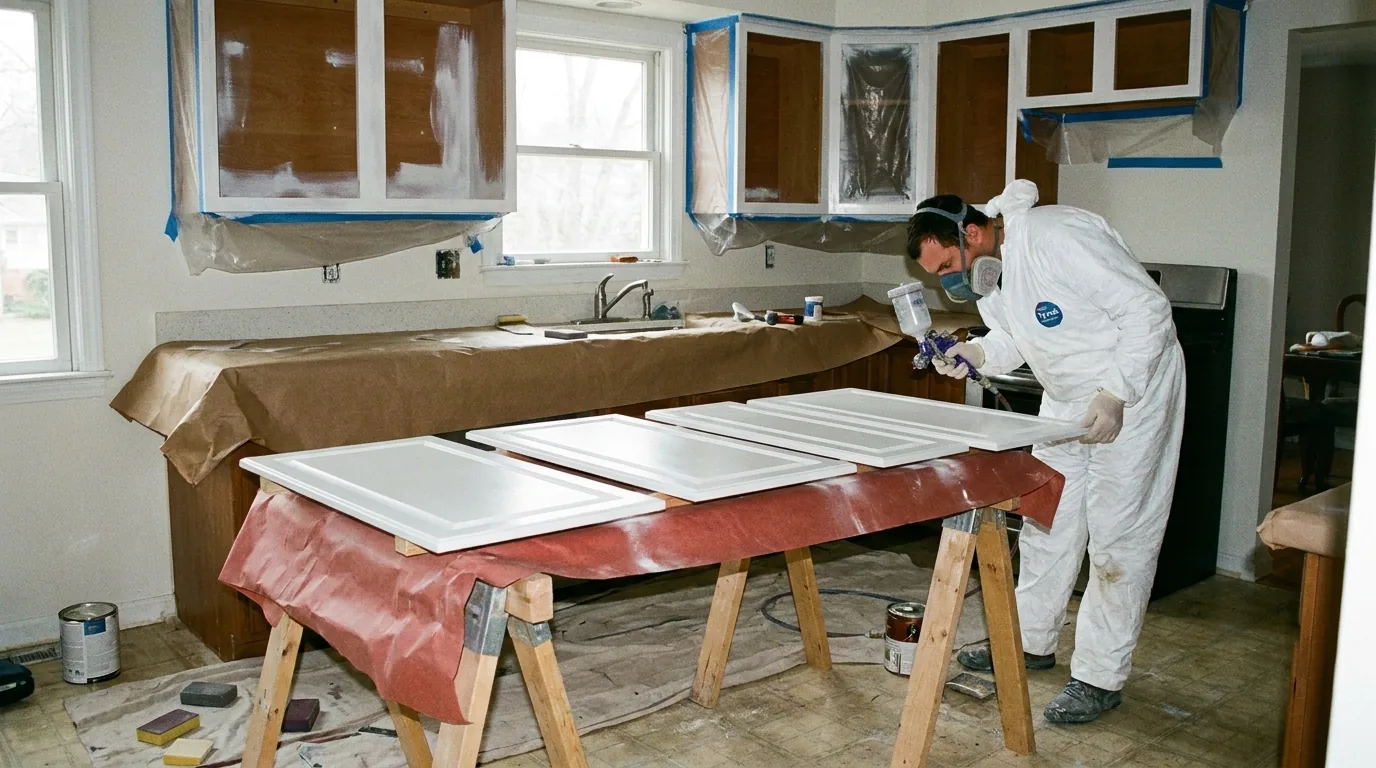
A kitchen cabinet repaint is the highest-leverage thing you can do to a Long Island kitchen. Done properly it reads as a full remodel from across the room, it takes about a week instead of six, and it costs a fraction of replacement. Done badly — brushed on, no degreasing, no bonding primer — it chips at every fingertip within four months and you have made the kitchen worse.
The gap between those two outcomes is entirely process.
First: Are Your Cabinets Worth Painting?
Be honest about this before spending anything.
Good candidates. Solid wood doors and face frames, of any age. Oak, maple, cherry, birch. Plywood boxes. Dated finishes — the honey oak that went into thousands of 1980s and 1990s Long Island kitchens, the orange-toned maple from the early 2000s, white cabinets that have yellowed. If the boxes are square, the doors close, and the hinges are sound, paint is a great decision.
Poor candidates. Thermofoil doors where the vinyl film is peeling off the MDF core — paint will not fix delamination. Particleboard boxes that have swollen from a leak under the sink. Cabinets where the layout itself is the problem. And any kitchen where you are also moving the plumbing, changing the footprint or replacing the counters and appliances anyway — at that point you are remodeling, and our kitchen remodeling page is the better read.
The Long Island specific one: a lot of South Shore kitchens took water in Sandy and again in later flooding. If the bottom rail of your base cabinets is soft or the toe kick is delaminating, painting the doors does not address it.
Why Cabinets Get Sprayed, Not Brushed
This is the single biggest quality determinant and it is not a matter of opinion.
A brushed cabinet door has brush marks. Even with a good waterborne enamel that levels well, on a flat slab or a raised panel you will see the texture in raking light — and kitchen lighting is almost always raking light, coming from under-cabinet fixtures at a low angle. A sprayed door has no texture at all. That is the entire difference between "we painted the cabinets" and "did you get new cabinets?"
Spraying also means we take the doors off, spray them flat and horizontal on sawhorses, and let gravity help the finish level. Doors painted hanging in place, vertically, sag.
The boxes and face frames are the part that stays in the kitchen. Those get masked off with plastic and paper, and sprayed in place with the room contained, or brushed and rolled with a fine-nap microfiber where spraying is impractical. Frames are flat and narrow enough that a good enamel lays down cleanly.
The Actual Process, Step by Step
1. Label and remove. Every door and drawer front comes off and gets numbered on the hinge mortise where it will never be seen. Hinges, knobs and pulls come off and go in labeled bags. Cabinets are not symmetrical and doors do not interchange — a job that skips labeling ends with doors that do not sit flush.
2. Degrease. Properly. This is the step cheap jobs skip and it is why cheap jobs fail. Kitchen cabinets carry twenty years of aerosolized cooking oil, especially the uppers next to the range. Nothing bonds to grease. Every surface gets washed with a degreasing cleaner, then rinsed, then dried.
3. Sand. Not to bare wood — you are de-glossing and creating tooth. A thorough scuff sand with 150 to 180 grit over every surface, by hand in the profiles where a machine cannot reach.
4. Repair and fill. Old hardware holes that will not be reused get filled and sanded flush. Dents, chips and split rails get repaired.
5. Bonding primer. This is the second thing cheap jobs skip. A dedicated bonding primer is what actually adheres to a factory-finished surface. On oak or any open-grain wood, this is also where you decide whether to fill the grain — if you want a smooth, contemporary finish rather than the grain showing through, it takes an extra grain-filling step, and it is worth asking for explicitly.
6. Sand the primer. 220 grit. Every coat gets sanded between coats. This is where a factory-smooth finish comes from.
7. Two coats of cabinet enamel. A waterborne alkyd or a catalyzed acrylic-urethane formulated for cabinetry. Standard wall paint on cabinets will stay soft and mark permanently under a fingernail. The right product cures hard.
8. Cure before reassembly. Enamel is dry to the touch in hours but continues hardening for two to three weeks. We rehang at the appropriate point, and we tell you to be gentle with the doors for the first couple of weeks. Nobody tells homeowners this and it is the reason a good job sometimes picks up early marks.
9. Rehang, adjust, new hardware. Doors go back on their own hinges in their own openings, get adjusted for even reveals, and new knobs and pulls go on if you are changing them.
Colors That Work in Long Island Kitchens
Warm whites are the safest and most durable choice — they photograph well, they do not fight with the oak floors that are in most Island homes, and they will still look right in eight years. A soft greige on the perimeter with a deeper island is the current default for good reason. Navy and deep forest green on a base run with white uppers has been strong for several years and still reads current.
The one thing to avoid is a stark, blue-toned pure white in a kitchen with warm wood floors and warm brass or bronze hardware. It reads cold and slightly cheap. Bring a sample home and look at it at night under your actual kitchen lights, not in the store.
How Long It Takes and What It Is Like to Live Through
A standard Long Island kitchen of 25 to 35 doors and drawer fronts is typically five to eight working days, with the doors offsite or in a contained area of the house for most of it.
You can use the kitchen through most of the job. The boxes are open — which is inconvenient — and there is a day or two where the frames are being sprayed and the room is masked. We plan around that with you.
Cabinet Painting vs Refacing vs Replacing
Painting. Cheapest, fastest, keeps your existing doors and layout. Best when the boxes and doors are sound and you only dislike the color.
Refacing. New doors and drawer fronts, veneer over the existing frames. Two to three times the cost of painting. Makes sense when you want a different door style but the layout works.
Replacing. New everything. Right answer when the layout is wrong, the boxes are failing, or you are moving plumbing anyway.
What We Do
Alec's Construction sprays cabinets across Nassau and Suffolk County, and because we are a general contractor we can also fix the soft base cabinet, replace the failed sink base, or take the whole kitchen if that is what it turns out to need. Winter is our best availability for cabinet work.
Call (631) 312-7441 for a free look at your kitchen.
Frequently Asked Questions
How long does painted kitchen cabinets last?
Ten to fifteen years when the job is done correctly — degreased, scuff sanded, bonding primer, and two coats of a real cabinet enamel sprayed rather than brushed. Jobs that skip degreasing or primer typically start chipping within a year.
Should kitchen cabinets be sprayed or brushed?
Sprayed. Brush marks are visible on cabinet doors under the low-angle light that kitchens have, especially from under-cabinet fixtures. Doors come off and get sprayed flat; frames can be sprayed in place or carefully brushed since they are narrow and flat.
Can you paint oak cabinets without the grain showing?
Yes, but it takes an extra step. Open-grain oak needs a grain filler applied and sanded before priming if you want a smooth contemporary finish. Ask for it specifically — it is additional labor and it is not included by default.
Can thermofoil cabinets be painted?
Generally no, and especially not if the vinyl film is already peeling from the MDF core. Paint does not fix delamination. If your thermofoil doors are still fully intact there are bonding primers that will work, but it is a lower-confidence job than solid wood.
How long does a cabinet painting job take?
Five to eight working days for a standard kitchen of 25 to 35 doors and drawer fronts. You can use most of the kitchen throughout, with a day or two where the room is masked for spraying the frames.
When can I use my cabinets normally after painting?
Doors are rehung when they are ready to handle, but cabinet enamel keeps hardening for two to three weeks. Be gentle with the doors during that period — most early marks on an otherwise good job come from full use in the first week.
Related Guides
- Interior Painting on Long Island
- Exterior House Painting on Long Island
- What House Painting Costs on Long Island
- The Best Time to Paint a House Exterior on Long Island
- How to Choose a Painting Contractor on Long Island
Get a Free Estimate from Alec's Construction
Licensed and insured, working across Nassau and Suffolk County since 2018. We come out, look at the actual job, and put a written number in your hand — no pressure, no obligation.
Book a Free WalkthroughOr call (631) 312-7441