If there is water coming into your Sayville house right now, the order is: stop the water, document everything, then fix the cause. Doing it in that order is what keeps a bad night from becoming a bad claim.
Fifteen minutes west, so if you are in Sayville and something has just failed, call (631) 312-7441 first and read the rest afterwards.
What to Do in the First Hour
- Move what you can and put buckets under active drips. If the ceiling is bulging with trapped water, a small hole punched at the low point drains it in a controlled way and can save the whole ceiling from coming down at once.
- Kill power to the affected area if water is anywhere near fixtures, outlets or the panel.
- Photograph everything before you touch it. Wide shots of the room, close shots of the damage, and shots of the exterior if you can do it safely. Timestamps matter.
- Do not get on the roof. Not in wind, not in rain, not on ice. More people are hurt on Long Island roofs during storms than by them.
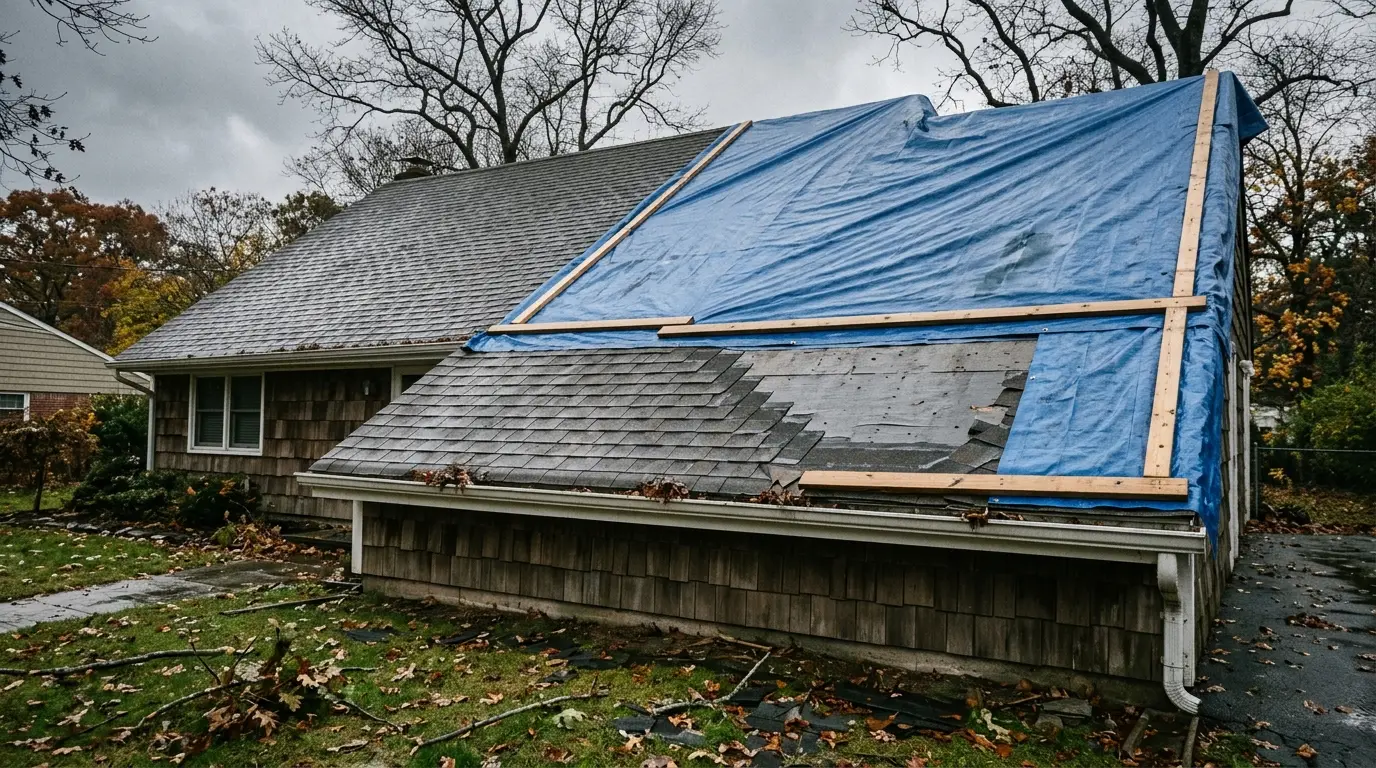
- Call it in. We tarp, and a properly installed tarp is not a blue sheet with bricks on it — it is fastened, it laps the ridge, and it sheds water rather than pooling it.
Response From Our Yard
Fifteen minutes west. We work out of East Patchogue, which is the whole reason emergency response on this island works or does not — a crew based in Nassau or upstate cannot tarp a Sayville roof at eleven at night in February.
We are a licensed general contractor, Suffolk County Home Improvement License HI-68303, insured, with the same crew since 2018. That matters after a storm more than at any other time, because storm season is when out-of-state crews show up on Long Island with a magnetic sign and a clipboard.
What Fails on a Sayville Roof
Bay exposure and mature canopy. Steep early-1900s roofs where the failure is at the flashing and the valley, not the field, and where access itself is the hazard in an ice storm.
Winter failure on Long Island is rarely dramatic. It is almost always one of these:
- Flashing. Chimney, sidewall, valley and skylight flashing is where nearly every leak we chase actually starts. The field of the roof is usually fine.
- The eave edge. Wind-driven rain and ice back water up under the first few courses, where there is often no ice-and-water membrane on an older roof.
- Limb strike. A single branch through the deck, which looks small from the ground and is not.
- Lifted or missing shingles on the windward slope, which then let the next rain in rather than the storm itself.
- Ice dams, which are an attic problem wearing a roof problem's costume.
Wind Versus Flood, and Why It Decides Everything in Sayville
On the south shore this is the single most consequential question in a storm claim, and it gets decided by evidence collected in the first day.
A homeowners policy covers wind. It does not cover flood — that is a separate NFIP or private flood policy. When a nor'easter puts both wind and water on a Sayville house in the same twelve hours, the adjuster has to decide which one caused which damage, and the homeowner who documented the difference is the one who gets paid.
What that means practically: photograph the roof damage and the interior water staining before any surge water reaches the house if you possibly can, and photograph the exterior water line separately with a timestamp. Damage from above and damage from below are two different claims and they have to look like two different claims in the file.
The other south shore reality is the named-storm deductible. It is a percentage of your dwelling coverage rather than a flat dollar figure, and on a nor'easter that gets named it can be several times a standard deductible. It is worth knowing your number before the storm, not during the claim.
The Claim, and How Not to Lose It
Most storm damage on a Sayville house is covered. Claims get reduced or denied for procedural reasons far more often than for coverage reasons.
Duty to mitigate. Your policy requires you to prevent further damage once you know about it. Tarping is mitigating. Keep the receipt — emergency mitigation is usually reimbursable and it is usually paid separately from the repair itself.
Document before, during and after. Photographs with timestamps, a written list of what was damaged, and every receipt. A contractor's dated inspection report carries far more weight with an adjuster than phone photos alone.
Town of Islip permitting. Named-storm wind deductibles apply on the south shore and are a percentage of coverage.
Understand RCV versus ACV. Replacement cost value pays what it costs to replace. Actual cash value pays that minus depreciation. On a recoverable-depreciation policy you get the held-back portion once the work is actually done and invoiced — which means a homeowner who takes the first cheque and does not do the repair leaves the depreciation on the table permanently.
Be careful who you sign with. After a named storm, Sayville gets door-knocked. The tells are the same every time: out-of-area plates, pressure to sign an assignment of benefits on the spot, an offer to "cover your deductible," and no local license number they will write down. Ask for the Suffolk County home improvement licence number and the insurance certificate from the agent. Ours is HI-68303.
After the Emergency
The tarp is not the repair. Once the weather allows we come back, open up what is wet, replace deck and framing where it has gone soft, correct the flashing detail that let it in, and put the interior back — drywall, insulation, paint.
And where the cause was an ice dam, we fix the attic, because a roof repair that leaves the insulation and ventilation alone is a repair you will be making again next winter.
We work the claim alongside you — scope, documentation and the adjuster meeting — and we do not start the permanent work until you know what the policy is paying.
Emergency line: (631) 312-7441.
Frequently Asked Questions
Do you do emergency roof repair in Sayville?
Yes. Fifteen minutes west. We tarp, stop active water and stabilise the interior, then come back for the permanent repair once conditions allow. Call (631) 312-7441.
What should I do first when water comes through the ceiling?
Move what you can, put containers under the drips, and if the ceiling is bulging with trapped water, punch a small hole at the low point to drain it in a controlled way — that often saves the whole ceiling. Kill power to the area if water is near fixtures or the panel. Photograph everything before you touch it. Do not go on the roof.
Will my insurance cover storm damage to my roof?
Usually, yes — wind and falling-limb damage are standard homeowners perils. Claims are reduced or denied for procedural reasons far more often than coverage ones: no documentation, no mitigation, or a delay in reporting. Town of Islip permitting. Named-storm wind deductibles apply on the south shore and are a percentage of coverage.
Is emergency tarping covered by insurance?
Emergency mitigation is generally reimbursable and usually paid separately from the repair itself, because your policy requires you to prevent further damage once you know about it. Keep the receipt and photograph the tarp in place.
How do I get rid of an ice dam?
Steam is the only safe way to open a channel through it, and that is emergency work to get water off the roof — not the fix. The actual fix is attic air sealing, insulation to depth and soffit-to-ridge ventilation, so the roof deck stays at outside temperature and the snow stops melting in the first place. Never chip at a dam with an axe or use a heat gun; both destroy the roof under the ice.
How do I avoid storm-chasing contractors in Sayville?
Ask for the Suffolk County home improvement licence number and get the insurance certificate from their agent, not a photo on a phone. Be wary of pressure to sign an assignment of benefits on the spot, offers to cover your deductible, and out-of-area plates. Ours is HI-68303, and we have been working out of East Patchogue since 2018.
Can a roof be repaired in the winter on Long Island?
Emergency repairs, tarping and flashing work, yes — those happen in any weather. A full shingle replacement needs temperatures warm enough for the seal strips to bond, so a winter tear-off is done with hand-sealing and the right materials, or stabilised now and completed in spring. We will tell you which one your roof needs.
Related Guides
- Emergency Roof Repair in Holbrook, NY
- Emergency Roof Repair in Bay Shore, NY
- Emergency Roof Repair on Long Island
- Ice Dams — Cause, Cure and Prevention
- Storm Damage Roof Claims on Long Island
Work With Alec's Construction
This guide is written by the crew that does the work. See Alec's Roofing service — tear-offs, repairs, flashing and storm damage across Suffolk and Nassau. Licensed and insured on Long Island, one crew start to finish, free walkthrough and a written estimate inside 48 hours.
Booking the cold months now: we also handle Seamless Gutters and Storm Damage & Insurance Restoration.
Also Serving Sayville
- ADUs in Sayville — accessory apartments and grants
- Basement Finishing in Sayville — egress, ceiling height and moisture
- Bathroom Remodeling in Sayville — full gut renovations
- Chimney Repair in Sayville — repointing, crowns, caps and flashing
- Deck Builders in Sayville — new builds, repairs and railings
- Driveway Paving in Sayville — blacktop, resurfacing and repairs
- Front Steps & Stoops in Sayville — rebuilds, treads and railings
- Gutter Installation in Sayville — seamless gutters, fascia and drainage
- House Painters in Sayville — exteriors while the fall window holds
- Storm Damage & Insurance Restoration in Sayville — emergency tarping and the claim
- Interior Painting in Sayville — the right work for the cold months
- Kitchen Remodeling in Sayville — cabinets, counters and layout
- Masonry & Pavers in Sayville — patios, walkways and retaining walls
- Roofing in Sayville — tear-offs, repairs and storm damage
- Siding in Sayville — James Hardie, vinyl and cedar
Get a Free Estimate from Alec's Construction
Licensed and insured, working across Nassau and Suffolk County since 2018. We come out, look at the actual job, and put a written number in your hand — no pressure, no obligation.
Book a Free WalkthroughOr call (631) 312-7441