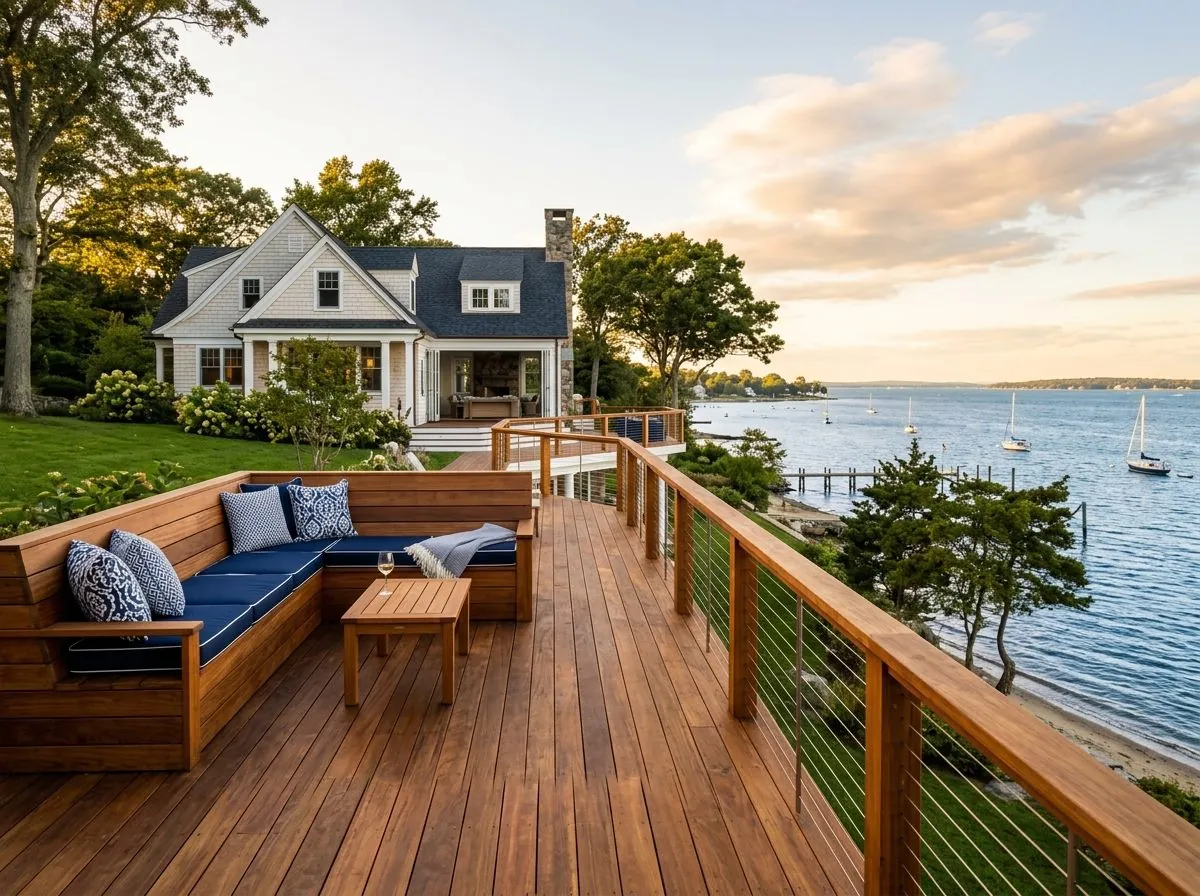
Sayville's housing runs older than deck culture — these houses were built with porches, and the rear deck arrived seventy years later as an addition to architecture that never planned for it. The difference between a deck that suits a 1910 Sayville house and one that looks bolted on is not budget. It is proportion and language.
What makes a deck belong on an old house
- Rail language: the stock aluminum baluster reads wrong against porch turnings; a painted rail with square balusters — or composite in the same profile — picks up what the porch established
- Skirting: old houses sit high, and an unskirted deck frame shows a dark void; framed lattice or board skirting in the house trim color closes the base the way the porch base does
- Proportion: decks read best here when they respect the house's bays — aligned to door and window rhythm rather than maximized to the setback
- Color: gray-brown composite against a white-trimmed 1910 house reads industrial; decking in muted tones with painted structure reads as part of the house
The structure underneath is modern regardless
Whatever the styling, the frame is current code: footings below frost, ledger flashed and fastened correctly into century-old band joists (which we open and inspect — old houses hide surprises exactly there), guards and stairs to spec. Attaching a new ledger to a 1910 band joist is the one step where these jobs differ structurally from new-house decks, and it is inspected, not assumed.
South of Main, the bay rules
Toward the water the fastener and hardware package upgrades to stainless — the same salt logic as every bay-adjacent trade — and framing hardware gets specified for the exposure. Composite decking itself is indifferent to salt; the metal holding it is not.
The porch stays the porch
One recurring Sayville conversation: owners asking to wrap or replace the front porch with decking. Our answer is consistent — the porch is the house's face and its repair is porch carpentry, not deck work; the deck belongs in back, speaking the porch's language at a respectful distance.
Frequently Asked Questions
What makes a deck look right on an older Sayville house?
Language and proportion: rails that pick up the porch's vocabulary instead of stock aluminum balusters, skirting that closes the base the way the porch base does, decking aligned to the house's door and window rhythm rather than maximized to the setback, and colors that read with the trim. The structure underneath is modern code either way.
Is attaching a deck to a century-old house different?
At one critical point, yes: the ledger. It carries half the deck, and it fastens into a 1910 band joist whose condition nobody knows until it is opened. We open and inspect before fastening — old houses hide rot and undersized framing exactly there, and correcting it during construction is cheap insurance against the classic deck failure.
How long does a deck take to build?
Five to eight days on site for a typical 300 to 500 square foot composite deck, after permit approval. The permit is the calendar driver — most Suffolk towns require one for any attached or elevated deck, and lead times vary by town.
Do I need a permit for a deck on Long Island?
Almost always, for anything attached to the house or elevated. Incorporated villages run their own desks with their own timelines. We handle the drawings and filing as part of the job, and we confirm which authority governs your parcel before quoting.
Related Reading
- Best Deck Materials — wood, composite and PVC compared
- Deck Cost on Long Island — the honest number ranges
- Deck Maintenance — what each material actually demands
- Deck Permits on Long Island — what triggers one and what it takes
- Hiring a Deck Builder — the questions that separate bids
Also Serving Sayville
- ADUs in Sayville — accessory apartments and grants
- Attic Insulation in Sayville — air sealing, baffles and R-49 depth
- Basement Finishing in Sayville — egress, ceiling height and moisture
- Bathroom Remodeling in Sayville — full gut renovations
- Chimney Repair in Sayville — repointing, crowns, caps and flashing
- Driveway Paving in Sayville — blacktop, resurfacing and repairs
- Emergency Roof Repair in Sayville — tarping, leaks and storm response
- Fallen Tree Removal & Roof Repair in Sayville — tree off the house, roof supported and repaired
- Flood & Water Damage Cleanup in Sayville — wet material out, drying metered
- Front Steps & Stoops in Sayville — rebuilds, treads and railings
- Garage Conversion in Sayville — turning the garage into living space
- Gutter Installation in Sayville — seamless gutters, fascia and drainage
- House Painters in Sayville — exteriors while the fall window holds
- Hurricane & Storm Damage Repair in Sayville — trees, flooding, cleanup and repairs
- Storm Damage & Insurance Restoration in Sayville — emergency tarping and the claim
- Interior Painting in Sayville — the right work for the cold months
- Kitchen Remodeling in Sayville — cabinets, counters and layout
- Masonry & Pavers in Sayville — patios, walkways and retaining walls
- Roofing in Sayville — tear-offs, repairs and storm damage
- Siding in Sayville — James Hardie, vinyl and cedar
- Storm Debris Removal & Cleanup in Sayville — trees, building debris and hauling
- Storm Roof & Siding Repair in Sayville — wind damage, tarped and rebuilt
- Windows & Doors in Sayville — insert and full-frame replacement
Work With Alec's Construction
This guide is written by the crew that does the work. See Alec's Decks service — framing, composite and pressure-treated builds and repairs. Licensed and insured on Long Island, one crew start to finish, free walkthrough and a written estimate inside 48 hours.
Booking the cold months now: we also handle Roofing and Painting.
We keep a permit office directory for Nassau and Suffolk, checked against each jurisdiction's own site, because we file in these counters constantly.
Ready to Get Started?
Free deck design consultation with a written scope covering framing, footings, flashing and code guards. Nassau and Suffolk County.