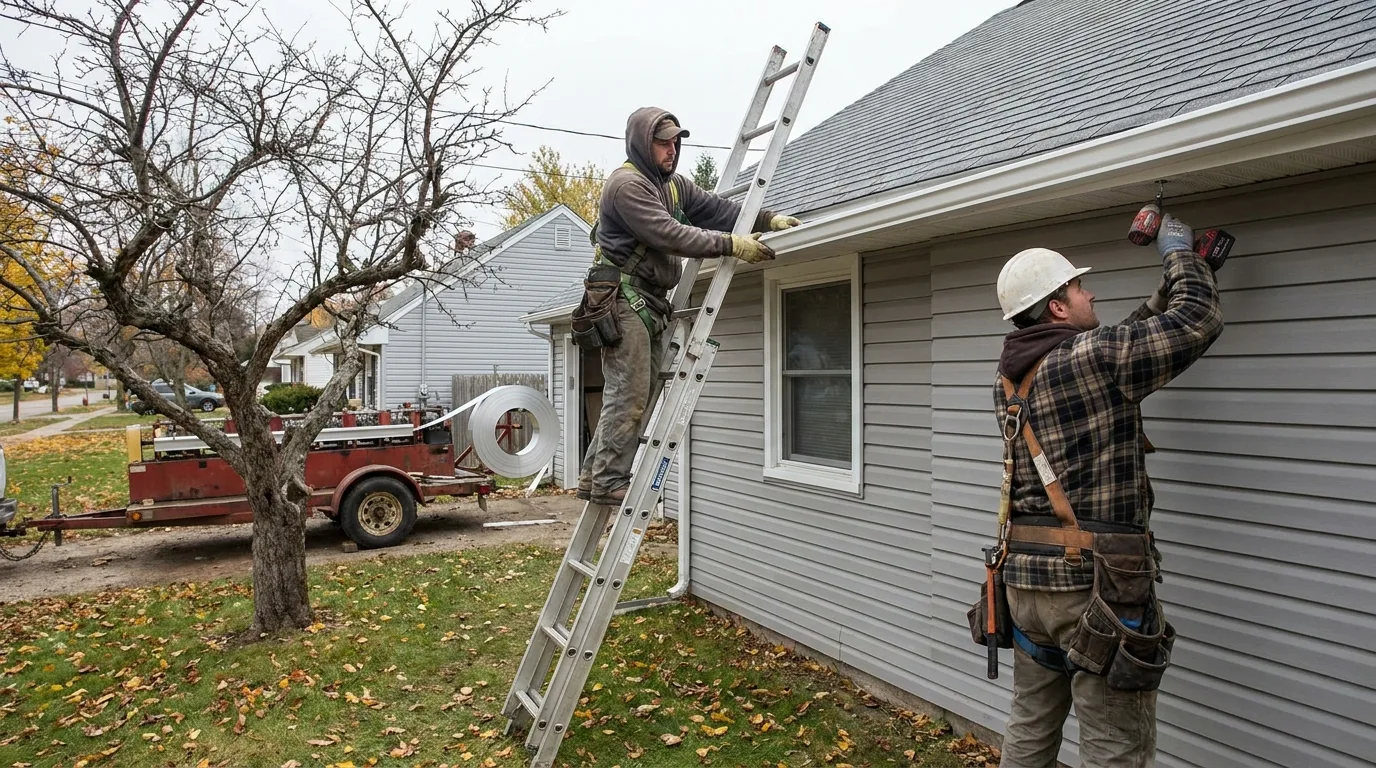
If you are looking at gutters in Smithtown, the two questions worth answering before anyone quotes a price are what falls on your roof and where the water goes once it leaves the downspout. Those decide the system. Linear footage only decides the invoice.
What Lands in a Smithtown Gutter
Genuinely wooded — mature oak and hickory on larger lots, one of the heaviest leaf loads on the Island.
That matters because it determines whether guards are worth buying and which kind. Broadleaf debris sits on top of almost any guard. Pine needles thread straight through screen-type guards and mat into a felt that water cannot pass, which makes a cheap screen in a needle area worse than no guard at all — the clog moves to the top of the gutter where you cannot reach it.
The Rooflines Here
Larger colonials with two-story runs, multiple valleys and long fascia lines that need proper hanger spacing to stay straight.
Roof geometry is most of the labour in a gutter job. A simple gable is two long straight runs. Dormers, valleys and intersecting rooflines mean more corners to fabricate, more transitions, and more inside corners — and inside corners are where overflow starts, because two roof planes deliver their water to the same short length of gutter.
Pitch matters too. A steep roof accelerates the water, and a shallow 5-inch profile lets it shoot straight over the front lip in heavy rain no matter how clean it is.
Undersized Gutters Are the Recurring Problem in Smithtown
The houses here are bigger than the Long Island average, and the gutter systems on them usually are not.
Standard 5-inch K-style with 2x3 downspouts was adequate for a modest roof. On a large Smithtown colonial with two-story runs and multiple roof planes feeding the same gutter, it is not — the run backs up in any real storm and water sheets over the front lip in the middle of the run, which is why cleaning it never seems to help.
Six-inch K-style carries roughly 40 percent more water, and a 3x4 downspout carries a bit over twice what a 2x3 does while being far less likely to clog with shingle grit or needles. The other half of the fix is downspout count: one outlet for every 30 to 35 feet of run, more on a steep roof. The single most common defect we find on a big Smithtown house is 45 feet of back gutter running to one downspout at the end.
Where the Water Has to Go in Smithtown
Bigger roofs mean far more volume. Undersized 5-inch gutters and 2x3 downspouts overflow on Smithtown colonials in any real storm; 6-inch with 3x4 downspouts is often the right answer.
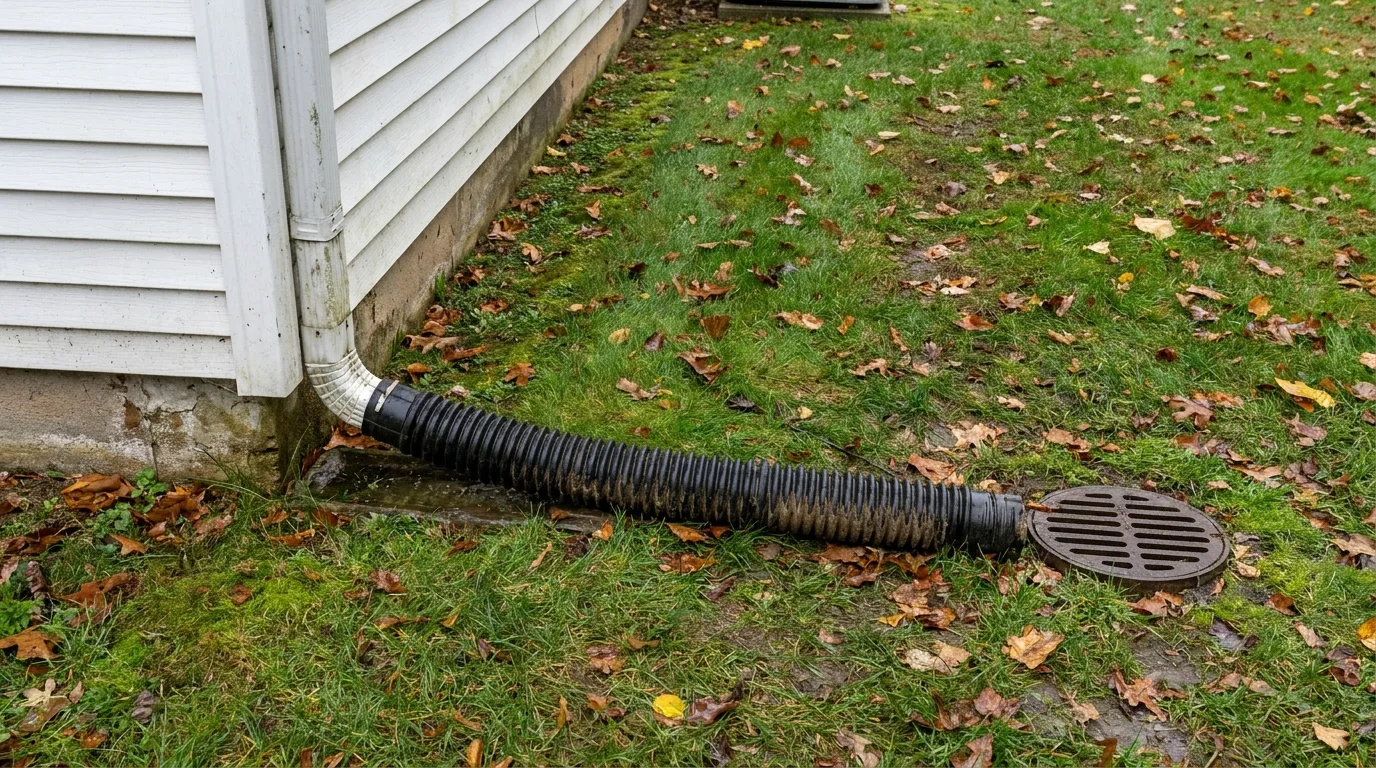
The number that makes this concrete: one inch of rain on a 2,000 square foot roof is about 1,250 gallons of water. A three-inch nor'easter is roughly 3,700 gallons, and if the downspouts end in splash blocks, all of it lands within three feet of the foundation over a few hours.
The backfill around a foundation is looser than undisturbed ground — it was dug out and put back — so water discharged at the wall runs straight down that loose ring and finds the cold joint or the block cores. That is the mechanism behind most wet basements in Smithtown, and it is a drainage problem, not a foundation problem.
Discharge should be six feet from the house at absolute minimum and ten if the lot allows. Where there is no grade to daylight to, a drywell sized to the actual roof area feeding it is the answer — Long Island's sandy soil percolates well, and the usual reason a drywell "fails" is that it was too small for the roof.
What a Real Smithtown Gutter Install Includes
- Old gutter and downspouts removed and hauled away
- The full fascia run probed for rot before anything new goes up
- Drip edge checked and corrected where it is missing, so water cannot wick back behind the board
- Seamless .032 aluminum roll-formed on site in one continuous run per elevation — not .027, which dents under a ladder and oil-cans between hangers
- Hidden hangers at 24 inches, tighter at 16 to 18 on ice-prone north-facing runs, screwed into solid wood
- Corners and outlets riveted and sealed, not snapped together
- Pitched a quarter inch per ten feet toward the outlets
- Downspouts every 30 to 35 feet, secured to the wall
- Discharge carried well clear of the foundation
- Runs water-tested with a hose before we leave
The Fascia Behind It
This is the part that separates a gutter company from a general contractor, and it is why we quote it the way we do.
When the old gutter comes off a Smithtown house that has been overflowing for a few seasons, some of the fascia behind it is usually soft. Hanging new aluminum on soft fascia is money wasted — the hangers have nothing to bite, and the new run sags exactly the way the old one did within two or three years.
We probe the board, cut out what is gone back to a sound rafter tail, sister the tail if it is soft too, prime the new fascia on all six sides including the cut ends, correct the drip edge, and then hang the gutter. See fascia and soffit repair for what that work actually involves.
While the soffit is open we check the venting, because it is free to check. Blocked soffit intake — insulation stuffed into the eave, solid aluminum installed over the old vented panel, or vents painted shut — is what causes ice dams and winter condensation on the underside of the roof deck.
What It Costs in Smithtown
As a Long Island market range, 5-inch seamless aluminum runs roughly $9 to $16 per linear foot installed and 6-inch with 3x4 downspouts roughly $13 to $22. A typical house here has 150 to 220 linear feet.
The variables that actually move the number on a Smithtown house are height, roof geometry, fascia condition, downspout count and drainage work. Fascia is the one that surprises people — on a badly neglected house it can add $1,500 to $4,000, and it is not an upsell, it is the reason the gutters will still be straight in ten years. Full breakdown in the cost guide.
Timing
Gutter work is one of the few exterior trades with no real seasonal limit on Long Island — we install through the winter. But the sensible time is before the leaves come down and before the first freeze, because a house that goes into winter with sagging gutters, standing water and discharge at the foundation spends the whole season doing damage you pay to repair in April.
If you have had ice damming at the eaves before, the run of gutter under that eave wants tighter hanger spacing, and the real fix is upstairs in the attic insulation and venting.
Licensed, Insured, Local
Alec's Construction Inc. is based on Barton Avenue in East Patchogue and works throughout Suffolk County and across Long Island. Suffolk County Home Improvement License HI-68303, general liability and workers compensation — certificates from our agent on request.
Because we are a licensed general contractor rather than only a gutter company, the fascia, the rafter tails, the drip edge, the soffit venting and the drainage are all in scope. The gutter goes on last, onto something solid. See our gutter service page and our roofing service.
Call (631) 312-7441 for a free walkthrough in Smithtown.
Frequently Asked Questions
How much does gutter installation cost in Smithtown, NY?
As a Long Island market range, 5-inch seamless aluminum runs about $9 to $16 per linear foot installed and 6-inch with 3x4 downspouts about $13 to $22. A typical house here has 150 to 220 linear feet. Height, roof geometry, fascia condition, downspout count and drainage work are what move the number.
What size gutters do I need in Smithtown?
Six-inch K-style with 3x4 downspouts on most of the larger homes here — a 6-inch gutter carries about 40 percent more water and a 3x4 downspout more than twice what a 2x3 does. Five-inch is only adequate on a modest roof with a modest pitch.
Are gutter guards worth it in Smithtown?
Smithtown has enough tree cover that guards make sense on most houses here, but only quality micro-mesh — cheap screens let needles and seeds through and then mat on top where you cannot reach them. And guards are never worth buying for a gutter that is undersized or unpitched; fix that first.
How long do gutters last in Smithtown?
Twenty to thirty years on .032 aluminum with hidden hangers and regular cleaning. The pitch and the fasteners generally need attention before the metal does.
Do you replace rotted fascia when installing gutters in Smithtown?
Yes, and it should never be optional. Hangers screwed into soft fascia have nothing to hold, so the new run sags within a few years. We probe the full run, cut out what is gone back to a sound rafter tail, prime the new board on all six sides and correct the drip edge before the gutter goes back on.
How far should downspouts discharge from the house?
Six feet minimum, ten if the lot allows. A splash block spreads the water over about eighteen inches and does nothing to move it away. On a flat lot with nowhere to daylight to, a drywell sized to the roof area feeding it is the answer.
Are you licensed and insured to install gutters in Smithtown?
Yes. Alec's Construction Inc. holds Suffolk County Home Improvement License HI-68303 and carries general liability and workers compensation. We will have our agent send certificates on request.
Can gutters be installed in winter in Smithtown?
Yes — gutter work is one of the few exterior trades with no real seasonal limit on Long Island. The sensible time is before the leaves come down and before the first freeze, so the house is not spending the whole winter putting water where it should not go.
Related Guides
- Gutter Installation in Port Jefferson, NY
- Gutter Installation in Babylon, NY
- Seamless Gutters on Long Island
- What Gutter Installation Costs on Long Island
- Are Gutter Guards Worth It on Long Island?
Also Serving Smithtown
- Roofing in Smithtown — tear-offs, repairs and storm damage
- Siding in Smithtown — James Hardie, vinyl and cedar
- House Painters in Smithtown — exteriors in the fall window
- Interior Painting in Smithtown — winter is the best season inside
- Masonry & Pavers in Smithtown — patios, walls and walkways
- Chimney Repair in Smithtown — repointing, crowns and flashing
- Driveway Paving in Smithtown — blacktop and asphalt
- ADUs in Smithtown — accessory apartments and grants
- Storm Damage Restoration in Smithtown — claims and emergency tarping
- Front Steps & Stoops in Smithtown — rebuilds and repair
- Kitchen Remodeling in Smithtown — cabinets, counters and layout
- Bathroom Remodeling in Smithtown — full gut renovations
Get a Free Estimate from Alec's Construction
Licensed and insured, working across Nassau and Suffolk County since 2018. We come out, look at the actual job, and put a written number in your hand — no pressure, no obligation.
Book a Free WalkthroughOr call (631) 312-7441