Southold Town covers the length of the North Fork, from Laurel out to Orient Point, plus Fishers Island seven miles off the coast. It is farmland, vineyards, hamlets and waterfront — and it has an acute housing problem. The people who staff the farm stands, wineries, restaurants and marinas increasingly cannot afford to live in the town they work in, and seasonal demand has pushed year-round rentals to a premium.
That is the backdrop for accessory dwelling units in Southold. An ADU here is not a novelty; it is one of the few tools available to a homeowner who wants to house a family member, generate steady year-round rental income, or add long-term value to a property. This guide covers how ADUs work in Southold Town, the septic reality that governs almost every North Fork project, and what building one actually costs.
Who Regulates Your Property: Town vs Village
Before anything else, confirm which jurisdiction you are in. Most of the North Fork is unincorporated and falls under the Town of Southold — that includes Mattituck, Cutchogue, Peconic, Southold hamlet, East Marion, Orient, Laurel and New Suffolk.
The Village of Greenport is an incorporated village with its own government, its own zoning code and its own building department. If your property is inside Greenport Village, Town of Southold zoning does not govern it and you apply to the village instead. Fishers Island is part of Southold Town but is practically its own world, with ferry-dependent logistics that materially change construction cost and schedule.
Getting this wrong wastes weeks. Check your tax bill or the parcel viewer before you plan anything.
Accessory Apartment Rules in Southold
Southold, like most Long Island towns, permits accessory dwellings under defined conditions rather than as a matter of right. The conditions that typically govern these approvals across Long Island — and that you should expect to satisfy in Southold — include owner-occupancy of one of the two units, a limit of one accessory unit per lot, a cap on the accessory unit's floor area relative to the principal dwelling, minimum lot area, dedicated off-street parking, and registration or a rental permit that is renewed periodically.
Southold: changed in 2026 — verified September 2026
- April 2026 — the big one. The Town Board removed the requirement that an accessory apartment be created inside a “permanently existing” one-family dwelling. You may now build a new detached accessory apartment, not only convert an existing structure.
- May 2025: the Board eliminated the previous three-year occupancy prerequisite.
- Size: not less than 450 square feet and not more than 750 square feet of livable floor area, as defined in Town Code §280-4.
- The owner must occupy either the principal dwelling or the accessory apartment, and provide a minimum of three off-street parking spaces.
- One accessory apartment per lot, and no bed-and-breakfast on premises where an accessory apartment exists.
- The other unit must be occupied by a family member as defined in §280-4, or by a resident on Southold's Affordable Housing registry who is eligible for placement.
- The permit is not transferable. A future owner must reapply to the ZBA, and the Building Department requires an annual renewal inspection. Southold ZBA: (631) 765-1809.
- Southold's Plus One ADU intake, administered by the Long Island Housing Partnership, is closed as of September 2026.
Because the specifics change as the code is amended, verify the current requirements with the Southold Town Building Department or Planning Department before you commit to a design. We do that verification as part of every project we take on.
Septic Is the Deciding Factor on the North Fork
This is the single biggest constraint on North Fork ADUs and the one homeowners underestimate most. The North Fork is unsewered. Nearly every property runs on an on-site septic system, and the aquifer beneath it is the sole source of drinking water for the region.
Adding a dwelling unit adds bedrooms, and bedrooms drive sanitary flow. That means Suffolk County Department of Health Services approval is generally required, and on many parcels it means upgrading to an innovative/alternative on-site wastewater treatment system that reduces nitrogen discharge. Suffolk County has run grant programs to offset the cost of these upgrades, which can meaningfully change your project budget.
Practically: get a septic evaluation before you fall in love with a floor plan. A property that cannot support additional sanitary flow cannot support an ADU, no matter what the zoning says. We start every North Fork feasibility review here.
Plus One ADU Program
New York State's Plus One ADU Program provides funding to help eligible homeowners build or rehabilitate an accessory dwelling unit, with awards of up to $125,000 per project. It is administered through New York State Homes and Community Renewal via regional partner organizations, and it is aimed at low-to-moderate income owner-occupants.
Program status — verified September 2026
As of September 2026, the Southold Plus One ADU intake is closed to new applications. It is administered by the Long Island Housing Partnership and has opened and closed in rounds before, so it can reopen. On Long Island, Huntington and Riverhead are the towns accepting applications today. Plan your project so it works without the grant, and treat a future round as upside.
The $125,000 is a cap, not an amount every applicant receives, and it is awarded as a grant. Huntington's published guidelines cap household income at 100% of Nassau/Suffolk area median income (2023 HUD limits: $109,400 for a one-person household, $156,300 for four) and require that you have owned and lived in the home for at least one year. Applications go on a first-come waitlist and are then re-ranked on priority points, including whether the unit will be affordable at or below 80% AMI and whether it can be permitted without a zoning variance. Municipal code always overrides the program guidelines. Verify your town's status before you budget around a grant: LIHP (631) 435-4710. We also check it for you on the walkthrough — see our Plus One ADU grant page for the eligibility checklist and what the build costs if your town's round is closed.
Availability, income limits and the application window vary by administering partner and funding round, so confirm current status before you count on it. When a homeowner does qualify, it changes the math on a project entirely.
ADU Types That Work in Southold
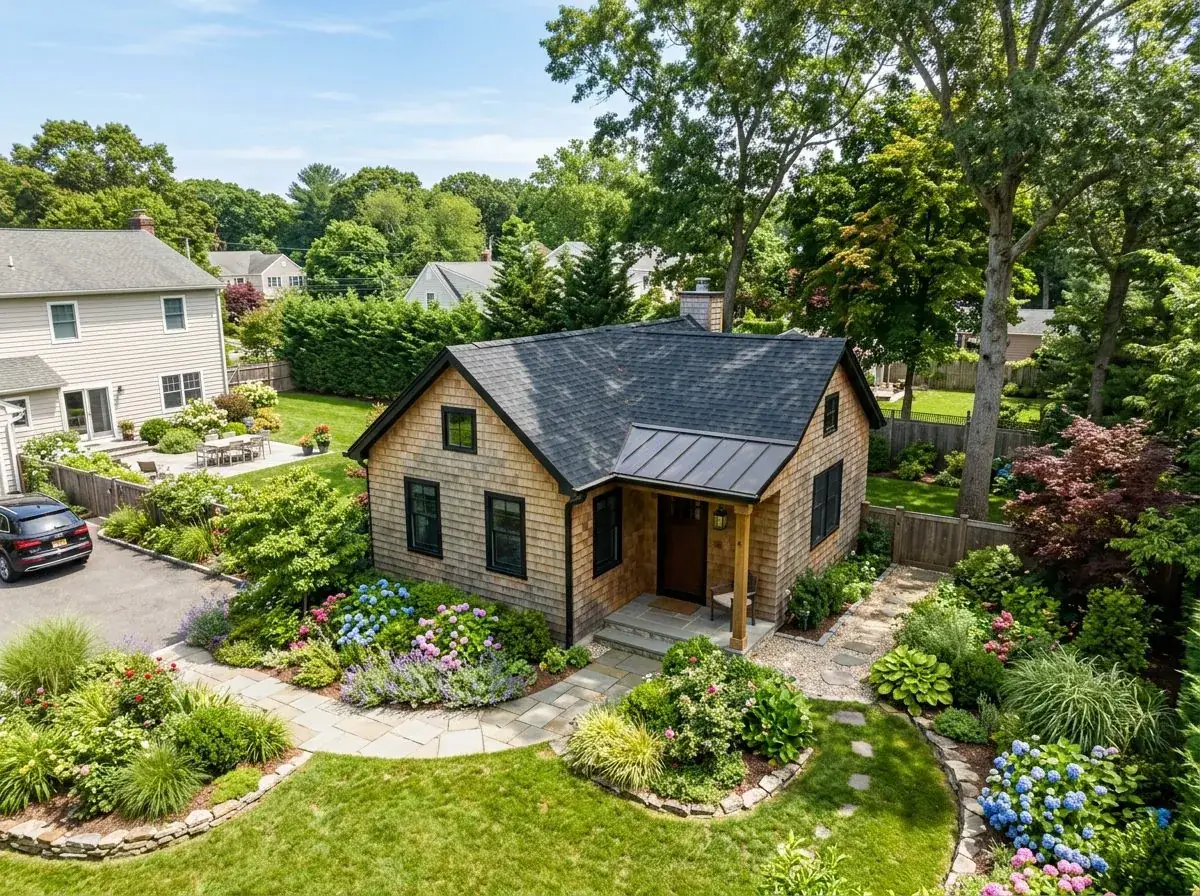
Detached cottage. The North Fork's larger lots make a freestanding cottage genuinely viable here in a way it is not in denser parts of the island. It commands the strongest rent and keeps both households fully private.
Barn, garage or outbuilding conversion. Southold has real agricultural building stock. Converting an existing structure can preserve the character of the property and sometimes simplifies siting, though bringing an old building up to residential code is rarely cheap.
Attached wing or addition. Shares utilities and foundation with the main house, generally the least expensive route to a code-compliant second unit.
Second-story or above-garage unit. Adds a unit without consuming additional ground area, which matters when septic siting and setbacks are tight.
Permit Process and Timeline
The sequence on a typical Southold ADU runs: feasibility and septic evaluation, survey and site plan, architectural drawings, health department submission, building department application, any zoning relief required, then construction and final inspections.
Health department review is usually the long pole. Budget several months from application to approval before a shovel goes in the ground, and expect the build itself to run three to six months depending on type and scope. Anyone promising a permitted ADU in a few weeks on the North Fork has not done one.
What ADUs Cost in Southold
Costs below are typical ranges for permitted, code-compliant work on the North Fork and exclude septic upgrades, which can add substantially:
Attached addition: roughly $150,000 to $250,000 depending on size and finish level.
Garage or barn conversion: roughly $110,000 to $200,000, driven heavily by the condition of the existing structure.
Detached new-build cottage: roughly $200,000 to $320,000.
An innovative/alternative septic system, where required, commonly adds $25,000 to $50,000 before any grant offset. Waterfront and Fishers Island projects carry premiums beyond these ranges.
Southold Communities We Serve
We build throughout Southold Town: Mattituck, Cutchogue, Peconic, Southold hamlet, New Suffolk, Laurel, East Marion and Orient, along with the surrounding North Fork. We also work across the rest of the East End and Suffolk County.
Frequently Asked Questions
Can I rent out an ADU in Southold?
Generally yes, subject to the town's rental registration requirements and owner-occupancy conditions. Short-term rental rules are separate and more restrictive than long-term tenancy — confirm both before you plan around rental income.
Do I need county health department approval?
For almost any North Fork ADU, yes. The area is unsewered and additional bedrooms increase sanitary flow, which triggers Suffolk County Department of Health Services review.
Is Greenport covered by Southold Town rules?
No. Greenport is an incorporated village with its own zoning and building department. If you are inside village limits you apply to the village.
How long does the whole process take?
Plan on several months of approvals before construction, then three to six months to build. Septic approval is usually what sets the schedule.
Related ADU Guides
- Suffolk County septic requirements for ADUs
- Suffolk County ADU laws
- Plus One ADU grant program
- ADUs in Riverhead
- What ADUs cost on Long Island
Work With Alec's Construction
This guide is written by the crew that does the work. See Alec's ADUs service — accessory apartments, garage conversions and grant paperwork. Licensed and insured on Long Island, one crew start to finish, free walkthrough and a written estimate inside 48 hours.
Booking the cold months now: we also handle Additions & New Construction and Bathroom Remodeling.
Not sure whether the town or village files your permit? That question trips up more Long Island projects than any other — the directory sorts it out.
Ready to Build Your ADU in Southold?
Contact Alec's Construction for a free consultation. We will confirm which authority governs your property, review lot size, coverage, parking, egress and sewer or septic capacity, and give you a detailed estimate.
Get a Free Consultation